
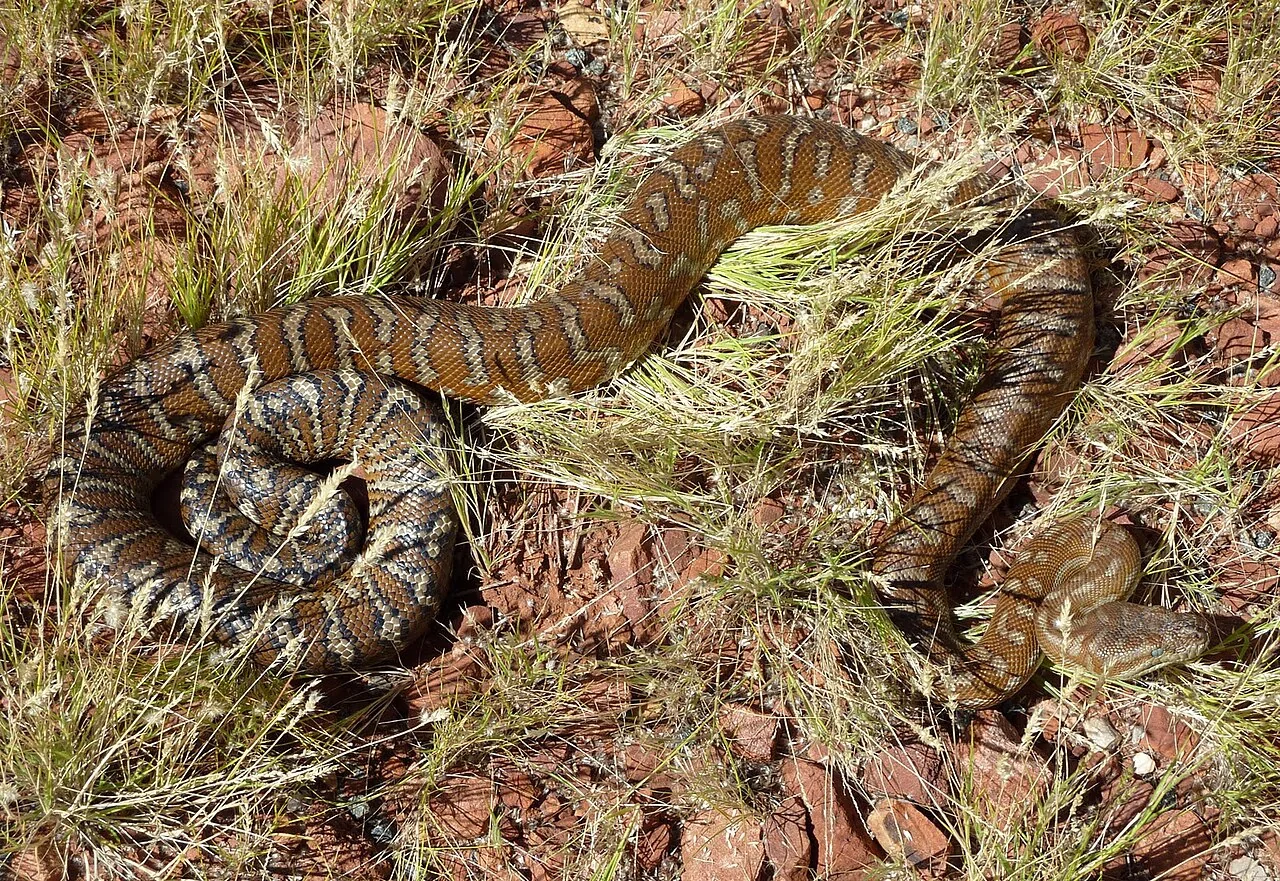
Scientific name
Morelia bredli
Other names: Morelia spilota bredli · Python bredli
Bredl’s python combines an arid Australian origin with actual use of trees and raised features. A setup must allow these choices rather than reducing its environment to hot, bare ground. [2]
Origin
Central Australia, in the Northern Territory. [1]
- Central Australia
- Climber
- Constrictor
Verified taxonomy; total-length measurements; clearly attributed practical thermal reference point.
At a glance
| ADULT SIZE | Approximately 2 m Average total length, not an upper limit [5]. |
|---|---|
| LIFESPAN | Not established Oakvale’s general estimate is not a species-specific average [3]. |
| LIFESTYLE | Ground and height Trees and raised features; seasonal pattern [2]. |
Adult size
Approximately 2 m average total length in the AROD overview; longer individuals exist. [5]
Lifespan
No robust species-specific average retained; Oakvale gives a general estimate for several reptiles, insufficient to establish a lifespan specific to this species. [3]
Lifestyle
Uses rocks and trees; activity varies with the season. [2]
Housing
A HABITAT WITH RAISED FEATURES
Sturdy branches — Floor space and supports that can actually be used [2][4].
Floor space and height that can actually be used, with solid supports and cover. [2][4]
Care parameters
WARM SPOT · DAY
35 °C — Practical basking point, Exotics Keeper [4].
COOL AREA · DAY
To characterise — Gradient requested, cool end not quantified [4].
Humidity
Differentiated zones — Moist microzones mentioned, no single relative-humidity target [4].
Localised heating
35 °C, a practical reference point Basking point proposed by Exotics Keeper; it does not describe all air in the terrarium. [4]
Cool area
To characterise The source calls for a gradient but does not quantify its cool end. [4]
Humidity
Differentiated zones The reference mentions moist microzones, without a single relative-humidity target. [4]
Feeding
A MENU TO ADJUST
Natural diet of mammals and birds; document meals and body condition [3].
Current name and difference from carpet pythons
The Reptile Database recognises Morelia bredli as a species and retains Morelia spilota bredli among the former combinations. [1] AROD explains that its relationships with carpet pythons have been debated. [5] This profile follows the current name without presenting every colour form as an additional species. During transfer, distinguish taxonomic identity, any colour selection and reported ancestry. Red colour alone certifies neither precise wild provenance nor an absence of crossing.
Adult size, lifespan and lifestyle
Approximately 2 m average total length in the AROD overview; longer individuals exist. [5]
No robust species-specific average retained; Oakvale gives a general estimate for several reptiles, insufficient to establish a lifespan specific to this species. [3]
Uses rocks and trees; activity varies with the season. [2]
Origin and behaviour in the environment
Niabi Zoo describes use of rocky features and trees, along with more nocturnal activity in summer and more daytime activity when nights are cool. [2] An arid landscape therefore does not mean permanent sun exposure. In a captive project, this diversity suggests providing several accessible positions. Observing where the animal stays is useful, but a single photographed position does not demonstrate a lasting preference; compare times of day and seasonal changes.
Building a solid route
Exotics Keeper emphasises usable height, supports and opportunities for a gradient. [4] Provide branches able to support the snake’s actual weight, continuous supports and shelters whose interiors can be checked. Published average size must not serve as a design ceiling: measure the individual and anticipate changes in its build. A sketch with dimensions, door access and heat-source positions allows a check that the space remains functional after decor is installed.
Climate: distinguish local sunshine from ambient conditions
The specialist magazine proposes a basking point of 35 °C in a setup creating a gradient. [4] It also mentions Australian climatic extremes: these are not captive instructions. We infer neither a mandatory winter drop nor a humidity percentage from these observations. Measure the heated support, shaded air and cool refuge separately. Before any change, keep previous readings and specify the probe’s position; a temperature without a measurement location remains difficult to interpret.
Feeding and body condition
Oakvale describes a natural diet including mammals and birds. [3] Exotics Keeper reports an often strong feeding response in captivity. [4] This does not justify offering prey whenever the enclosure is opened. Ask for the individual history, then document prey species, size, date and acceptance. Frequency must be adjusted with a competent person according to growth and body condition. We set neither a target adult weight nor automatic ration increases, owing to a lack of sex- and lineage-specific data.
Breeding without an improvised timetable
Reproduction is oviparous. [1] Oakvale describes laying in a cavity and the female coiled around the eggs. [3] These natural history details do not give incubator settings. Breeding requires a separate project covering parental condition, event monitoring and available places for juveniles. A seasonal appetite change is insufficient to diagnose reproductive activity. Recording it alongside weight, temperatures and behaviour facilitates later assessment.
Handling, maintenance and preparation level
AROD states that this non-venomous python remains capable of biting. [5] Its build and movement require prepared actions. Design maintenance so that water can be changed or soiling removed without routinely detaching the snake from a branch. Check access to fixings and the absence of points where the body could be trapped on closure. This approach gives observation an important role; a species’ temperament reputation never replaces assessment of the individual.
Monitoring that informs settings
Keep a manual journal of meals, refusals, sheds and weighings, accompanied by a plan of measured zones. When heating or branches change, date the intervention to link observations to a precise setup. A fragmented shed or a refusal does not immediately establish a single cause. Document the context and seek suitable advice if the phenomenon persists or accompanies a change in condition. Lifespan and weight are left unquantified rather than presented as guarantees.
Checklist
- Keep the name used at transfer and known ancestry.
- Test branch strength and shelter access.
- Measure surfaces and air zones separately.
Observations to record
- Meals and refusals recorded manually.
- Comparable weights and photographs.
- Temperature map and interventions.
The app provides individual animal records. Check which features are available for your animal in the released version.
Related guides
Original guides in French
Sources
Document-based overview; not a substitute for veterinary advice.
- The Reptile Database — Morelia bredli
Source accessed - Niabi Zoo — Bredl’s Python
Source accessed - Oakvale Wildlife — Centralian Carpet Python
Source accessed - Exotics Keeper — Bredl’s Python, 16 mars 2025
Source accessed - Stewart Macdonald, AROD — Morelia bredli
Source accessed