
Scientific name
Mniarogekko chahoua
Other names: Rhacodactylus chahoua
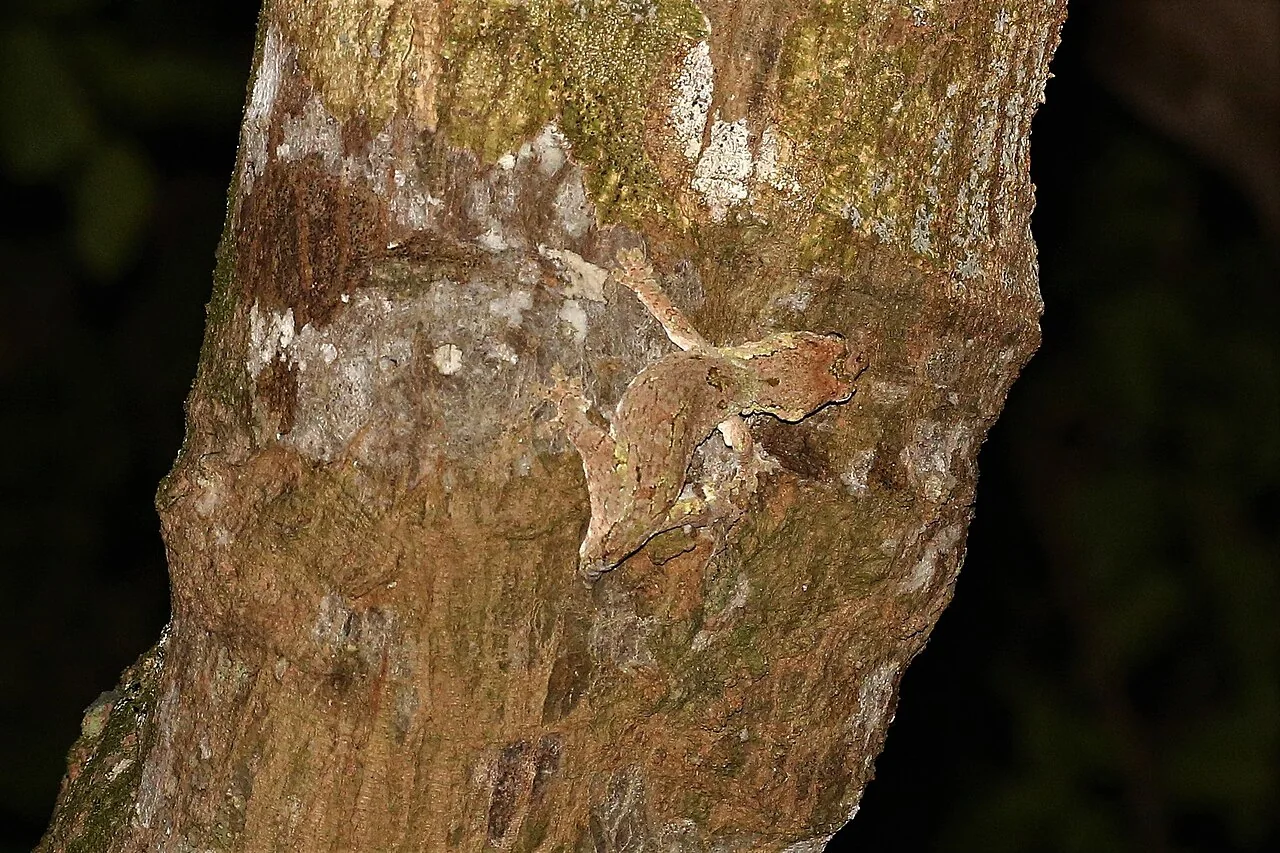
Mniarogekko chahoua, formerly Rhacodactylus chahoua, is a New Caledonian gecko whose coloration resembles lichens. Tree cavities play an important role as shelters [1][4].
Origin
New Caledonia: scattered populations on Grande Terre; island observations exist, but older maps must be read in light of the separation of M. jalu [1][3][4].
- Arboreal
- Nocturnal
- Omnivorous
At a glance
An arboreal gecko from New Caledonia; the former name Rhacodactylus chahoua and the distinct species M. jalu call for provenance to be checked [1].
| ADULT SIZE | ≈ 25 cm Total; approximately 14,5 cm snout to vent according to BGSU [2]. |
|---|---|
| ACTIVITY | Nocturnal Arboreal, rests in cavities [4]. |
| DIET | Omnivorous Suitable complete preparation and insects [2]. |
Adult size
BGSU gives approximately 25 cm including the tail and 14,5 cm from snout to vent; average values from its profile [2].
Lifespan
20–30 years stated by BGSU for captive keeping; no survival series or detailed individual record in this profile [2].
Lifestyle
Nocturnal and arboreal; rests in tree crevices or cavities and explores at night [4].
Housing
ARRANGING ITS HABITAT
Branches and cavities — Tall, ventilated enclosure; no universal minimum calculated here [2][3].
Prioritise a tall, ventilated enclosure with cavities and branches. BGSU’s historical minimum volume does not specify all dimensions; no universal minimum is calculated from it [2].
Care parameters
PUBLISHED AMBIENT CONDITIONS
22–26 °C — Rounded conversion of the BGSU reference point [2].
Humidity
60–80 % — IGA reference point; maintain ventilation and access to water [3].
Preferred ambient conditions
22–26 °C [2] Rounded conversion of BGSU’s 72–78 °F; check several heights.
Heat to monitor
28–30 °C [3] IGA identifies these peaks as requiring monitoring, not as a permanent target.
Humidity
60–80 % [3] Average husbandry reference point; ventilation and water availability remain distinct.
Feeding
FEEDING AND MONITORING
Combine suitable complete food and prey; document the menu and avoid excess [2][3].
Reading names and localities
The transfer to Mniarogekko dates from the 2012 revision, also associated with the recognition of M. jalu [1][3]. The strain labels “Mainland” and “Pine Island” are not additional species. Do not assign a geographical origin from colour or size. The most useful document to retain is one linking the animal to its parents and breeder, with any uncertainties already present.
Adult size, lifespan and lifestyle
BGSU gives approximately 25 cm including the tail and 14,5 cm from snout to vent; average values from its profile [2].
20–30 years stated by BGSU for captive keeping; no survival series or detailed individual record in this profile [2].
Nocturnal and arboreal; rests in tree crevices or cavities and explores at night [4].
Shelters that resemble cavities
Endemia describes an animal using closed forest and gallery forest, hidden in trees during the day [4]. This behaviour gives concrete purpose to cork tubes and opaque retreats. Installing access routes to these shelters and retaining a way to check them visually improves observation without repeated disturbance. Available height must be usable: a large enclosure without supports does not automatically provide a better movement area.
Preventing hot spells
The university profile proposes moderate ambient conditions; IGA emphasises monitoring summer peaks [2][3]. Before arrival, measuring the terrarium during the room’s hottest hours establishes the actual margin. Keeping a note of conditions when appetite falls avoids concluding too quickly that it is an unexplained food refusal. The thermal reference point given here does not allow a duration of tolerance to overheating to be extrapolated.
Humidity, water and substrate
The BGSU profile distinguishes moist substrate from waterlogged substrate and provides for a shallow dish [2]. Natural shelters and moisture-retentive soil must not conceal soiled areas. Checking the bottom of a cavity is particularly useful after misting or a container spill. To interpret readings, record whether the probe received water directly: its immediate reading may then not describe the entire ambient environment.
Documented omnivorous feeding
The BGSU profile prioritises complete commercial gecko preparations and also proposes insects [2]. This approach allows more precise monitoring than a variable recipe of fruit and supplements. Mineral provision must be considered alongside lighting and product composition, without automatically adding every available powder. Keeping a copy of the label and recording quantities actually consumed makes the feeding record transferable in the event of a consultation.
Interactions and movement
Andrea Vaccari describes differing individual temperaments and possible incompatibility when pairing animals [3]. An animal that allows observation is therefore not necessarily available to be picked up. A monitoring sheet can distinguish spontaneous movement, reaction to opening and interaction with another individual. Firm gripping by the tail or forced removal from a support should be avoided; preparing a calm transfer is preferable to a succession of attempts.
Breeding without rushing
Oviparity is established in the taxonomic database [1]. IGA distinguishes bodily growth from reproductive maturity, particularly in females, and emphasises that not all pairs work [3]. No trigger weight or universal incubation temperature is proposed here. A female laying without a male deserves the same monitoring of body condition; an absence of observed mating does not remove the need to look for clutches.
Conservation and record quality
The assessment reproduced by Endemia describes a restricted distribution and threats linked particularly to introduced predators and trafficking [4]. Older maps may mix information from before a revision, which justifies retaining locality context. For a captive animal, tracking growth, shedding and meals produces an individual record; it does not by itself validate a claimed wild origin. Gaps in provenance must remain visible rather than being filled by assumption.
Checklist
- Prepare several accessible shelters before arrival.
- Check measurements at locations the animal actually uses.
- Keep origin information and individual observations.
Observations to record
- Meals
- Weight
- Sheds
- Temperature
- Humidity
- Behaviour
The app provides individual animal records. Check which features are available for your animal in the released version.
Related guides
Original guides in French
Sources
Document-based overview; not a substitute for veterinary advice.
- The Reptile Database — Mniarogekko chahoua
Source accessed - Bowling Green State University — New Caledonian Mossy Prehensile-tailed Gecko
Source accessed - Andrea Vaccari, Italian Gekko Association — Mniarogekko chahoua
Source accessed - Endemia — Mniarogekko chahoua
Source accessed