
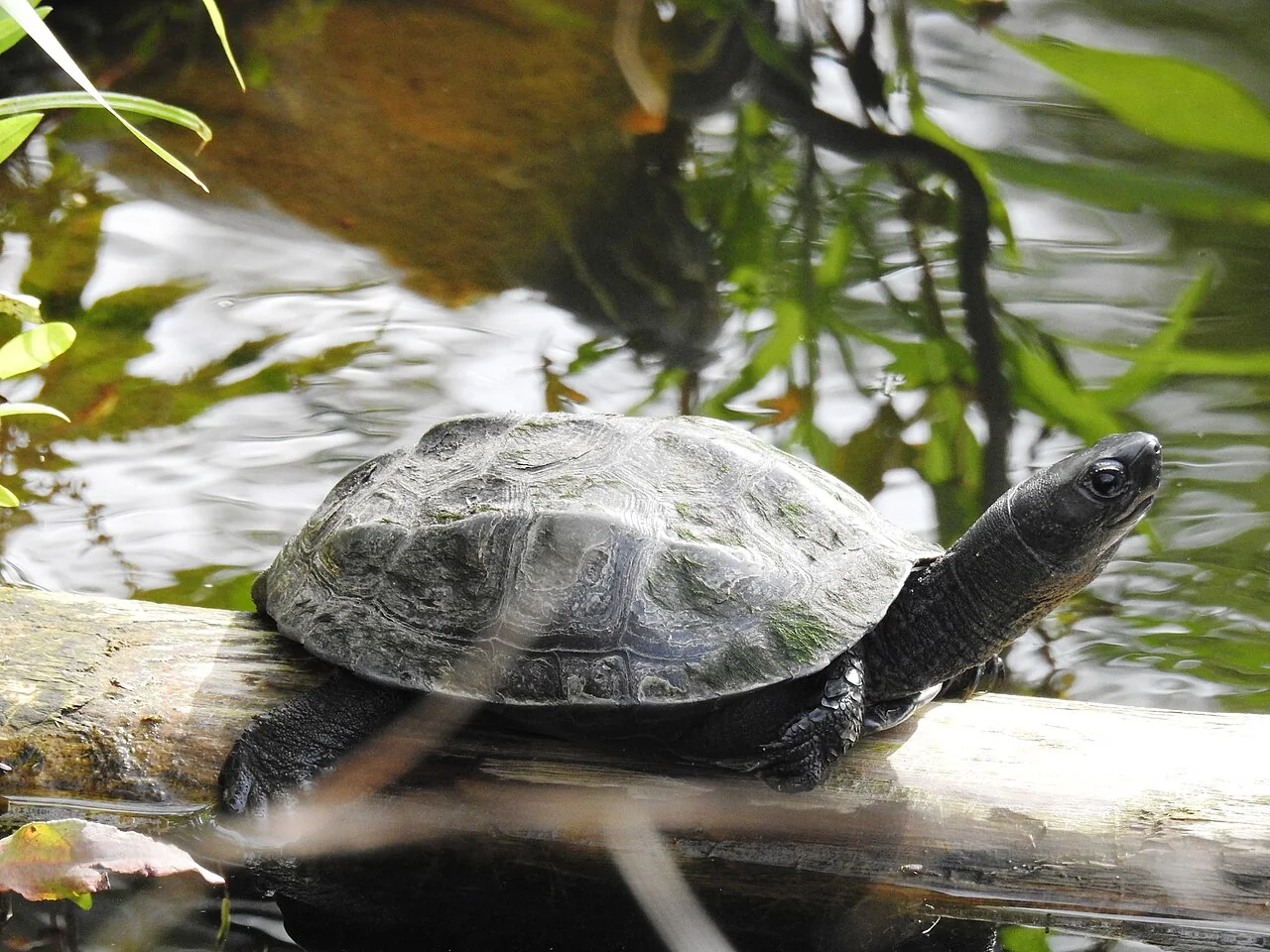
Scientific name
Mauremys reevesii
Other names: Chinemys reevesii
Mauremys reevesii is an Asian turtle with three longitudinal keels. The name Chinemys reevesii belongs to its taxonomic history. [1] Trade and breeding have moved many animals: country of purchase is insufficient to establish a strain’s biological origin.
Origin
East Asia; scientific documents distinguish populations and historical introductions rather than treating all breeding stocks as one provenance. [1][2]
- Three keels
- Aquatic
- Provenance matters
Documentary overview: identity checked; natural observations and captive practices attributed separately. Undocumented limits remain explicit.
At a glance
East Asia. An aquatic turtle using shallow water and emerged basking areas. [1][2][4]
| SIZE | 12 to >20 cm Carapace; varies by sex and individual [4]. |
|---|---|
| LIFESPAN | 15–20 years and more Captive reference points [4][2]. |
| LIFESTYLE | Water and platform Aquatic environment [4]. |
Adult size
Córdoba Zoo gives approximately 12 cm for males, 13–15 cm for many females and over 20 cm for some; carapace length. [4]
Lifespan
Córdoba Zoo gives 15–20 years in captivity. The scientific overview also reports captive animals exceeding 24 years: these reference points are not individual guarantees. [4][2]
Lifestyle
Aquatic, particularly using shallow water and emerged areas for basking. [4]
Housing
REFERENCE AREA
≈ 90 × 45 cm — Clinical minimum for an adult, to adapt [3].
Royal Veterinary Center proposes at least approximately 90 × 45 cm of area for an adult, a dry platform and gently moving water; adapt to actual size. [3]
Care parameters
WATER
22–26 °C — Clinical reference point [3].
PLATFORM
30–32 °C — Clinical reference point [3].
Humidity
Tested water — Air and platform must not be confused with the water volume.
Water
22–26 °C according to Royal Veterinary Center [3] Measure immersed, without direct contact with the heater.
Platform
30–32 °C according to the same clinic [3] Active-keeping reference point, with an opportunity to retreat.
Tank air
24–28 °C in this recommendation [3] Do not confuse air and water.
Feeding
AQUATIC OMNIVORE
Formulated food, invertebrates and plants according to age and consumption [3].
Identify the animal and its provenance
The three longitudinal ridges are particularly visible in juveniles and become less pronounced with growth, according to the zoo. [4] An old photograph will therefore not always be comparable with one of an adult. Keeping supplier name, known birthplace and any lineage avoids replacing unknown provenance with a geographical hypothesis.
Adult size, lifespan and lifestyle
Córdoba Zoo gives approximately 12 cm for males, 13–15 cm for many females and over 20 cm for some; carapace length. [4]
Córdoba Zoo gives 15–20 years in captivity. The scientific overview also reports captive animals exceeding 24 years: these reference points are not individual guarantees. [4][2]
Aquatic, particularly using shallow water and emerged areas for basking. [4]
Arranging usable water space
The clinic recommends easy exits and a moderate current. [3] Water volume is not the only criterion: a turtle must find intermediate resting places and reach the platform without an unstable passage. Testing the setup at its actual water level, then observing it as the animal grows, detects access that has become too narrow or steep.
Filter, measure, then intervene
Filtration and water renewal are part of the clinical protocol. [3] To turn this into documented maintenance, record what was actually cleaned rather than simply “aquarium done”. A change in flow, accumulated leftovers or altered behaviour must be related to dates and measurements. Equipment must remain accessible without having to chase the animal around the whole tank for a long time.
Light and thermoregulation
The same centre provides for UVB lighting and a heated dry zone. [3] The setup deserves precise description: distance, any barrier between lamp and turtle, available surface and probe locations. The percentage printed on a tube is not a measurement at carapace level. Retaining a less-exposed zone allows the animal to choose rather than endure uniform conditions.
Omnivorous diet and age
The zoo describes feeding mainly comprising small animal prey, with a plant contribution. [4] Royal Veterinary Center uses formulated aquatic-turtle food accompanied by invertebrates and plants, changing with age. [3] Monitoring must distinguish food offered from quantity swallowed. A ration is not defined simply by counting pieces, whose volume can vary greatly.
Breeding: conditions and population
The scientific monograph shows growth differences between populations and describes the effect of incubation temperature on outcomes. [2] A laying season observed in one region must not become an automatic timetable. Sex, known age, size and female history are distinct pieces of information. This profile prescribes neither cooling nor an incubation recipe to trigger reproduction.
Interactions and observation
The clinic emphasises that some males may chase other turtles and that an individual can live perfectly well alone. [3] If several animals are kept, actual resource access must be checked for each. A photograph of two turtles on one platform does not demonstrate absence of competition. Calm observation sequences, during and outside meals, reveal a persistent difference in access.
Conservation and commitment
The zoo explains wild population decline through exploitation. [4] Documented captive origin and absence of wild collection are therefore central to the project. Older conservation texts are insufficient to establish current sale rules. Keeping supporting documents and planning lasting housing for a potentially large female avoids confusing a small pet-shop animal with a short-term responsibility.
Checklist
- Plan for female size.
- Document the route to the platform.
- Keep provenance documentation.
Observations to record
- Shell
- Water
- Meals
- Interactions
The app provides individual animal records. Check which features are available for your animal in the released version.
Related guides
Original guides in French
Sources
Document-based overview; not a substitute for veterinary advice.
- The Reptile Database — Mauremys reevesii
Source accessed - Lovich et al. (2011), IUCN/SSC TFTSG — Mauremys reevesii
Source accessed - Royal Veterinary Center — Reeves’ Turtle Care Sheet
Source accessed - Zoo Córdoba — Tortuga china
Source accessed