
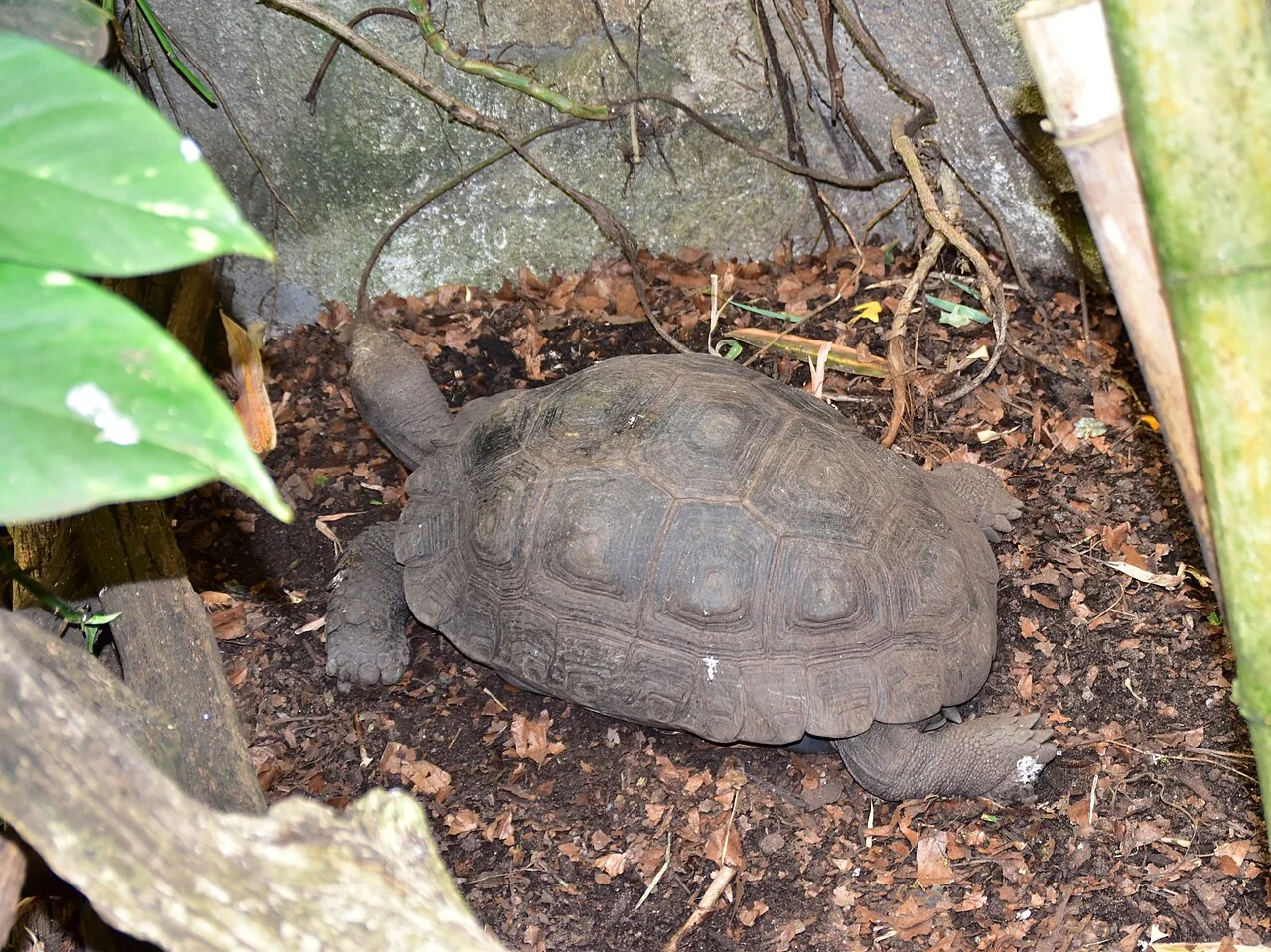
Scientific name
Manouria emys
Manouria emys is a large humid-forest terrestrial tortoise, known for building a nesting mound and sometimes defending its nest. [2][3] The 2025 EAZA recommendations address housing on the scale of a true enclosure, separating zoological observations from hypotheses about lifespan.
Origin
South and Southeast Asia, from northeastern India to Malaysia, Sumatra and Borneo; the subspecies emys and phayrei have distinct distributions. [1]
- Very large enclosure
- Mound nest
- Specialist project
Documentary overview: identity checked; natural observations and captive practices attributed separately. Undocumented limits remain explicit.
At a glance
| SIZE | At least 60 cm Maximum straight carapace length [2]. |
|---|---|
| LIFESPAN | Poorly documented 20 years cited; higher potential uncertain [4]. |
| LIFESTYLE | Forest-dwelling terrestrial Moist ground and nearby waterways [2]. |
Adult size
Up to at least 60 cm straight carapace length and 37 kg in the scientific monograph; phayrei is the larger of the two recognised subspecies. [2]
Lifespan
EAZA cites 20 documented years for phayrei, then suggests a probably longer lifespan. The hypothesis of more than a century is not presented here as a demonstrated record. [4]
Lifestyle
Forest-dwelling and terrestrial, often near waterways, also using more distant areas depending on season and age. [2]
Housing
EAZA GUIDELINE
≥20 m² / adult — 2025 professional recommendation [4].
EAZA recommends considering at least 20 m² for an adult, with more space and separation facilities if several animals are present. [4]
Care parameters
DAYTIME AIR
18–25 °C — EAZA; consider age and origin [4].
WARM ZONE
26–29 °C — Broad area with a retreat [4].
Humidity
Very humid refuges — EAZA suggests an ideal 80–99 %, with adapted areas [4].
Daytime air
Approximately 18–25 °C in the EAZA guide [4] Adapt to origin and age; very young animals need different attention.
Locally warm area
26–29 °C according to EAZA [4] An area wider than the animal, with shade and a retreat.
Humidity
Very humid areas and refuges described by EAZA [4] The document suggests an ideal 80–99 %; do not confuse this humid air with completely flooded ground.
Feeding
VARIED PLANT FOODS
Plants and fungi documented in the field; identified captive ingredients [2].
Two subspecies, a precise record
The reference distinguishes M. e. emys, more southern and insular, from M. e. phayrei, more northern. [1] Retaining the stated subspecies, origin and associated documents allows the corresponding observations to be interpreted. Differences in size and climate make a simple ‘Asian tortoise’ label insufficient. Uncertain identification must remain explicitly uncertain.
Adult size, lifespan and lifestyle
Up to at least 60 cm straight carapace length and 37 kg in the scientific monograph; phayrei is the larger of the two recognised subspecies. [2]
EAZA cites 20 documented years for phayrei, then suggests a probably longer lifespan. The hypothesis of more than a century is not presented here as a demonstrated record. [4]
Forest-dwelling and terrestrial, often near waterways, also using more distant areas depending on season and age. [2]
Forest observations in context
The monograph describes humid forests, riverbanks and bamboo stands. In a Thai study, juveniles were particularly close to waterways; adults moved farther away during rainy months. [2] A photograph near a river should therefore not be converted into a permanently aquatic lifestyle. Water is a resource and a landscape element within usable terrestrial space.
Think enclosure before terrarium
The floor area recommended by EAZA changes the scale of the project. [4] It must be possible to maintain refuges, check an individual and separate it without reducing its entire space to a corridor. Keeper access routes must not be the only clear areas. For an adult weighing several tens of kilograms, supports, pools and walls must be designed for full load before introduction.
Substrate and water movement
The monograph lists moist litter and humus among captive substrates. [2] Designing cleanable areas and checking drainage prevents forest furnishings from hiding waste accumulation. The condition of material beneath the surface must be inspected separately from its external appearance. Wooden elements must allow a large animal to pass without getting trapped and remain accessible for inspection.
A mainly plant-based diet
The phayrei study summarised in the monograph reports numerous plants and fungi, including bamboo shoots. [2] This natural diversity does not mean that all household plants are interchangeable or edible. A captive diet is built from identified ingredients and monitored consumption. Comparing what is offered with what remains helps detect persistent selection of only a few foods.
Building the nest
Observations published by McKeown and colleagues describe females gathering leaves and debris while moving backwards, then laying their eggs in the mound. The forelimbs contribute to sweeping; the hindlimbs can move materials upwards. [3] The detail matters: a simple tray of sand does not reproduce the whole sequence. Breeding requires planning for the collection, volume and stability of these materials.
Observed maternal protection
In the collections studied, some females repelled intruders near the nest and continued rearranging the mound after laying. Durations varied between observations. [3] This behaviour should neither be provoked for photographs nor assumed to occur in every female. Providing maintenance access that limits disturbance allows observation without turning daily checks into a confrontation.
Limitations, monitoring and conservation
Exact lifespan remains imperfectly documented despite the species' impressive size. Planning lasting care and a succession solution now is therefore more useful than a spectacular maximum age. Retain measurements, captive origin and documents, check current obligations and do not collect from the wild. This profile provides neither an incubation recipe nor a veterinary protocol: a breeding project warrants specialist support.
Checklist
- Plan for 20 m² and a heavy adult.
- Identify the subspecies.
- Maintain suitable nesting materials and access.
Observations to record
- Shell
- Weight
- Ground
- Behaviour
The app provides individual animal records. Check which features are available for your animal in the released version.
Related guides
Original guides in French
Sources
Document-based overview; not a substitute for veterinary advice.
- The Reptile Database — Manouria emys
Source accessed - Stanford et al. (2015), IUCN/SSC TFTSG — Manouria emys
Source accessed - McKeown, Meier et Juvik — Management and Breeding of Manouria emys, CTTC
Source accessed - EAZA (2025) — Best Practice Guidelines Manouria emys
Source accessed