
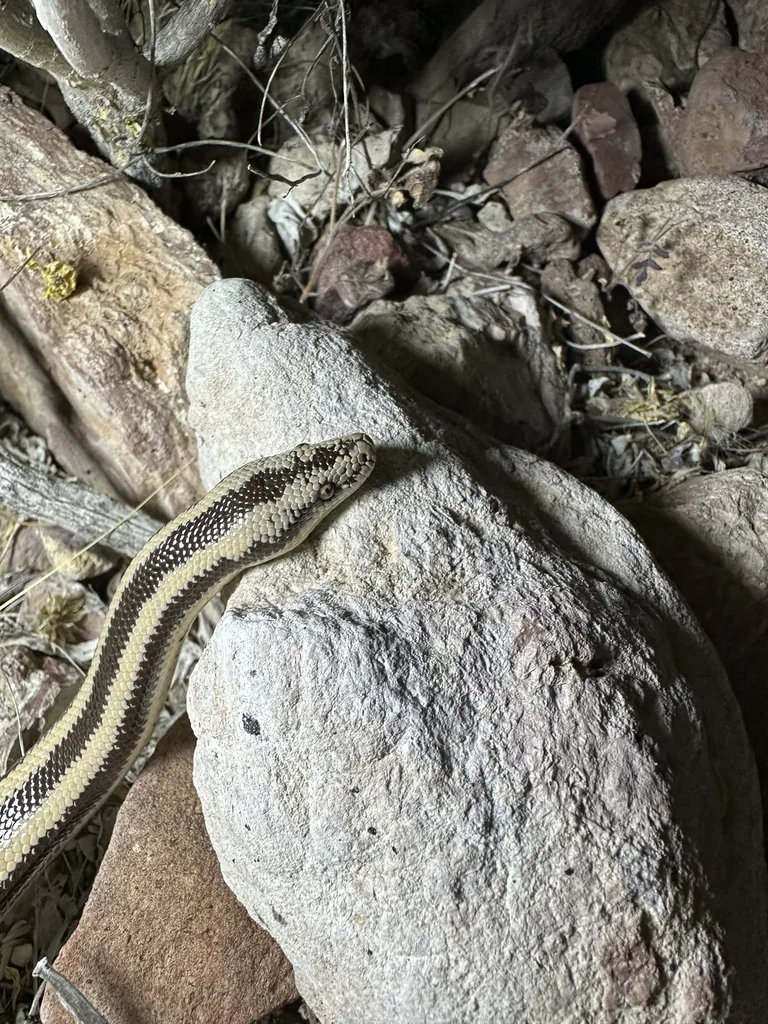
Scientific name
Lichanura trivirgata
Other names: Charina trivirgata
The rosy boa is more than three coloured stripes. Its provenance and the taxonomic scope of sources matter, because older profiles bring several lineages together under Lichanura trivirgata. [1][2]
Origin
Baja California, Sonora and southern Arizona within the scope distinguished by the Nevada document; taxonomic boundaries remain debated. [1][2]
- Terrestrial
- Rocky shelters
- Provenance matters
Species kept distinct; group-level sources explicitly qualified. The roseofusca/orcutti name is debated. No brumation protocol, water deprivation or reproductive figure transferred.
At a glance
| ADULT SIZE | Variable according to provenance 43–107 cm in Oakland’s broad overview, TL/SVL unspecified [3]. |
|---|---|
| LIFESPAN | 15–30 years estimated Rosy boas broadly [3]. |
| LIFESTYLE | Terrestrial Also climbs; variable activity [3]. |
Adult size
Oakland gives 43–107 cm for rosy boas broadly, without a TL/SVL convention; no average specific to the current scope retained. [3]
Lifespan
15–30 years estimated by Oakland for rosy boas broadly; not a demonstrated average lifespan for this species alone. [3]
Lifestyle
Terrestrial, able to climb; activity varies with the season in group-level overviews. [3]
Housing
A SUITABLE HABITAT
Shelters and secure closure — Avoid surfaces that abrade the snout [5].
Individual housing with accessible shelters and a closure without rough edges; sizing according to the individual and its provenance. [4][5]
Care parameters
WARM SPOT · DAY
29–32 °C — Lichanura spp. framework [4].
COOL AREA · DAY
24–27 °C — Genus-level framework [4].
Humidity
Mainly dry ground — Accessible moist refuge [4].
Heating surface
29–32 °C ReptiFiles framework for Lichanura spp., not an optimum specific to one locality. [4]
Cooler zone
24–27 °C Same genus-level framework; check shelters separately. [4]
Humidity
Moist refuge, mainly dry ground The source distinguishes local access to moisture from a constantly wet environment. [4]
Feeding
MONITORED FEEDING
Mice; know independent intake and usual presentation [5].
A name to link to a verifiable locality
The 2018 Nevada memo distinguishes populations called L. orcutti from L. trivirgata; The Reptile Database subsequently notes competing uses of roseofusca and orcutti. [1][2] Attributing every measurement found under “rosy boa” to this profile would therefore be misleading. Keep former names in the original record, with location and captive generation when known. Selected colour does not prove a locality, and a photograph of three stripes does not resolve this question alone.
Adult size, lifespan and lifestyle
Oakland gives 43–107 cm for rosy boas broadly, without a TL/SVL convention; no average specific to the current scope retained. [3]
15–30 years estimated by Oakland for rosy boas broadly; not a demonstrated average lifespan for this species alone. [3]
Terrestrial, able to climb; activity varies with the season in group-level overviews. [3]
Size and behaviour: consider the individual
Available dimensions often cover the whole group. Oakland describes a robust body, activity varying with the season and climbing ability despite a terrestrial lifestyle. [3] Provide a setup allowing several routes, without taking a small advertised size as a guarantee. Observe where the animal positions itself before intervening. A boa stationary in a shelter may simply be invisible at the chosen time; the log benefits from distinguishing observation time from actual activity duration.
Rocky refuges without traps or abrasion
Merker, Limburg and Montoya draw attention to snout injuries against abrasive closures and propose shelters in warm and cool areas. [5] Examine corners, vents and cable openings with this use in mind. Rocky decor must remain stable when an animal passes beneath it; a natural appearance is insufficient. Inspection must be possible without demolishing the setup. If the boa regularly rubs its snout, record the exact location and times before randomly changing several elements.
Climate: a genus framework, then measurements
The displayed values come from the ReptiFiles guide for Lichanura spp. [4] They form a basis for discussion with someone familiar with the provenance, not an experimental validation specific to every boa. Record surface and shelter temperatures with suitable equipment. Clearly separate daytime and night-time measurements. Before arrival, check the effect of room temperature and actual heating operation; a thermostat setpoint alone does not describe the snake’s exposure.
Water and humidity: document choices
Water-access recommendations differ greatly between published practices: the older guide by the three breeders restricts provision, whereas ReptiFiles provides daily availability. [4][5] This profile retains accessible clean water without reproducing a deprivation schedule. Check overflows, condensation and moist-refuge condition to separate hydration from saturation of all the ground. During a difficult shed, collect observations rather than automatically attributing the problem to one humidity percentage.
Meals and feeding response
The breeders in the specialist source describe use of mice; the ReptiFiles guide favours thawed prey. [4][5] Ask what the animal actually takes, because a food label specifies neither format nor presentation method. Prepare meals separately from routine handling and record refusals without confusing them with intentionally skipped meals. Do not choose a frequency from length alone: body changes, previous intake and seasonal context must remain visible in monitoring.
Live young and seasonality
Birth of live young is established for L. trivirgata. [1] Gestation and litter figures in general profiles sometimes mix several taxonomic scopes; they are not transferred here into a timetable. A breeding project requires separate monitoring of each parent, provenance of both lineages and setups ready for juveniles. Cooling described in some experiences is not an automatic response to food refusal. Have its conditions and relevance to the animals concerned clarified before any seasonal change.
Monitoring and handling precautions
The first aim is a series of comparable observations: position in the terrarium, snout condition, meals, shedding and weight measured with the same equipment. The breeders recommend supporting the body rather than squeezing the animal. [5] Prepare the transfer container before opening and keep sessions functional. A group-level profile guarantees neither temperament nor a target adult weight. Respiratory signs, lesions or unexplained body-condition loss require assessment by a competent veterinarian.
Checklist
- Document locality and former name.
- Inspect closures and abrasive surfaces.
- Provide clean water and distinct refuges.
Observations to record
- Provenance and identity
- Meals actually accepted
- Snout and shedding condition
- Weight and shelter temperatures
The app provides individual animal records. Check which features are available for your animal in the released version.
Related guides
Original guides in French
Sources
Document-based overview; not a substitute for veterinary advice.
- The Reptile Database — Lichanura trivirgata
Source accessed - Nevada Department of Wildlife — Scientific Name Change of the Rosy Boa, 23 juillet 2018
Source accessed - Oakland Zoo — Rosy Boa
Source accessed - Mariah Healey, ReptiFiles — Rosy Boa, Lichanura sp.
Source accessed - Gerold Merker, Randy Limburg et Bob Montoya — Rosy Boa Care Sheet
Source accessed