
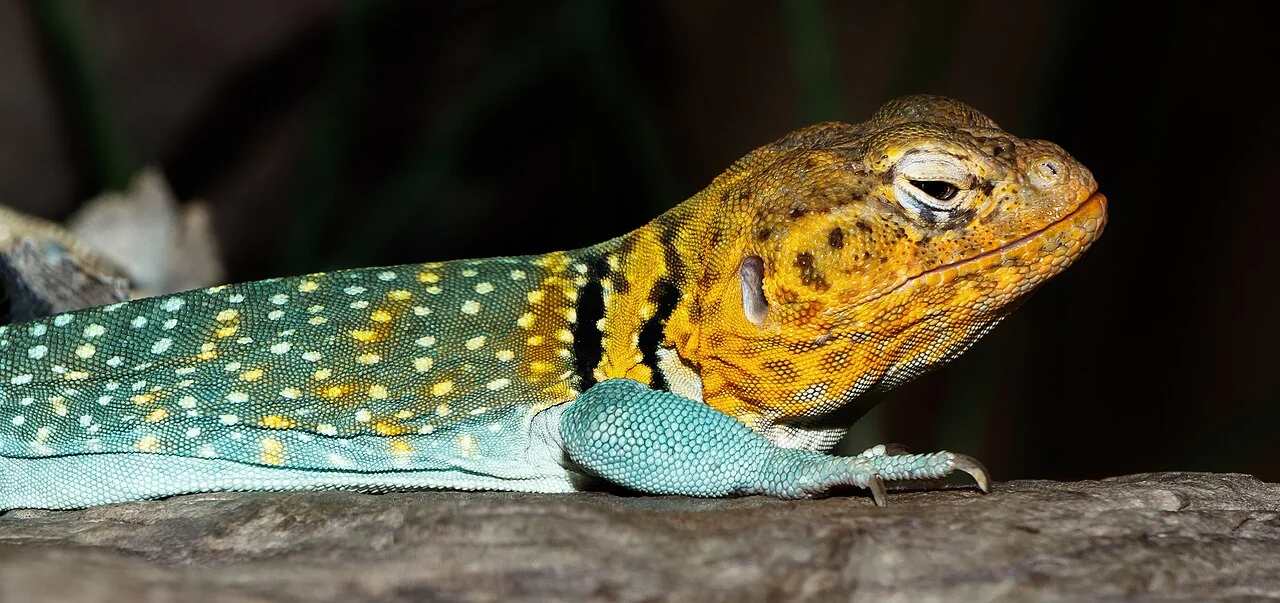
Scientific name
Crotaphytus collaris
Two dark markings encircle the neck. In open spaces, it can flee by running on its hind limbs [1].
Origin
North America; populations notably in Missouri [1].
- Diurnal
- Rock-dwelling
- Territorial
At a glance
| ADULT SIZE | 20–36 cm Total length [1]. |
|---|---|
| LIFESPAN | Rarely > 5 years Natural observation from Missouri; not a captive reference [1]. |
| LIFESTYLE | On rocks Diurnal and territorial [1]. |
Adult size
Around 20–36 cm in total length according to the Missouri Department of Conservation [1].
Lifespan
In the natural populations described in Missouri, lifespan rarely exceeds 5 years; this is not a captive average [1].
Lifestyle
Diurnal, on rocks and in crevices [1].
Housing
SPACE AND ROCKS
90 × 45 × 45 cm — ReptiFiles minimum; provide more space for activity. Dimensions L × W × H [3].
ReptiFiles suggests at least 90 × 45 × 45 cm (L × W × H), recommending more space for activity [3].
Care parameters
HEATING SURFACE
40–48 °C — [3] Surface measurement, distinct from ambient air.
COOL SIDE · DAY
25–32 °C — [3] Reference from the Crotaphytus guide; preserve thermal choice.
Humidity
50–70 % — ReptiFiles range for eastern species, including C. collaris; with a separate humid hide [3].
Heating surface
40–48 °C [3] Surface measurement, distinct from ambient air.
Cool side · day
25–32 °C [3] Reference from the Crotaphytus guide; preserve thermal choice.
Humidity
50–70 % ReptiFiles range for eastern species, including C. collaris; with a separate humid hide [3].
Feeding
AN APPROPRIATE DIET
Insects and small animals in the wild [1]; fed crickets and locusts in captivity [2].
Feeding
The natural diet includes insects and other small animals [1]. Harling reports crickets and locusts fed beforehand in captivity [2].
Behaviour and precautions
Males defend a territory and use colours and head movements to communicate. Provide visual barriers and avoid competition [1].
Daily monitoring
Record meals, weights and use of heated rocks. Track activity changes through the seasons without abruptly altering settings. Readings must specify the location and type of thermometer used.
Checklist
- Stabilise stones.
- Maintain cool retreats.
- Record seasonal variations.
Observations to record
- Meals
- Weight
- Sheds
- Temperature
- Humidity
The app provides individual animal records. Check which features are available for your animal in the released version.
Related guides
Original guides in French
Sources
Document-based overview; not a substitute for veterinary advice.