
Scientific name
Lampropeltis holbrooki
Other names: Lampropeltis getula holbrooki
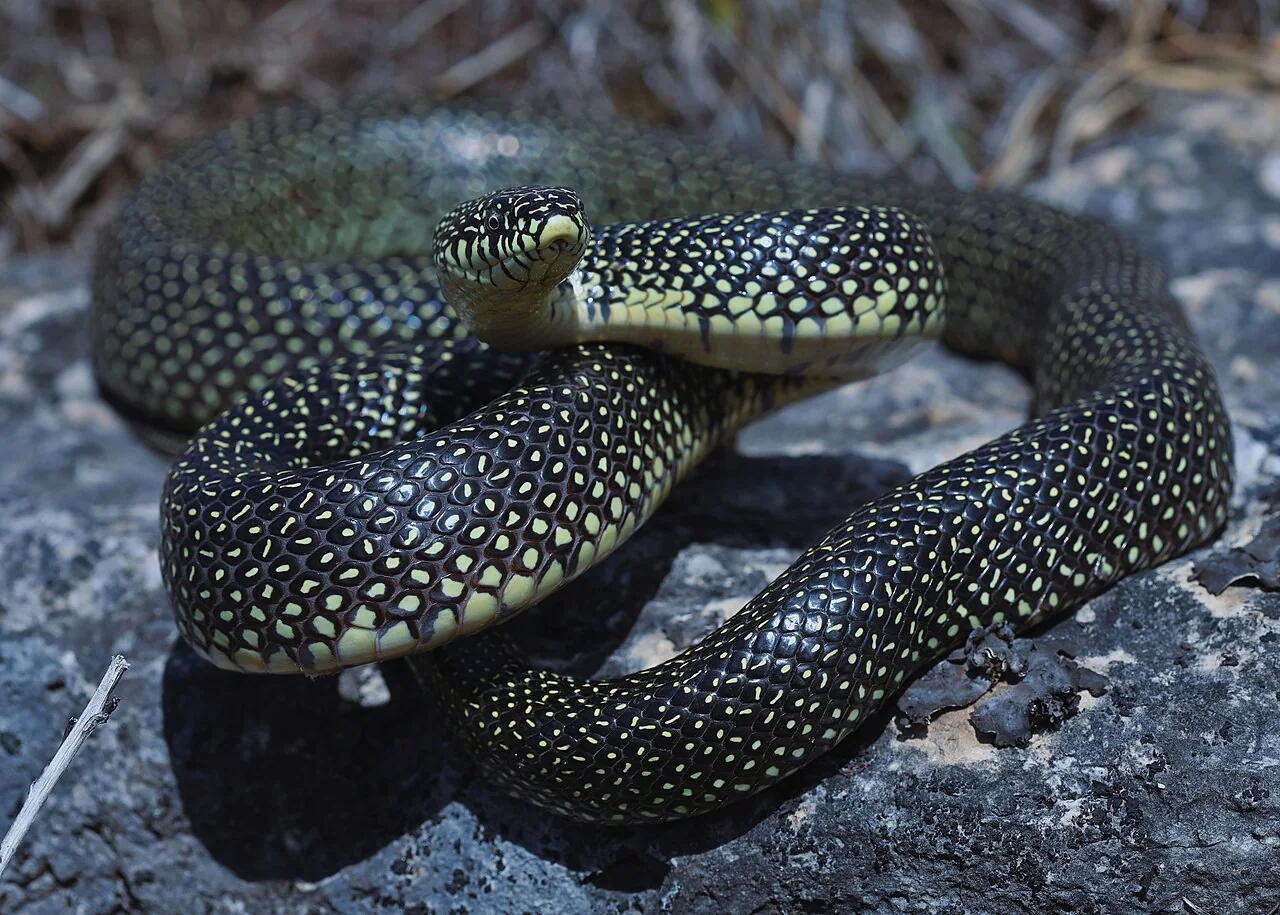
The speckled kingsnake generally has small pale spots on a dark background. Its diet can include other snakes: individual housing and precise feeding records are central choices for keeping it. [1][2]
Origin
Central and southern United States, particularly the Mississippi basin; boundaries and former intergradation zones require cautious reading. [1]
- Terrestrial
- Ophiophagy
- Seasonal activity
Current name cross-checked against the Missouri guide. Genus-level climate framework explicitly attributed; no general venom immunity, target weight or temperament guarantee asserted.
At a glance
| ADULT SIZE | Usually 89–122 cm Up to 183 cm; TL/SVL unspecified [2]. |
|---|---|
| LIFESPAN | >14 years reported Captivity; not an average [2]. |
| LIFESTYLE | Terrestrial Activity varies with season [2]. |
Adult size
Usually approximately 89–122 cm according to Missouri, with individuals reaching 183 cm; TL/SVL convention not explained on this page. [2]
Lifespan
Missouri reports a little over 14 years in captivity; its projection beyond 20 years remains an estimate. [2]
Lifestyle
Daytime or night-time activity according to season; numerous ground-level hiding places. [2]
Housing
A SUITABLE HABITAT
One individual per habitat — Cannibalism documented [2][3].
One snake per enclosure; ground movement, accessible shelters and controlled opening. [2][3]
Care parameters
WARM SPOT · DAY
29–32 °C — General Lampropeltis framework [4].
COOL AREA · DAY
21–26 °C — Genus-level reference point [4].
Humidity
40–60 % — General framework to contextualise [4].
Heating surface
29–32 °C General Lampropeltis framework, not a demonstrated individual optimum. [4]
Cooler zone
21–26 °C Same practice framework, to measure on site. [4]
Reference humidity
40–60 % General guide reference point, to contextualise. [4]
Feeding
MONITORED FEEDING
Farmed mice; control presentation during an energetic response [3].
Recognising the species and its former name
Lampropeltis getula holbrooki is a historical name for the species now retained as L. holbrooki. [1] Usual coloration combines a dark background with small pale dots, but juvenile patterns may be more organised into bands. [2] Identification must keep provenance and age in mind. Retain purchase documents and the original designation; do not infer hybridisation or locality from a single pattern. Older profiles of the getula complex must be reread in this context.
Adult size, lifespan and lifestyle
Usually approximately 89–122 cm according to Missouri, with individuals reaching 183 cm; TL/SVL convention not explained on this page. [2]
Missouri reports a little over 14 years in captivity; its projection beyond 20 years remains an estimate. [2]
Daytime or night-time activity according to season; numerous ground-level hiding places. [2]
An ecology broader than a single decor
Missouri describes the species in grasslands, edges and wooded or moist areas, using shelters beneath objects and in burrows. [2] This diversity suggests preparing several functions in the habitat: movement, hiding and choosing different exposure. Completely open decor does not reproduce this opportunity. Draw the route between shelters and water points, then check that maintenance remains feasible. Actually accessible space matters more than an accumulation of decorative elements.
Individual housing and organising openings
Cannibalism is documented, and KJ Lodrigue explicitly advises against keeping two animals together. [2][3] Plan a separate setup for every snake, including during cleaning and temporary transport. Prepare the container before opening the terrarium and close neighbouring enclosures. Monitoring also becomes more reliable: missing prey or a dropping found belongs to an identified individual. This organisation is particularly useful in a collection where several snakes have similar maintenance schedules.
Temperatures and humidity: measure an actual gradient
The table’s values are genus-level reference points from a specialist guide. [4] They represent neither the body temperature sought by each individual nor weather extremes across its range. Check ambient conditions, surfaces and shelters with separate measurements. Also record night-time conditions and room temperature. Before a change, keep the previous value and its measurement location: without this detail, two apparently different readings may simply have been taken in different places.
Feeding: an energetic response is not a need
In his captive experience, Lodrigue uses farmed mice and describes an energetic feeding response. [3] This primarily requires controlled presentation and a clear register, without concluding that a striking animal must be fed more. Ask for the size and form of previous meals and record refusals as well as meals. A wild diet including other snakes does not justify offering them in captivity. Keep hands outside the striking path and clearly separate feeding actions from maintenance interventions.
Activity and defensive reactions
In Missouri, surface activity becomes more nocturnal during warm periods; tail vibration and musk release are described as defences. [2] A handling session must therefore not serve to test a reputation for docility. Record the circumstances of a reaction, then adjust intervention organisation. Prefer observation from a distance at different times to understand the individual’s habits. Retreat into a shelter after opening primarily indicates that interaction, not a permanent trait.
Breeding and housing juveniles
The species lays eggs. [1] Missouri field calendars and published captive experiences describe different situations; they are not combined here into a breeding recipe. Before any pairing, plan parent identification, effective monitoring and immediately available housing. Lodrigue notes that some hatchlings are difficult to start on mice. [3] Anticipate this stage and the support needed, without promising a guaranteed number of juveniles, laying frequency or success.
Log, maintenance and the acquisition decision
The register can link meals, weight, sheds, cleaning and shelter use. Take body photographs under comparable conditions and indicate whether a measurement was made before or after a meal. A coherent history is better than an unfounded weight target. Also prepare access to a competent veterinarian before acquisition. Repeated regurgitation, a lesion or deterioration in body condition requires assessment; neither the genus’s supposed hardiness nor an apparently correct temperature explains the problem sufficiently.
Checklist
- Prepare strictly individual housing.
- Organise transfers before any opening.
- Check independent feeding and previous records.
Observations to record
- Meals, refusals and prey size/form
- Activity by time and season
- Sheds and weight
- Settings and measurement locations
The app provides individual animal records. Check which features are available for your animal in the released version.
Related guides
Original guides in French
Sources
Document-based overview; not a substitute for veterinary advice.
- The Reptile Database — Lampropeltis holbrooki
Source accessed - Missouri Department of Conservation — Speckled Kingsnake
Source accessed - KJ Lodrigue Jr. — Speckled Kingsnake
Source accessed - Mariah Healey, ReptiFiles — Kingsnake, Lampropeltis sp.
Source accessed