
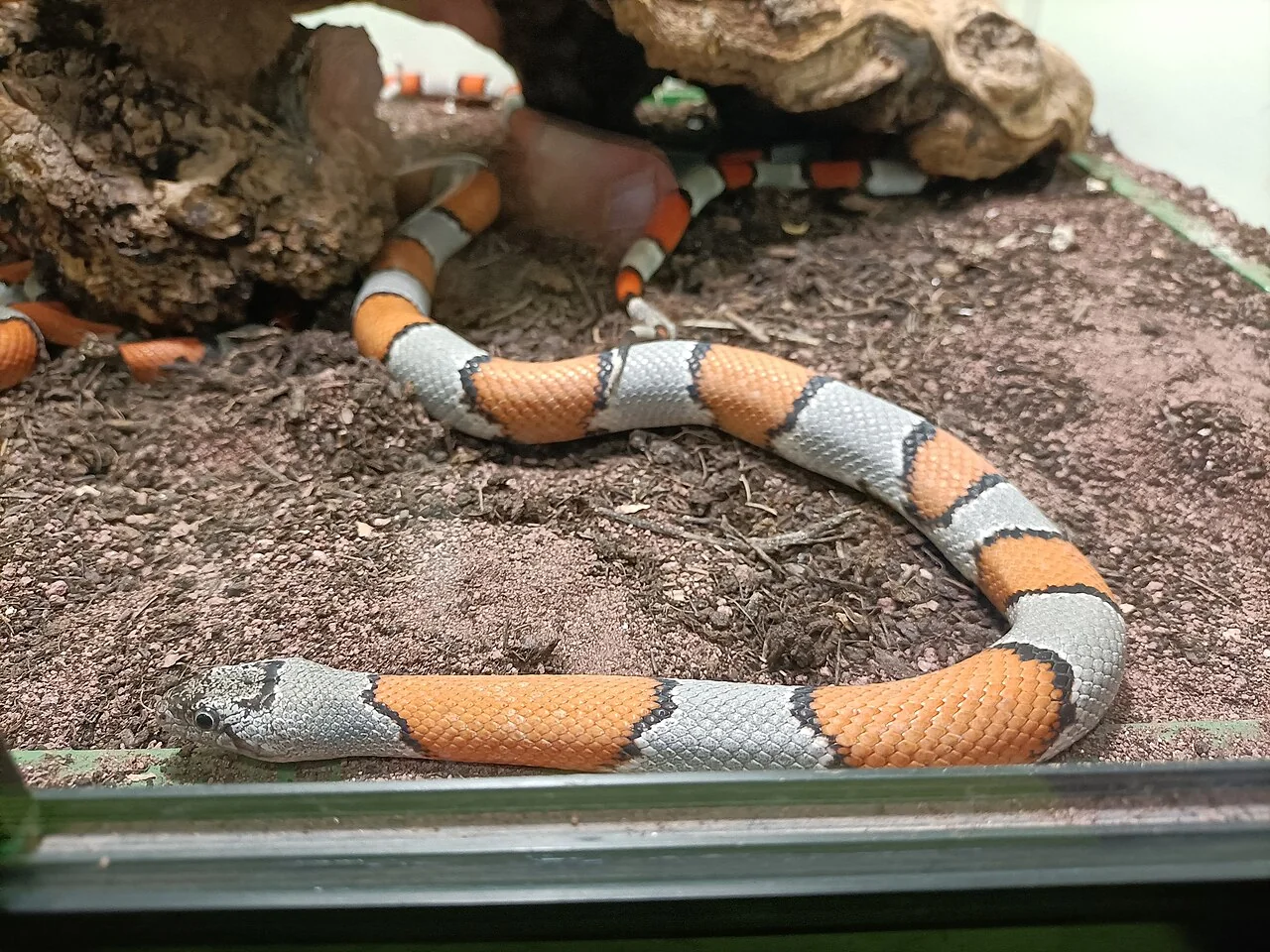
Scientific name
Lampropeltis alterna
Other names: Lampropeltis mexicana alterna · Lampropeltis blairi
The grey-banded kingsnake is associated with rocky environments and deep refuges. Its pattern diversity attracts attention, but provenance and established feeding are more useful criteria when preparing for its arrival. [1][2]
Origin
South-western United States and northern Mexico; the New Mexico plan documents the Texas Trans-Pecos and south-eastern New Mexico in particular. [1][2]
- Terrestrial
- Rocks and crevices
- Nocturnal
Ecology from the public 2002 plan, without reusing its former legal provisions or prices. Numerical conditions limited to the attributed general framework; no species-specific lifespan asserted.
At a glance
| ADULT SIZE | Usually 51–90 cm Total length; maximum 146,7 cm TL [1][2]. |
|---|---|
| LIFESPAN | Not established here No species-specific average retained. |
| LIFESTYLE | Terrestrial and secretive Crevices, mainly nocturnal emergence [2]. |
Adult size
The conservation plan gives a usual total length of 51–90 cm; the reported taxonomic maximum reaches 146,7 cm TL. [1][2]
Lifespan
No sufficiently documented average lifespan in the sources retained; plan a long-term commitment.
Lifestyle
Secretive and mainly nocturnal, using crevices and underground shelters. [2]
Housing
A SUITABLE HABITAT
Accessible rocky shelters — Plan inspection without forcible extraction.
Individual housing with inspectable shelters inspired by crevices; dimensions adjusted to the individual, without a species-specific minimum validated here.
Care parameters
WARM SPOT · DAY
29–32 °C — General Lampropeltis framework [4].
COOL AREA · DAY
21–26 °C — Genus-level reference point [4].
Humidity
To measure locally — No species-specific percentage established.
Heating surface
29–32 °C General Lampropeltis reference point, to refine for this species. [4]
Cooler zone
21–26 °C Same general framework; not a measurement of its wild habitat. [4]
Humidity
Microclimates to measure No percentage specific to alterna established in this account.
Feeding
MONITORED FEEDING
Mice used in captivity; wild diet dominated by lizards [2].
Alterna and blairi forms: one species
The Reptile Database lists blairi among the synonyms of alterna and distinguishes this species from L. mexicana. [1] Form or locality labels must therefore not create several taxonomic profiles. Joe Forks describes intermediate patterns between the traditionally named forms. [3] Ask for written provenance and keep photographs of the parents when they exist. Attractive band contrast may help recognise the individual, but replaces neither lineage history nor identity verification.
Adult size, lifespan and lifestyle
The conservation plan gives a usual total length of 51–90 cm; the reported taxonomic maximum reaches 146,7 cm TL. [1][2]
No sufficiently documented average lifespan in the sources retained; plan a long-term commitment.
Secretive and mainly nocturnal, using crevices and underground shelters. [2]
Reading the habitat without reproducing extreme dryness
The New Mexico plan describes access to deep crevices in rocky environments; surface observations are often nocturnal and linked to summer rain. [2] The word desert therefore does not mean that the animal remains exposed to heat and dry air all day. In your project, distinguish visible decor from truly accessible refuges. Prepare several places to disappear into, with conditions you can check, rather than a spectacular rocky facade whose interior can never be inspected.
Installing usable, safe crevices
A shelter’s practical value is judged by accessibility for the snake and for maintenance. Design passages without pinch points, using stable, removable elements. A hidden snake must not be extracted by pulling its body. Reserve a clear transfer area and a simple procedure for checking every refuge. Photograph the setup before adding the rest of the substrate: this document will help locate supports and identify movement after cleaning or modification.
Heat and humidity: retain the scope of the figures
The two displayed temperatures come from a practice framework shared by several Lampropeltis. [4] They do not demonstrate an optimum for every alterna locality. Before arrival, have the breeder’s regime clarified and check your measurements in shelters, on accessible surfaces and during the night. Record air humidity and substrate condition separately. A hide that is permanently avoided calls for investigation; it does not, by itself, prove that temperature is responsible.
Feeding: anticipate juvenile preferences
The conservation plan mainly describes lizards in the wild diet and use of domestic mice in captivity. [2] This difference makes feeding history particularly valuable. Ask for recent independent meals with prey you can actually provide, including size and presentation. Avoid buying a juvenile on the assumption that a transition will be automatic. The register must distinguish offering from ingestion, then record refusals and changes in body condition. A persistent problem deserves help from the breeder and a veterinarian rather than a succession of improvised attempts.
Behaviour, secretiveness and interventions
Joe Forks reports that animals spend much of their time out of sight and that ophiophagy, although rare, has been observed in captivity. [3] Separate housing facilitates attribution of meals and droppings here. Choose observation times compatible with emergence, without continually lighting refuges to obtain visible activity. For a transfer, prepare the closable container, access and route before opening. A one-off defensive reaction must be recorded with its trigger, without permanently labelling temperament.
Breeding: distinguish observation from protocol
The species lays eggs. The conservation plan emphasises that much reproductive knowledge comes from captive animals; Forks reports clutches of four to thirteen eggs in his breeding account. [1][2][3] This figure is neither a promise nor a target for a female. Cooling accounts are not reproduced as universal instructions. Before any project, plan parental monitoring, a laying place, egg identification and juvenile housing, along with a realistic solution for getting juveniles feeding.
Monitoring suited to an often-unseen animal
Record observed emergence, meals taken, sheds, weighings and every intervention in shelters. Stability of the setup makes comparisons more meaningful: if heating, substrate and hides change simultaneously, a behavioural change becomes difficult to understand. Keep a dated record of every setting. An incomplete shed, regurgitation or deterioration in body condition calls for examination of context and, if necessary, veterinary advice. The experience required mainly lies in this ability to observe without disturbing and anticipate difficult juveniles.
Checklist
- Check identity and provenance.
- Obtain evidence of independent feeding.
- Prepare stable, removable shelters.
Observations to record
- Meals and prey presentation
- Observed nocturnal emergence
- Sheds and weight
- Shelter microclimates
The app provides individual animal records. Check which features are available for your animal in the released version.
Related guides
Original guides in French
Sources
Document-based overview; not a substitute for veterinary advice.
- The Reptile Database — Lampropeltis alterna
Source accessed - Painter, Hayes et Stuart, NMDGF — Recovery and Conservation of the Gray-banded Kingsnake, 2002
Source accessed - Joe Forks — Gray-banded Kingsnake
Source accessed - Mariah Healey, ReptiFiles — Kingsnake, Lampropeltis sp.
Source accessed