
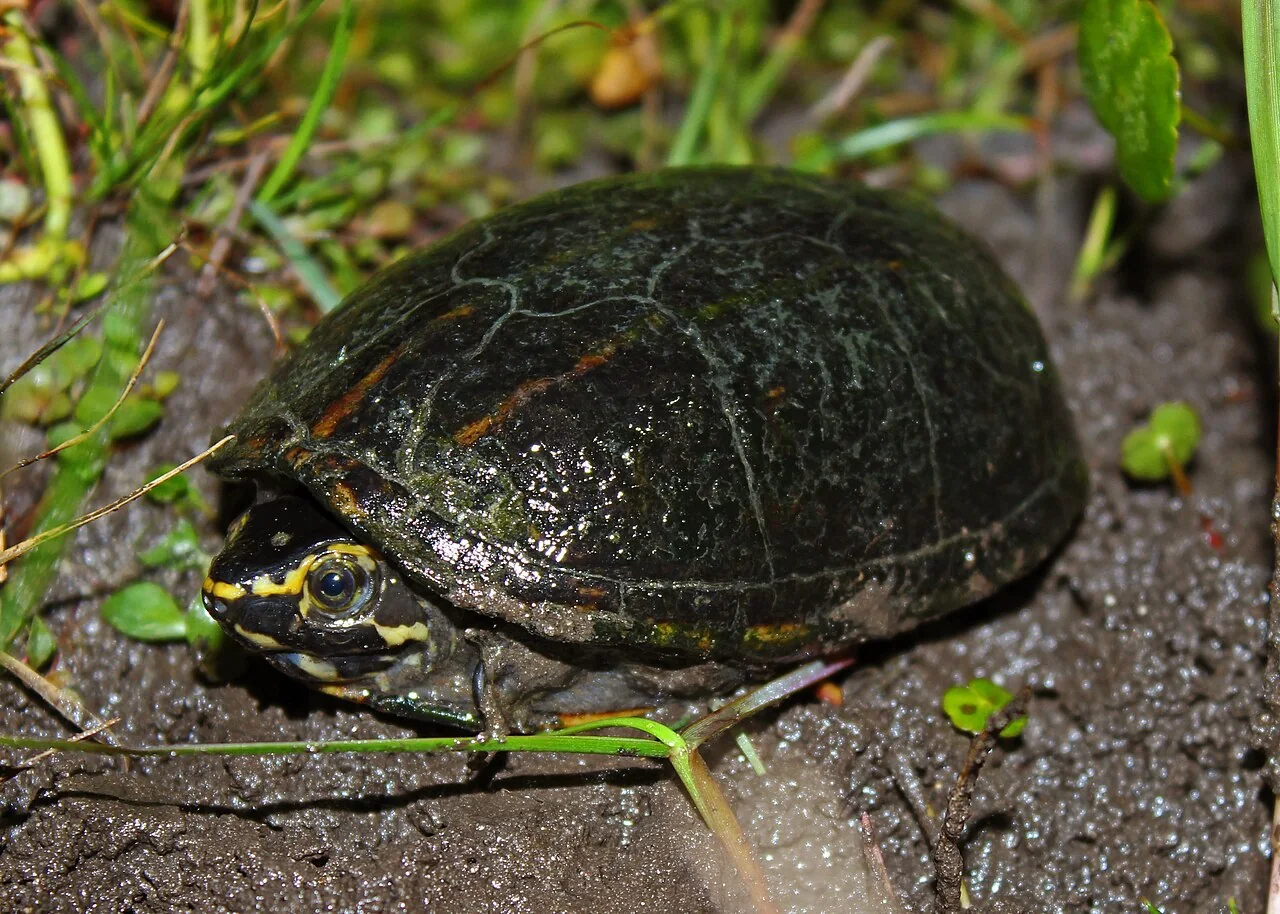
Scientific name
Kinosternon baurii
Kinosternon baurii is a small freshwater turtle. The three shell stripes may be faint in some northern populations. [1][4]
Origin
Atlantic plain of the United States, from Florida to Delaware. [2][4]
- Semi-aquatic
- Omnivorous
- Calm water
At a glance
| ADULT SIZE | ≈ 7,5–10 cm Usual size; documented female maximum: 13,8 cm. [2][4] |
|---|---|
| LIFESPAN | 20–50 years Zoo estimate, without a wild/captive breakdown. [2] |
| LIFESTYLE | Semi-aquatic Calm water and movements onto land. [4] |
Adult size
Usually 7,5–10 cm of shell; a female maximum of 13,8 cm is documented in the specialist synthesis. [2][4]
Lifespan
Maryland Zoo states 20–50 years, without a detailed distinction between wild and captive settings. [2]
Lifestyle
Calm water and terrestrial movements during rain. [4]
Housing
WATER AND LAND
≈ 2/3 water · 1/3 land — Clinical reference: filtration, supports and easily accessible dry area. [3]
Chicago Exotics describes around two thirds water and one third land, with filtration and easy access to a dry area. Depth and supports must suit the individual. [3]
Care parameters
WATER
≈ 23–26 °C — Submerged measurement, far from and near the heater. [3]
AMBIENT AIR
≈ 26–28 °C — Reference distinct from water. [3]
HEATED DRY AREA
≈ 29–33 °C — The source does not specify air or surface. [3]
Humidity
Not quantified — No specific humidity level adopted; also monitor water and the land area.
Water
≈ 23–26 °C. [3] Measure near and far from the heat source.
Ambient air and dry area
Air ≈ 26–28 °C; heated dry area ≈ 29–33 °C. [3] The source does not specify whether the dry-area reading is a surface temperature.
Air humidity
No specific percentage adopted. Water quality and access to a land area must be monitored separately.
Feeding
A VARIED AQUATIC MENU
Suitable prey and complete food for aquatic turtles according to the clinic; monitor the amount actually eaten. [3]
Feeding
In the wild: invertebrates, algae, seeds and carrion. [2] In captivity, the clinic suggests a varied diet combining suitable prey and complete food for aquatic turtles. [3]
A small, mobile turtle
The scientific synthesis describes movement onto land when water levels fall or after rain. Some populations live in brackish water; this does not justify automatically adding salt to every enclosure. [4]
Useful records
Record water temperature, water changes, meals and weight. Photograph access routes to the dry area after moving furnishings. Distinguish total tank volume from genuinely usable area, and keep water-quality measurements with their date and the method used.
Checklist
- Check access to the dry area.
- Guard the water heater.
- Keep a record of water changes.
Observations to record
- Water
- Weight
- Meals
- Activity
The app provides individual animal records. Check which features are available for your animal in the released version.
Related guides
Original guides in French
Sources
Document-based overview; not a substitute for veterinary advice.
- The Reptile Database — Kinosternon baurii
Source accessed - Maryland Zoo — Striped mud turtle
Source accessed - Chicago Exotics Animal Hospital — Mud Turtle Care
Source accessed - Johnston, Dodd et Wilson, 2021 — Kinosternon baurii, IUCN TFTSG
Source accessed