
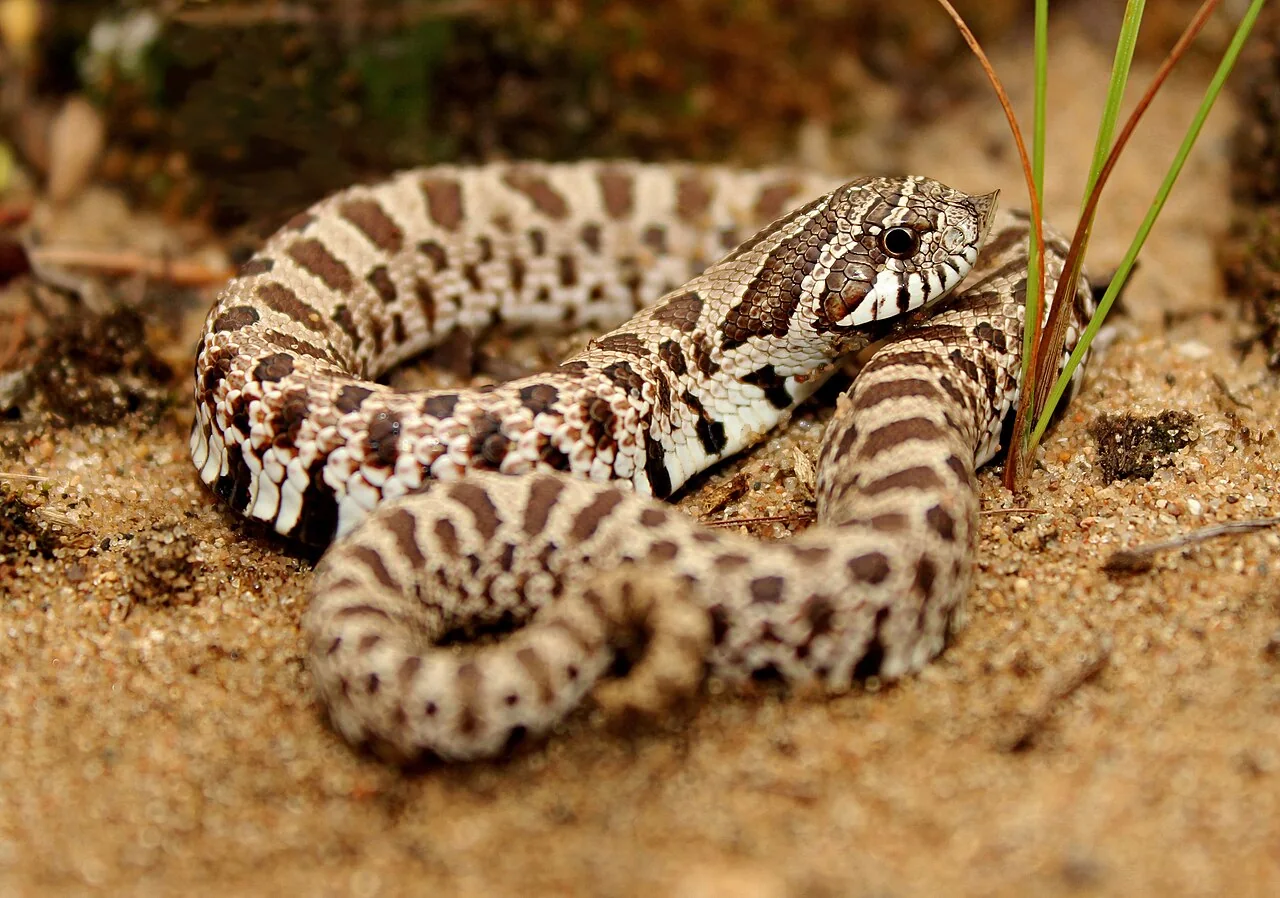
Scientific name
Heterodon nasicus
Heterodon nasicus is a North American species; ‘hognose’ also refers to snakes from other genera and continents. [1][3]
Origin
Southern Canada and the central United States. Mexican populations formerly included now belong to Heterodon kennerlyi in the database consulted. [1]
- Burrowing
- Upturned snout
- Handling precautions
At a glance
Southern Canada and the central United States. [1] Its snout helps with digging and finding prey in the soil. [2]
| ADULT SIZE | ≈ 30–91 cm Zoological range without a breakdown by sex. [2] |
|---|---|
| LIFESPAN | 15 to 20 years Estimate in captivity. [2] |
| LIFESTYLE | Burrowing Snout adapted for digging. [2] |
Adult size
Around 30–91 cm in total length according to Utica Zoo; this range does not distinguish the sexes. [2]
Adult weight
No adult range distinguishing sex and length is adopted. Utica Zoo’s general masses do not specify life stage sufficiently to define a healthy adult weight. [2]
Lifespan
15–20 years in captivity according to Utica Zoo; a zoological estimate, not an individual guarantee. [2]
Lifestyle
The snout helps with digging and finding prey in the soil. [2]
Experienced keeper
The diet, burrowing needs and bite precautions justify prior experience. Human envenomations are documented; this editorial level does not downplay that risk. [4][5]
Housing
SUBSTRATE FOR BURROWING
Burrowing and shelters — Ground that allows digging, shelters and reliable closures. [5]
Ground that allows burrowing, warm and cool shelters, reliable closures. [5]
Care parameters
WARM ZONE · DAY
≈ 31–33 °C — 88–92 °F, according to the species-specific care sheet. [5]
COOL AREA · DAY
≈ 24–27 °C — 75–80 °F; around 21–24 °C at night. [5]
Humidity
30–50 % — Clinical reference for H. nasicus; preserve opportunities to burrow. [5]
Warm zone
Around 31–33 °C. [5] Rounded conversion of 88–92 °F in the species-specific care sheet.
Cool area
Around 24–27 °C. [5] Conversion of 75–80 °F; keep this zone accessible.
Night
Around 21–24 °C. [5] Conversion of 70–75 °F; no breeding cooling regime is inferred.
Humidity
30–50 % according to the clinic. [5] Ambient value; do not saturate the burrowing substrate.
Feeding
FAMILIAR, SUITABLE PREY
Thawed mice; frequency according to life stage, details in the profile. [5]
Habitat and lifestyle
Utica describes a snake that digs and searches for prey in the soil using its upturned snout. [2] A purely decorative layer does not provide this opportunity.
Thermostatically controlled heating, burrowing substrate without pine or cedar. [5] Enclosure size still needs to be tailored to the individual.
Lighting and water
Optional low-level UVB, lighting for 10–12 hours and a small water container according to the clinic. [5] No equivalence between a lamp’s percentage and UVI is invented.
Feeding in captivity
Thawed mice close to the body’s width: juveniles every 4–5 days, adults every 7–10 days according to the clinic. Persistent refusal: seek advice. [5]
Toads feature in the wild diet reported by Utica. This natural-history information is not an instruction to collect amphibians or improvise a dietary change. [2] Keep previous feeding information and the body-condition record.
Reproduction: an egg-laying species
Animal Diversity Web describes eggs laid in the soil and independent young, with no parental care after laying. [6] No incubation settings are adopted because this synthesis lacks a complete, contextualised protocol.
Breeding must be prepared separately: the parents’ identity, maturity and condition, monitoring of laying and the young’s feeding. Age alone or a published size does not prove that a female can be bred.
Handling and health
Flattening the neck, hissing and playing dead are defences described by the zoo; do not provoke them for a video. [2] A scientific survey reports swelling and other symptoms after bites, sometimes prolonged. Its voluntary reports do not measure the actual frequency of incidents. [4]
Abnormal breathing, retained eye caps or weight loss: consult a veterinarian. [5] A symptomatic bite in a person requires medical advice; no home treatment is proposed here.
Daily monitoring
Record accepted or refused meals, environmental readings, digging, sheds and weight. Keep the probe locations on record: an air measurement does not automatically tell you the conditions at the bottom of the substrate.
The absence of a standard adult mass must not be replaced with an average found for another hognose snake. The Experienced level is an explained editorial choice, not a certificate of ease or danger.
Checklist
- Avoid provoking defensive behaviour.
- Document previous feeding.
- Have the thermal plan clarified.
Observations to record
- Meals
- Weight
- Sheds
- Burrowing
The app provides individual animal records. Check which features are available for your animal in the released version.
Related guides
Original guides in French
Sources
Document-based overview; not a substitute for veterinary advice.
- The Reptile Database — Heterodon nasicus
Source accessed - Utica Zoo — Western hognose snake
Source accessed - Royal Veterinary College — Hognose snake care, révision décembre 2024
Source accessed - Damm et al., 2026 — 34 reports of snakebite envenoming by Heterodon nasicus
Source accessed - Tree of Life Exotic Pet Medical Center — Western hognose snake care
Source accessed - University of Michigan, Animal Diversity Web — Heterodon nasicus
Source accessed