
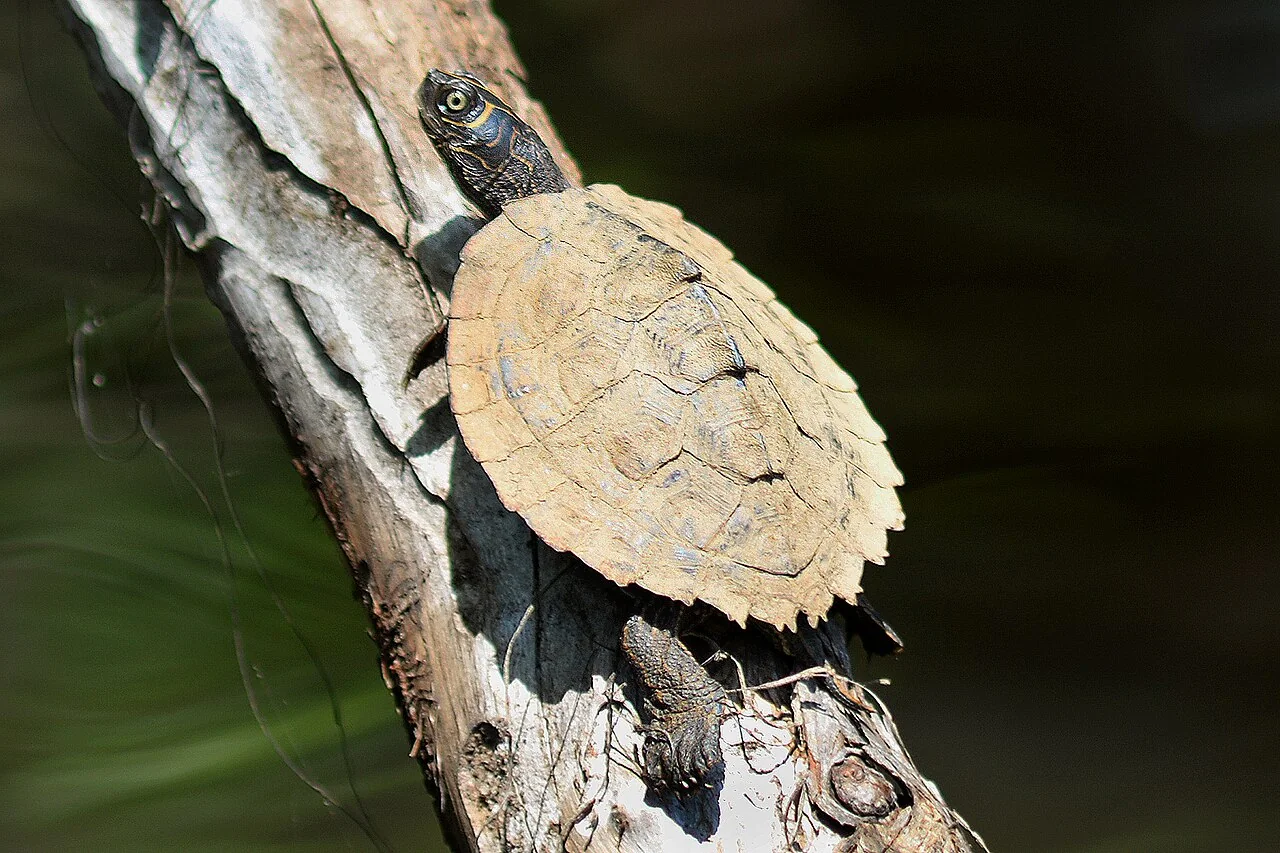
Scientific name
Graptemys pseudogeographica
Graptemys pseudogeographica is a North American river turtle. The size difference between sexes can completely transform an aquarium project. [2][3] A small juvenile shell does not indicate the space a future female will occupy; swimming area and basking-platform strength must be planned from the outset.
Origin
Mainly the Mississippi basin and associated regions in the United States; the reference distinguishes the forms pseudogeographica and kohnii. [1]
- Marked dimorphism
- Dry basking area
- Aquatic
Documentary overview: identity checked; natural observations and captive practices attributed separately. Undocumented limits remain explicit.
At a glance
| SIZE | 9–27,8 cm Carapace, strongly influenced by sex [2][3]. |
|---|---|
| LIFESPAN | Not quantified Selected sources insufficient. |
| LIFESTYLE | Diurnal aquatic Rivers and calm side channels [2]. |
Adult size
9–27,8 cm carapace length in the University of Nebraska account. For the nominate form, Austin gives approximately 9–14,6 cm for males and 12,7–27,3 for females. [2][3]
Lifespan
No sufficiently documented average or maximum lifespan is displayed in this selection of sources.
Lifestyle
Diurnal and aquatic, using rivers and adjacent waters with basking supports. [2][4]
Housing
SUGGESTED ENCLOSURE
≥120 ×60 ×60 cm — Enlarge according to the individual; specialist guide [4].
Herpeton suggests at least 120 ×60 ×60 cm for an appropriately sized individual and specifies that a large female needs more. This guideline does not automatically provide capacity for a group. [4]
Care parameters
WATER
22–26 °C — Herpeton [4].
PLATFORM
30–34 °C — Herpeton [4].
Humidity
Genuinely dry basking area — Water quality is a priority [3].
Water during activity
22–26 °C according to Herpeton [4] Measure underwater; do not copy a winter weather temperature.
Heating surface
30–34 °C according to Herpeton [4] Retain retreat areas and monitor water temperature separately.
Feeding
OMNIVORE
Animal and plant resources; captive diet adapted to the individual [2][3].
Do not confuse map turtles
The Reptile Database explains changes in the treatment of kohnii, historically sometimes separate and currently a subspecies in this reference. [1] Retaining the full name received and sufficiently clear identification photographs makes it easier to match the animal with the right publications. Head markings should not be interpreted alone from a blurred image. A turtle sold simply as a ‘Mississippi turtle’ remains insufficiently identified.
Adult size, lifespan and lifestyle
9–27,8 cm carapace length in the University of Nebraska account. For the nominate form, Austin gives approximately 9–14,6 cm for males and 12,7–27,3 for females. [2][3]
No sufficiently documented average or maximum lifespan is displayed in this selection of sources.
Diurnal and aquatic, using rivers and adjacent waters with basking supports. [2][4]
An open environment with refuges
The University of Nebraska describes large rivers and adjacent bodies of water. [2] The aim of the layout is not to create an artificial torrent, but to let a swimming turtle move without tightly spaced obstacles. Providing open areas and visual screens helps manage this balance. Abundant furnishings that restrict turning can remove most of the tank's theoretical space.
The platform is part of the habitat
Austin emphasises the importance of basking, heating and UVB. [3] A ramp accessible to juveniles may become too light or too narrow as they grow. Testing the support at the expected body mass and watching exits from a distance are two different checks. The turtle must be able to position itself entirely out of the water without being forced to stay at the hottest point.
Water: a measurable priority
Austin considers water quality a sensitive issue for this species. [3] Describing the filter and cleaning, as well as measured results, avoids confusing expensive equipment with effectively managed water. Choosing a bottom that is easy to inspect can simplify maintenance. Leftovers trapped beneath a platform and areas without circulation warrant checking after each major rearrangement.
Feeding and growth
University observations describe an omnivore eating invertebrates and fish among other foods; Austin adds aquatic plants in his account. [2][3] A list of natural foods does not become a calculated diet. Size, growth and actual consumption should guide the captive menu with a professional. Waiting near the glass alone does not establish that the ration is insufficient.
A local natural season
In Nebraska, the university account places activity mainly from April to October and reports multiple clutches, with 10–12 eggs in the cited reference. [2] These regional observations explain seasonal biology; they do not set dates for a heated captive setup. Recording laying and hatching separately remains essential. This profile gives no cooling or incubation duration to apply without a specialist protocol.
Observe without triggering dives
Herpeton describes escape dives when a map turtle is startled. [4] Movement near the tank and the position of refuges can therefore affect observations. Installing obstacles without sharp edges and keeping escape routes clear makes the setup easier to assess. A turtle often underwater during visits does not necessarily use its basking area in the same way when alone.
Plan for the female and the long term
If sex is unknown, prepare the enclosure for the possible large size rather than promising a small permanent aquarium. Cohabitation is not validated simply by adding litres: retain a means of separation. Captive-origin documents, identity and current keeping regulations must be checked before purchase. Neither wild collection nor release is part of responsible keeping.
Checklist
- Plan for the female's size.
- Inspect diving routes.
- Monitor water and platform.
Observations to record
- Shell
- Sex
- Water
- Basking
The app provides individual animal records. Check which features are available for your animal in the released version.
Related guides
Original guides in French
Sources
Document-based overview; not a substitute for veterinary advice.
- The Reptile Database — Graptemys pseudogeographica
Source accessed - University of Nebraska–Lincoln — False Map Turtle
Source accessed - Austin’s Turtle Page — False Map
Source accessed - Herpeton Academy — False Map Turtle
Source accessed