
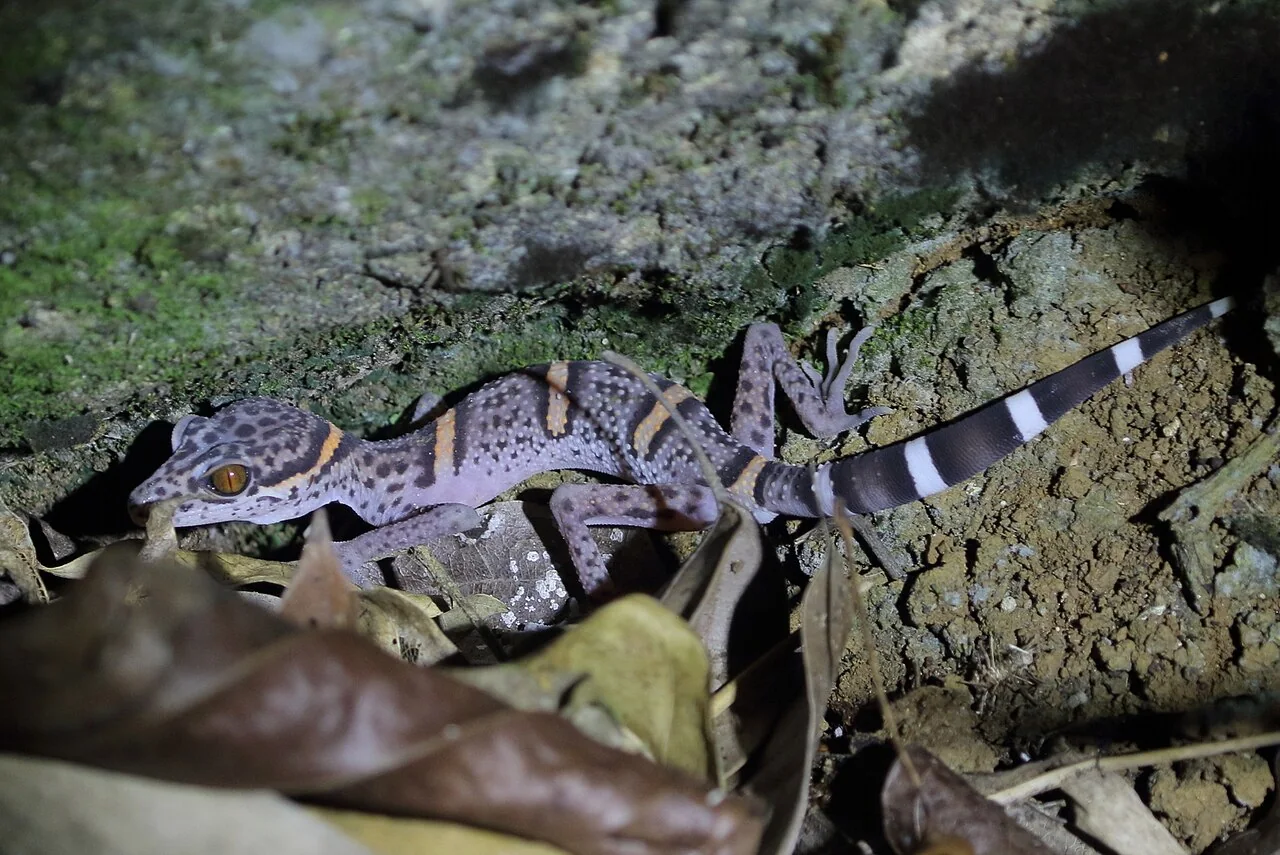
Scientific name
Goniurosaurus luii
Other names: Goniurosaurus kadoorieorum
Goniurosaurus luii is a nocturnal gecko associated with forests on limestone terrain. Available field measurements show the importance of distinguishing humid air from a support that is actually dry [3].
Origin
Southern China and northern Vietnam; the profile draws on populations studied in karst massifs, without extending the settings to all Asian geckos [3][4].
- Nocturnal
- Rock-dwelling
- Karst
At a glance
A nocturnal gecko of karst habitats; the climate values presented come from natural observations in Vietnam [3].
| ADULT SIZE | ≈ 24 cm Total length according to Wally Kern [2]. |
|---|---|
| ACTIVITY | Nocturnal Rock faces and crevices, not only caves [3]. |
| DIET | Insectivorous Hunting observed in the field [3]. |
Adult size
Approximately 24 cm total length in Wally Kern’s description; a keeper’s order of magnitude, not the average of a wild series [2].
Lifespan
Wally Kern’s captive estimate of 10–15 years, without a published individual register from which to establish life expectancy [2].
Lifestyle
Nocturnal, uses rock faces and crevices; it does not live only deep inside caves [3].
Housing
ARRANGING ITS HABITAT
Rocks and crevices — Fixed supports and usable height; setup inference from field observations [3].
Securely fixed rock decor, accessible crevices and opportunities to retreat; usable height matters as much as floor area, as inferred from field observations [3].
Care parameters
AIR · FIELD
21,9–28,6 °C — Observed Vietnamese values, not a captive instruction [3].
Humidity
59–85 % · field — 71 measurements associated with this species; not a terrarium target [3].
Air in the field
21,9–28,6 °C [3] Vietnamese observations; a range encountered, not a captive instruction.
Humidity in the field
59–85 % [3] 71 measurements associated with G. luii; do not use the range for the other species studied.
Feeding
FEEDING AND MONITORING
Suitable prey monitored individually; field observations do not establish a captive ration [2][3].
Identity and historical data
The taxonomic database accepts Goniurosaurus luii and places G. kadoorieorum in its synonymy [1]. Older lists may therefore count separately names that are now associated. For a captive individual, retaining the designation used at birth, provenance and current name allows records to be linked without losing information. Field publications must also be read with their date in mind: a revision does not guarantee that every animal photographed under an old name has been re-examined.
Adult size, lifespan and lifestyle
Approximately 24 cm total length in Wally Kern’s description; a keeper’s order of magnitude, not the average of a wild series [2].
Wally Kern’s captive estimate of 10–15 years, without a published individual register from which to establish life expectancy [2].
Nocturnal, uses rock faces and crevices; it does not live only deep inside caves [3].
A rock climber rather than a cave label
The Vietnamese study recorded luii on inclined surfaces, sometimes up to three metres above the ground [3]. This suggests providing a stable structure and shelters at different positions. It is a reasoned translation of behaviour, not a prescription for a three-metre-high terrarium. Fixing elements before adding substrate, removing traps between slabs and retaining maintenance access address the particular constraints of rock decor in an enclosed space.
Understanding climate measurements
Ngo and colleagues obtained a mean air temperature of 25,6 °C and mean humidity of 74 % in measurements associated with luii [3]. These field observations do not prove that these averages are optimal throughout the year. They depend on the period and places where the animals were found. A terrarium requires monitoring of extremes, opportunities to retreat and suitable ventilation, rather than aiming for a single number on a screen.
Humidity and surfaces: two pieces of information
The same study emphasises frequent use of dry rocks despite ambient humidity [3]. Continuously wetting every crevice therefore does not reproduce this description. Checking surfaces separately from the hygrometer is a useful principle: record where water remains, what dries and what stays inaccessible for cleaning. One shelter can be more humid than another without the entire setup being waterlogged. No universal misting frequency is inferred from the published one-off observations.
Hunting and captive feeding
A field observation shows luii eating a large cave cricket [3]. It documents actual prey without describing the entire diet or requiring that insect species to be sought. Selection of captive-bred prey must account for size, prior feeding and balance of the menu. Documenting capture and actual consumption avoids counting prey merely placed in the decor as a meal. Leftovers hidden between stones must remain retrievable.
Breeding and limits of the figures
The BfN report collates captive results including incubation of 65 days at 28 °C and 84 days at 24 °C for luii [4]. These results are neither a guarantee nor a controlled experimental comparison. Before a breeding project, plan monitoring of the female and setups for juveniles. Repeated clutches are insufficient to conclude that body condition remains satisfactory. Protocol details must come from an identified breeding setup and be discussed as a whole.
Observe without pulling the animal from its shelter
Wally Kern emphasises the animals’ secretive nature and coloration differences between juveniles and adults [2]. Nocturnal observation from a distance therefore often provides more information than frequent inspection of every hiding place. Recording positions used helps detect a change after altering the decor. An animal that remains unseen is not necessarily ill; however, a simultaneous absence of food intake or deterioration in body shape calls for a concrete check and, if necessary, veterinary advice.
Traceability and critical reading
Karst terrain does not constitute a uniform habitat, and results from one locality must not be extended without examination. This profile distinguishes a keeper’s estimate, a captive compilation and original measurements. This separation allows a project to be discussed using the right documents rather than adding incompatible figures together. Photographs, dates of birth and individual observations remain valuable, but they do not replace a population study and never justify presenting a lineage without provenance as a certain geographical population.
Checklist
- Check the animal’s identity and retain its provenance.
- Install and measure the refuges before arrival.
- Plan individual monitoring of meals, sheds and movement.
Observations to record
- Meals
- Weight
- Sheds
- Temperature
- Humidity
- Behaviour
The app provides individual animal records. Check which features are available for your animal in the released version.
Related guides
Original guides in French
Sources
Document-based overview; not a substitute for veterinary advice.
- The Reptile Database — Goniurosaurus luii
Source accessed - Wally Kern — Goniurosaurus luii, The Cave Gecko
Source accessed - Ngo et al. 2022 — Ecological niche overlap of two allopatric karst-adapted tiger geckos
Source accessed - Langner et al., BfN 2022 — Evaluation of the Captive Breeding Potential
Source accessed