
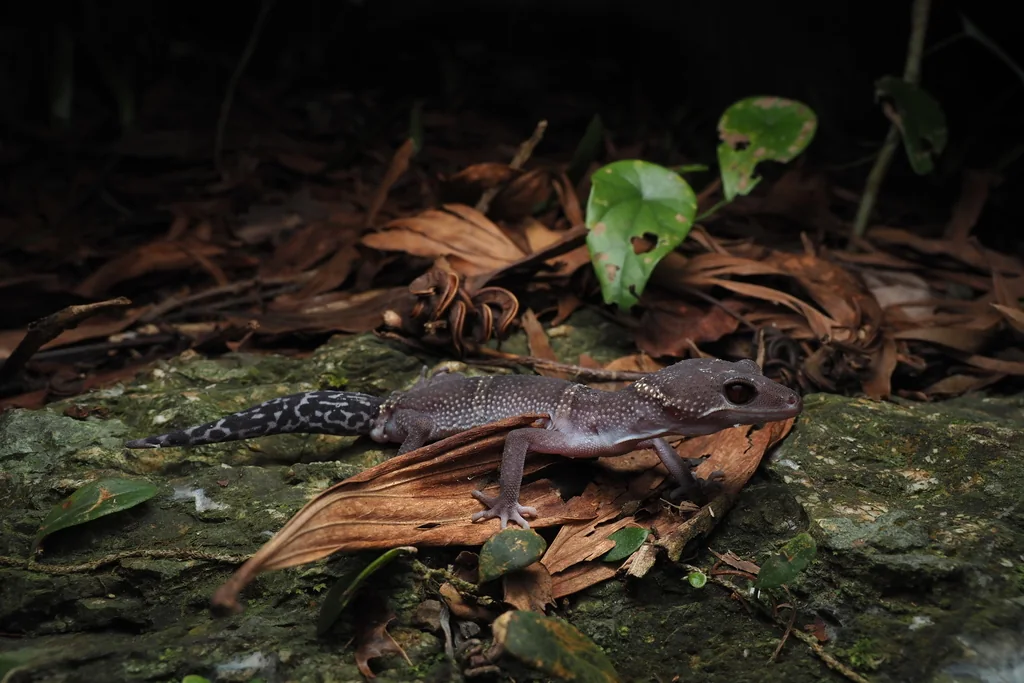
Scientific name
Goniurosaurus hainanensis
Other names: Goniurosaurus sinensis · Goniurosaurus kwanghua
This eyelidded gecko is often sold under a general cave gecko label. A 2025 revision nevertheless requires its provenance to be examined more carefully than its dorsal pattern alone [1][4].
Origin
Hainan Island, China; western populations including the Wuzhi type locality are covered by the revised name. Some eastern populations require a different assignment [4].
- Nocturnal
- Shelters
- Hainan
At a glance
The 2025 revision changes the scope of G. hainanensis: an old label without provenance may cover another lineage [1][4].
| ADULT SIZE | ≈ 17,5 cm Total according to Wally Kern; a keeper’s reference point [2]. |
|---|---|
| ACTIVITY | Dusk and night Secretive in captive observations [2]. |
| DIET | Insectivorous Reported husbandry practice [2]. |
Adult size
Approximately 17,5 cm total length in breeder Wally Kern’s presentation; this is not an average measured in a wild population [2].
Lifespan
Wally Kern mentions 10–15 years in captivity, without a published demographic series; this estimate does not constitute a validated record [2].
Lifestyle
Secretive, crepuscular and nocturnal in the captive observations reported [2].
Housing
ARRANGING ITS HABITAT
Dark ground-level shelters — No validated minimum for the revised taxonomic definition; retain provenance.
A ground-level setup with dark retreats accessible for maintenance; no dimensional minimum specific to the revised taxonomic definition is validated in this profile.
Care parameters
CAPTIVE CLIMATE
Not established — Do not convert incubation figures into keeping conditions.
Humidity
Not quantified — Microhabitats and provenance must be clarified.
Temperature
Protocol not established Incubation figures are not keeping temperatures.
Humidity
Microhabitats to clarify Retain refuges and local variation; no percentage extrapolated from another species.
Feeding
FEEDING AND MONITORING
Suitable prey; monitor individual intake in shelters, without transferring a timetable from another species [2].
What the 2025 revision changes
Qi and colleagues combined morphological and genetic data. They associate G. sinensis and G. kwanghua with G. hainanensis, while an eastern lineage is left under G. cf. lichtenfelderi [4]. The three names must therefore not produce three separate species profiles. An old label does not, however, automatically become a modern identification: keeping the original name and known lineage allows expert advice to be sought without making uncertainty disappear.
Adult size, lifespan and lifestyle
Approximately 17,5 cm total length in breeder Wally Kern’s presentation; this is not an average measured in a wild population [2].
Wally Kern mentions 10–15 years in captivity, without a published demographic series; this estimate does not constitute a validated record [2].
Secretive, crepuscular and nocturnal in the captive observations reported [2].
Reading body shape without overinterpreting colour
Wally Kern describes a relatively compact body, red eyes and more contrasting bands in juveniles [2]. A photograph of an adult does not allow its geographical origin to be reconstructed. It can nevertheless document visible characteristics, a regenerated tail or changes in pattern. Taking side and top views without turning the animal over provides a more usable record than an image under strongly coloured lighting. Comparison must account for age and light.
Organising shelters that can be checked
The husbandry descriptions emphasise a secretive gecko using rocks, wood and leaf litter [2]. The setup can therefore offer several opaque retreats rather than a single shelter that would have to be lifted for every check. This is a design proposal inferred from the behaviour described. Heavy elements must be secured independently of the substrate. Reserving a route for removing leftovers and checking a shed avoids turning every care task into complete dismantling of the decor.
Climate: do not manufacture precision
The former grouping of several populations under one name limits the scope of general advice. Data published before the revision remain useful, but their attribution must be explained [3][4]. No humidity percentage or basking point is adopted here solely because it appears in a profile for another Goniurosaurus. For an animal already kept successfully, asking the previous keeper for actual measurements, their locations and their variation is more informative than a simple mention of a tropical terrarium.
Feeding and points to document
The sources retained provide no quantitative study of the wild diet usable to construct a complete ration. A captive menu must therefore be established with a specialist and a consumption history, without turning an accepted prey item into the sole food. Recording prey species, their size and supplement preparation makes the discussion concrete. An observed capture proves food intake; it does not, by itself, reveal long-term nutritional balance.
Known breeding, conditions to distinguish
The BfN report compiles clutches of two eggs and incubations of 53–76 days for hainanensis; it also cites a result of 53–54 days at 29 °C [3]. These are captive data predating the revision. They establish neither an optimal temperature nor a mandatory timetable. An incubator’s temperature does not describe the adult’s living climate. Any project requires a laying area, identification of the parents and a way to monitor juveniles separately.
Preventing record errors
The trade name Chinese gecko does not distinguish this species from its relatives. The taxonomic database indeed lists several historical combinations [1]. Keeping the invoice, initial photographs and exchanges about the lineage allows an animal’s history to be reread after a revision. Avoiding mixing lineages simply because their names have become synonyms is a traceability precaution: this decision presumes neither reproductive incompatibility nor complete genetic identity.
Monitoring and acknowledged limits
Observation must track emergence, food intake, body shape and sheds while reducing intrusions into shelters. A temporary absence from observations may result from a change of shelter; first check access and security. This overview presents a recent taxonomic identity and clearly dated older practices. It does not claim to resolve the needs of all populations formerly grouped under this name. This limit must remain visible whenever the figures are reused.
Checklist
- Check the animal’s identity and retain its provenance.
- Install and measure the refuges before arrival.
- Plan individual monitoring of meals, sheds and movement.
Observations to record
- Meals
- Weight
- Sheds
- Temperature
- Humidity
- Behaviour
The app provides individual animal records. Check which features are available for your animal in the released version.
Related guides
Original guides in French
Sources
Document-based overview; not a substitute for veterinary advice.
- The Reptile Database — Goniurosaurus hainanensis
Source accessed - Wally Kern — Goniurosaurus hainanensis, The Cave Gecko
Source accessed - Langner et al., BfN 2022 — Evaluation of the Captive Breeding Potential
Source accessed - Qi et al. 2025 — Integrative taxonomic revision, résumé éditeur diffusé par AGRIS
Source accessed