
Scientific name
Gekko vittatus
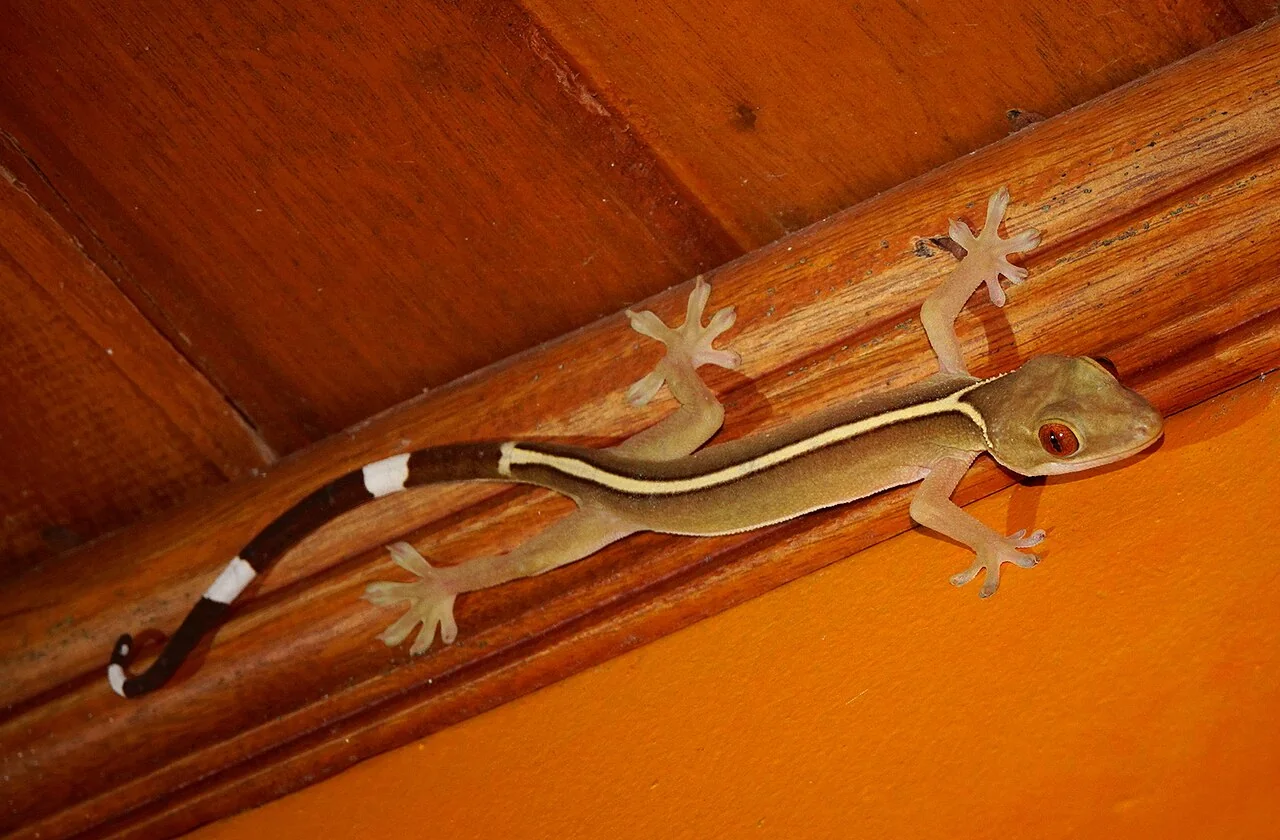
Gekko vittatus is a nocturnal arboreal gecko recognisable by its pale dorsal line. Its eggs adhere to supports, making the organisation of the decor important well before breeding [2].
Origin
New Guinea and several islands of Indonesia and the western Pacific; older records from Java or elsewhere are debated, and India is not a reliable origin [1].
- Nocturnal
- Arboreal
- Insectivorous
At a glance
A nocturnal arboreal gecko from the Indo-Pacific region; the pale dorsal stripe is insufficient to resolve every closely related identity [1][2].
| ADULT SIZE | ≈ 25 cm Total length according to IGA [2]. |
|---|---|
| ACTIVITY | Nocturnal Arboreal, with adhesive toes [2][3]. |
| DIET | Insectivorous IGA husbandry practice [2]. |
Adult size
Approximately 25 cm including the tail in the IGA profile; this value represents total length, not body length alone [2].
Lifespan
No longevity register or verifiable captive average was found in the sources retained.
Lifestyle
Nocturnal, arboreal, able to move on smooth vertical surfaces thanks to its adhesive toes [2][3].
Housing
ARRANGING ITS HABITAT
Height and bark — Branches, opaque retreats and removable supports for attached eggs [2].
A tall terrarium with solid branches, opaque retreats and removable supports; no dimension presented as a universal minimum [2].
Care parameters
LOCALISED HEATING
30–32 °C — IGA reference point; measure on the support used [2].
Humidity
Around 80 % — IGA reference point; check ventilation and local drying [2].
Localised heating
30–32 °C [2] IGA reference point, to measure on the support used.
Humidity
Around 80 % [2] Practical-source reference point; check ventilation and local drying.
Feeding
FEEDING AND MONITORING
Suitable prey; monitor juveniles and keep laying supports removable [2].
Name and distribution: examine older maps
The current name appears in The Reptile Database with a long history of synonyms [1]. IGA also notes that some populations formerly treated as vittatus correspond to Gekko remotus [2]. A very broad map may therefore combine records of differing quality. For a captive animal, the most useful information remains its documented lineage. An import label sometimes indicates only a country of transit; it does not prove birthplace or a particular population.
Adult size, lifespan and lifestyle
Approximately 25 cm including the tail in the IGA profile; this value represents total length, not body length alone [2].
No longevity register or verifiable captive average was found in the sources retained.
Nocturnal, arboreal, able to move on smooth vertical surfaces thanks to its adhesive toes [2][3].
The white line does not explain everything
The IGA description shows a pale line starting at the head and continuing along the back, with a ringed tail [2]. However, the presence or intensity of a marking is insufficient to determine age, sex or provenance. A photographic series taken under comparable lighting is useful for monitoring general condition, provided a perfect match with a reference image is not sought. Differences in lighting and posture strongly alter the impression created by coloration.
Building a setup for height
Jihlava Zoo emphasises adhesion to vertical surfaces [3]. Glass therefore becomes a possible route, including near a lamp or an opening. Arranging branches and shelters provides routes other than the walls. The decor must leave a maintenance area: changing food without dismantling a hide and observing supports without detaching the animal. Planning these actions before arrival reduces abrupt interventions when the gecko is just behind a door.
Heat, water and air circulation
IGA proposes a humid but ventilated setup, basking supports and water deposited on surfaces [2]. This framework does not establish a misting frequency valid in every room. Observing drying of exposed supports and shelter condition is necessary to adjust maintenance. A lamp changes temperature and evaporation simultaneously. Recording both parameters at the same place and time helps distinguish a lack of water from excessive heating.
Prey and dietary choices
Jihlava Zoo describes a diet of small invertebrates [3]. Captive lists must be read as options, not an obligation to offer every food mentioned. Preparing suitable captive-bred prey, documenting supplements and checking consumption provides a concrete basis. Meals offered at height must remain accessible to the gecko and retrievable by the keeper. Prey that disappears behind a decorative background is not automatically eaten; this distinction matters when trying to understand weight loss.
Territoriality and interventions
IGA notes strong incompatibility between males [2]. The clearest approach for individual monitoring is to plan one animal per setup, except for an organised breeding project. Cohabitation without visible bites may still conceal competition for food or retreats. If several animals are kept, each must be identifiable and separable. Chasing by hand between branches creates risks of falls and reflex movements: a transfer must be prepared with an accessible container.
Attached eggs and juveniles
Eggs are attached to the decor according to the IGA profile. Jihlava mentions one to two per clutch and incubations of 80–100 days, without specifying all conditions on that page [2][3]. These durations do not justify detaching an egg to check it. Removable supports may facilitate future management, but any handling must follow a competent protocol. Preparing juvenile housing before hatching avoids reliance on cohabitation with adults whose outcome would be uncertain.
Limits and monitoring the supports used
The most useful observations connect resting places, prey captures, sheds and the appearance of clutches. A photograph of the decor allows an egg’s position to be found again without repeated opening. The available sources describe the species and practices, but do not validate a single protocol for every lineage. Lifespan remains unquantified here. This reservation does not reduce the commitment required: a long-term setup and access to suitable care must be planned.
Checklist
- Keep the scientific name and documented origin.
- Check access to shelters, water and food.
- Measure the gradient before placing the animal in the setup.
Observations to record
- Meals
- Weight
- Sheds
- Temperature
- Humidity
- Behaviour
The app provides individual animal records. Check which features are available for your animal in the released version.
Related guides
Original guides in French
Sources
Document-based overview; not a substitute for veterinary advice.
- The Reptile Database — Gekko vittatus
Source accessed - Italian Gekko Association — Scheda allevamento Gekko vittatus
Source accessed - Zoo Jihlava — Gekon pruhovaný
Source accessed