
Scientific name
Gekko kuhli
Other names: Ptychozoon kuhli
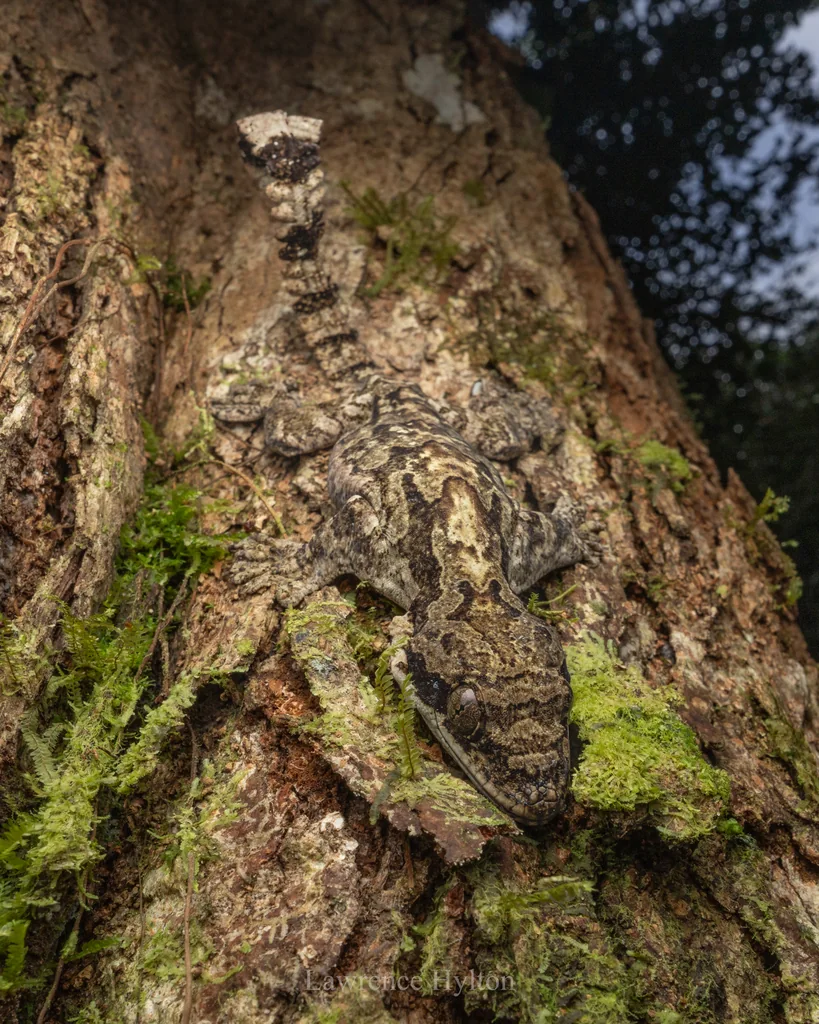
Formerly named Ptychozoon kuhli, this gecko has skin folds and webbed toes associated with gliding locomotion. Above all, it remains a secretive arboreal animal to observe without provoking a jump [1][2].
Origin
South-East Asia, particularly the Malay Peninsula and several Sunda Islands; The Reptile Database notes a possible species complex that remains to be clarified [1].
- Arboreal
- Nocturnal
- Camouflage
At a glance
Formerly Ptychozoon kuhli, this arboreal gecko has skin expansions associated with gliding movement [1][2][4].
| ADULT SIZE | ≈ 22 cm Total; approximately 11 cm snout to vent [2]. |
|---|---|
| ACTIVITY | Nocturnal Daytime rest pressed against trunks [2]. |
| DIET | Insectivorous Prey in the captive account [3]. |
Adult size
Approximately 22 cm total length and 11 cm from snout to vent in Ecology Asia’s natural history presentation [2].
Lifespan
Daniel Martindale reports captive-born animals close to ten years old, without a detailed register; this account does not give a population average [3].
Lifestyle
Nocturnal and arboreal; may remain visible, pressed against a trunk, during the day [2].
Housing
ARRANGING ITS HABITAT
Branches and bark — Tall enclosure and plant cover; opaque resting supports [3].
A tall setup offering bark, branches and plant cover; the decor must allow resting on opaque supports [3].
Care parameters
CAPTIVE CLIMATE
Not established — The account consulted poorly distinguishes air and surface [3].
Humidity
70–85 % — A 2009 practice; no validation for every lineage [3].
Temperature
To define with the setup The older account does not distinguish air and surface clearly enough to provide a single instruction.
Humidity
70–85 % [3] A 2009 husbandry reference point, without validation for every lineage in the complex.
Feeding
FEEDING AND MONITORING
Suitable varied prey; do not turn occasional fruit-based offerings into the dietary base [3].
Ptychozoon and Gekko: retain the connection
The move to the genus Gekko does not create a second species; Ptychozoon kuhli remains a useful historical name for finding studies [1]. However, the possible existence of cryptic lineages calls for caution over provenance. An old photograph labelled kuhli does not resolve every taxonomic question. Keeping the country, documented locality and name used at transfer allows a later correction to be followed without inventing an origin.
Adult size, lifespan and lifestyle
Approximately 22 cm total length and 11 cm from snout to vent in Ecology Asia’s natural history presentation [2].
Daniel Martindale reports captive-born animals close to ten years old, without a detailed register; this account does not give a population average [3].
Nocturnal and arboreal; may remain visible, pressed against a trunk, during the day [2].
Camouflage and resting supports
Ecology Asia describes individuals that are difficult to spot on trunks, including in secondary forests and near buildings bordering suitable habitat [2]. Cork and opaque surfaces can therefore offer resting areas suited to this posture, as inferred from the habitat used. Avoid trying to make the animal constantly visible. Monitoring must remain possible, but decor open on every side does not provide the same retreat as a combination of branches and foliage.
Gliding: an adaptation, not an exercise
Heinicke and colleagues place gliding geckos within the history of Asian forests. Their study discusses possible evolutionary links with forest structure; it is not a husbandry manual [4]. Inferring a drop height to reproduce would be unjustified. In a terrarium, the priority remains stable supports and routes without traps. The name flying gecko authorises neither throwing, drop tests nor prompting intended to obtain a spectacular video.
Climate and quality of captive information
Martindale’s account provides a humidity range but uses temperatures whose measurement location is insufficiently clear [3]. Attribution is therefore retained and no universal thermal setting is displayed. Before arrival, obtaining the measurements actually used for the lineage and having the setup checked allows work within a concrete context. Volume, ventilation, support height and room conditions change the results. Identical lamp wattage does not equal identical exposure.
Feeding: observe what is eaten
Martindale feeds his animals several insects and reports individual preferences; fruit-based foods remain occasional in his account [3]. This observation does not demonstrate that a crested-gecko preparation can become the sole food. Organising a visible feeding point close to a support facilitates checking captures. Prey must be properly raised and prepared, and supplements considered alongside lighting. A list of accepted insects does not replace assessment of the complete ration.
Precautions on arrival
Skin folds require careful observation during an examination, without pulling or pinching the skin. The older guide reports difficulties in some imported animals, but its home treatments are not reproduced [3]. A visible abnormality needs competent identification rather than a product chosen from a photograph. Preparing a transfer container and a setup that is easy to inspect allows the animal to be monitored without repeated chasing. Claimed captive provenance must be documented; it does not remove the need for initial observation.
Adhesive clutches and planning ahead
Martindale describes clutches of two eggs attached to supports and highlights a crushing risk near the lid [3]. Visually checking the opening before moving a piece of decor therefore becomes important. Eggs must not be forcibly detached. A breeding project must plan supports, monitoring and juvenile housing. Durations reported in an account cannot alone be used to announce a hatching date or diagnose a failing egg.
Monitoring that respects uncertainties
Position on trunks, emergence and meals are more useful observations than continually seeking spectacular behaviour. Photographing visible characteristics under neutral light facilitates future identity checks. Natural data, evolutionary studies and a keeper’s experience answer different questions; they do not add up to a certified protocol. The profile therefore leaves some values unestablished and calls for individual preparation, particularly when lineage and provenance remain unknown.
Checklist
- Keep the scientific name and documented origin.
- Check access to shelters, water and food.
- Measure the gradient before placing the animal in the setup.
Observations to record
- Meals
- Weight
- Sheds
- Temperature
- Humidity
- Behaviour
The app provides individual animal records. Check which features are available for your animal in the released version.
Related guides
Original guides in French
Sources
Document-based overview; not a substitute for veterinary advice.
- The Reptile Database — Gekko kuhli
Source accessed - Nick Baker, Ecology Asia — Kuhl’s Gliding Gecko
Source accessed - Daniel Martindale 2009 — Flying Geckos: Care and Breeding
Source accessed - Heinicke et al. 2012 — Evolution of gliding in Southeast Asian geckos
Source accessed