
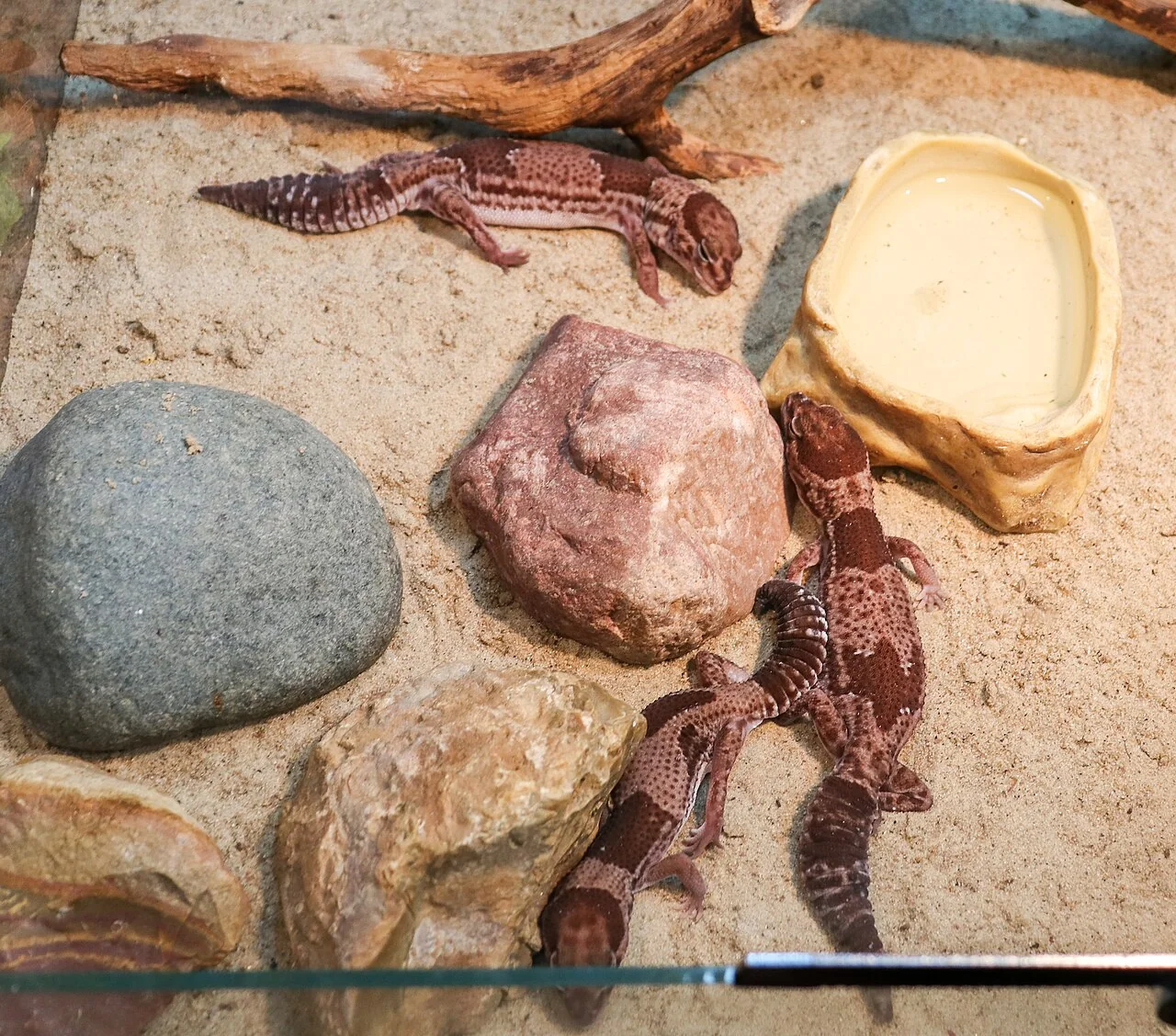
Scientific name
Hemitheconyx caudicinctus
Hemitheconyx caudicinctus is distinct from the leopard gecko. Its parameters come from guides that name it explicitly; they are not automatically copied from Eublepharis macularius. [1][3]
Origin
West Africa: ADW places its range from Senegal to northern Cameroon, in savannas and rocky woodland where it shelters during the day. [2]
- Terrestrial
- Nocturnal
- Insectivorous
- Individual housing
At a glance
West Africa, from Senegal to northern Cameroon. Nocturnal and terrestrial, it shelters on the ground during the day. [2]
| ADULT SIZE | 18–23 cm Total length [1]. |
|---|---|
| LIFESPAN | 10–20 years In captivity [2]. |
| LIFESTYLE | Ground-dwelling Mainly nocturnal [2]. |
Adult size
18–23 cm in total length, converted from the published 7–9 inches. [1]
Adult weight
No consolidated adult range: ADW’s text and table differ. No target weight is inferred from them. [2]
Lifespan
10–20 years in captivity in the Tree of Life and ADW guides. [1][2]
Lifestyle
Nocturnal and terrestrial; it uses shelters on the ground. Its movable eyelids and lack of adhesive pads distinguish it from many arboreal geckos. [2]
Beginner with guidance
Editorial assessment: an accessible project with guidance and prey preparation. Its discreet behaviour means consumption and shelter use need to be checked individually. [1]
Housing
SHELTERS AT GROUND LEVEL
91 × 46 × 46 cm — Linville minimum; length × depth × height [3].
Robert L. Linville, DVM, suggests a minimum of 91 × 46 × 46 cm for an adult, length × depth × height, rounded conversion of 36 × 18 × 18 inches. [3]
Care parameters
WARM GROUND · DAY
31–33 °C — Substrate temperature [1].
COOL SIDE · DAY
24–27 °C — Veterinary reference [1].
Humidity
50–70 % — With a humid hide and a drier area [1].
Day
Warm ground 31–33 °C; cool side 24–27 °C [1] Substrate measurement.
Night
21–24 °C [1] Night-time measurement.
Lighting
10–12 h per day; low-level UVB [1] UVI not specified; exposure needs calibration.
Humidity
50–70 % and a humid hide [1] Drier area and available water.
Feeding
AN APPROPRIATE DIET
Varied insects, fed before being offered; monitor consumption [1].
Creating protective ground cover
Linville describes warm, cool and humid hides, cork and leaves on the ground. These elements allow movement under cover. [3] Check the enclosure plan to ensure probes and the dish do not block entrances.
Tree of Life describes a suitable mixture of soil, sand and coconut fibre; paper is suitable for juveniles or health observation. Exclude calcium sand and constantly waterlogged ground. [1]
Feeding each life stage
Insects daily for juveniles, three to four times a week for adults; feed the prey 24–48 hours beforehand. Coordinate supplements and UVB with the veterinarian. [1]
Recording what remains after each feeding distinguishes a refused meal from an excessive portion. Keep the prey type and size, and product changes, in the log; this organisation helps explain appetite changes without imposing a universal insect count.
Respecting its rhythm
ADW describes a species that hides by day and hunts at night. Its tail serves as a reserve and can be shed in defence; never grasp it. Males defend their territory. Individual housing makes monitoring without competition easier. [2][3]
Reproduction: knowledge and limits
The species lays eggs. ADW reports small clutches and egg development dependent on conditions; the young become independent and adults can pose a threat to them. This biological information does not define an incubation temperature to use at home. [2]
No breeding age or weight threshold is validated in this profile. Prepare separate spaces and monitoring of the female before any project; do not induce a cycle through cooling on the basis of this summary.
Monitoring and warning signs
Food refusal associated with weight loss, weakness or retained shed warrants a consultation. [1] Linville’s guide recommends keeping individual records of weight, appetite, droppings, sheds and reproductive events. [3]
Each day, check water, probes, shelter condition and the animal’s appearance without unnecessarily disturbing it. Photographing an abnormality and dating its onset makes comparison easier; the log describes observations and does not replace a veterinary examination.
Checklist
Observations to record
- Meals and remaining prey
- Weight
- Sheds and toes
- Droppings
- Ground humidity and temperature
The app provides individual animal records. Check which features are available for your animal in the released version.
Related guides
Original guides in French
Sources
Document-based overview; not a substitute for veterinary advice.
- Tree of Life Exotic Pet Medical Center — African Fat-Tailed Gecko Care
Source accessed - University of Michigan, Animal Diversity Web — Hemitheconyx caudicinctus
Source accessed - Robert L. Linville, DVM — Gecko Care
Source accessed