
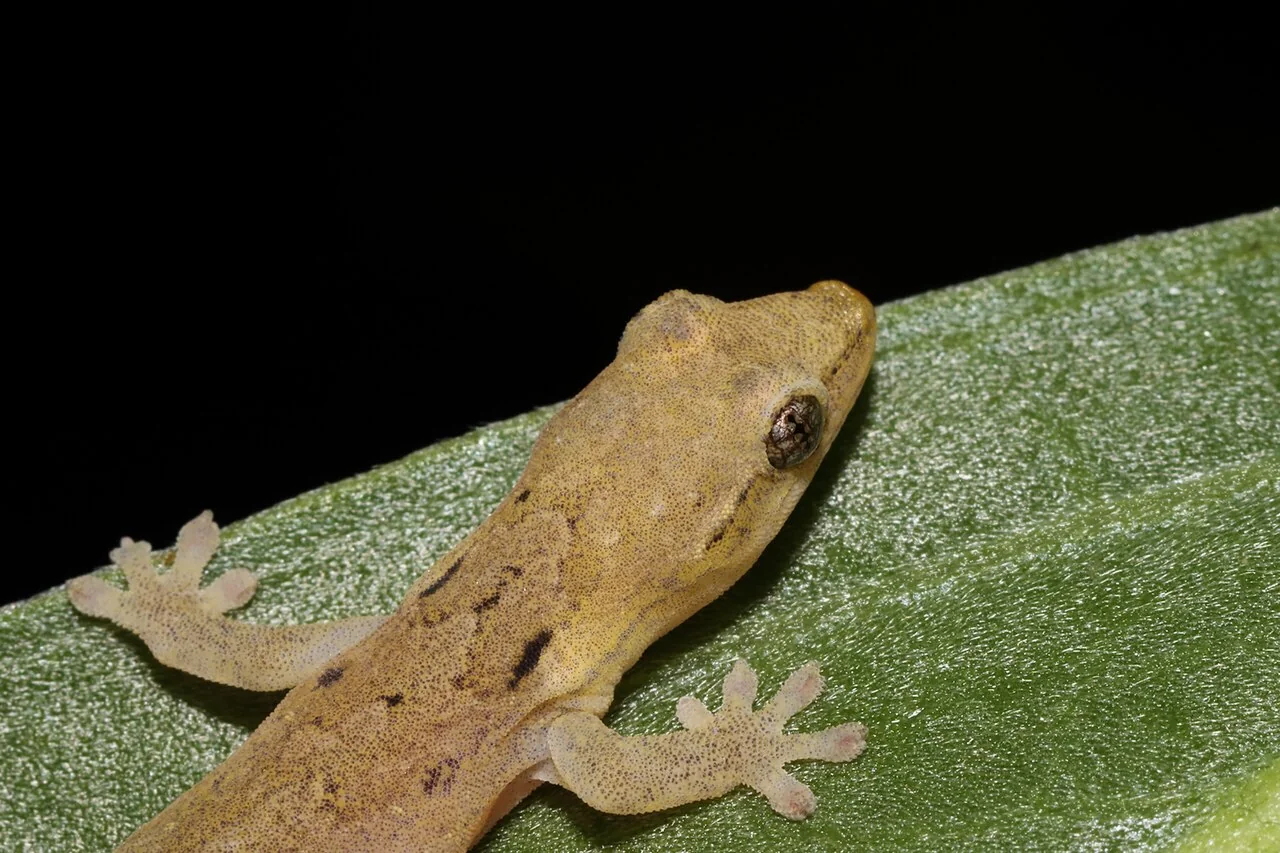
Scientific name
Lepidodactylus lugubris
This species includes parthenogenetic lineages: females can produce offspring without mating [2].
Origin
Indo-Pacific; numerous introduced populations [2].
- Small gecko
- Nocturnal
- Parthenogenetic
At a glance
| BODY SIZE | 4–4,4 cm Snout–vent; tail excluded [1]. |
|---|---|
| LIFESPAN | Not established No reliable reference in the sources consulted. |
| LIFESTYLE | Nocturnal Occasional daytime outings [1]. |
Adult size
Around 4–4,4 cm from snout to vent, without the tail [1].
Lifespan
Captive lifespan is not established by the two selected sources.
Lifestyle
Nocturnal, with some daytime outings [1].
Housing
AN ESCAPE-PROOF HABITAT
Slender supports and shelters — No minimum for home husbandry established by the experimental containers [1].
Supports and shelters, with close-fitting closures. Experimental containers do not establish a minimum for home husbandry [1].
Care parameters
TEMPERATURE · STUDY
24–28 °C — Laboratory enclosure, not a heating surface [1].
THERMAL GRADIENT
Cooler retreat — Non-uniform heating [1].
Humidity
To be documented — Two contradictory ranges in the article; no single instruction adopted [1].
Temperature · study
24–28 °C [1] Laboratory enclosure range, not a heating surface.
Thermal gradient
Cooler retreat [1] Avoid heating the entire space.
Humidity
To be documented The same article gives 50–80 %, then 30–40 %: this discrepancy does not allow a single instruction [1].
Night — NEHERP experience
NEHERP describes around 18–24 °C at night (65–75 °F). [3] Scope: captivity; NEHERP commercial experience. A reported limit is not a target or an established physiological threshold.
Feeding
AN APPROPRIATE DIET
Small insects and formulated food for fruit-eating geckos [1].
Feeding
The study alternates small insects with formulated food for fruit-eating geckos; prepared leftovers are removed the following day [1].
Behaviour and precautions
Reproduction without a male means births must be anticipated [2]. Identify individuals and monitor each one’s access to meals.
Daily monitoring
Keep a count of adults, eggs and juveniles. Link each weighing to an identification photo. Record laying locations and group changes to retain a useful history even as the colony grows.
Glued eggs and juvenile safety
Eggs are glued to the support when laid. NEHERP advises against detaching them because they may break; a removable laying support allows the whole assembly to be moved. Record laying without requiring every egg to be removed. [3]
Very young geckos can pass through small openings, particularly cable holes. Check these access points before their arrival. The breeder also advises against grouping individuals of very different sizes. [3]
Offering small, accessible amounts
For juveniles, a small shallow dish limits contact between the prepared food and toes or skin. Offer a few small prey items at a time and observe consumption. [3]
Checklist
- Inspect every small opening.
- Plan for births.
- Document humidity before arrival.
Observations to record
- Meals
- Weight
- Sheds
- Temperature
- Humidity
The app provides individual animal records. Check which features are available for your animal in the released version.
Related guides
Original guides in French
Sources
Document-based overview; not a substitute for veterinary advice.
- Griffing et al., Herpetological Review 49(2), 2018 — Protocols for Husbandry and Embryo Collection
Source accessed - The Reptile Database — Lepidodactylus lugubris
Source accessed - Mourning Gecko Care Sheet
Source accessed