
Scientific name
Lygodactylus williamsi
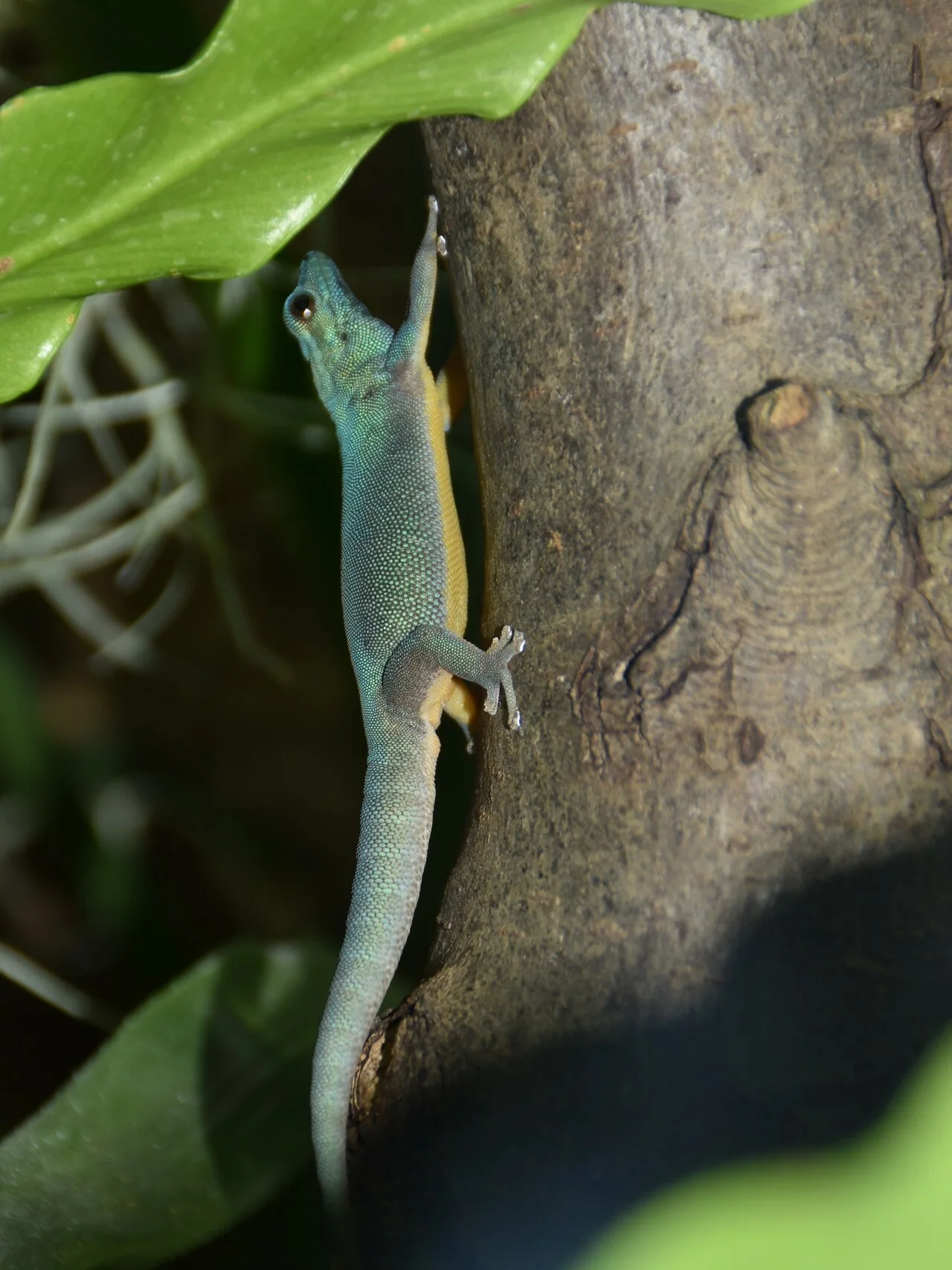
Adult males are often turquoise. In the wild, this species depends closely on the pandanus Pandanus rabaiensis [2].
Origin
Tanzania, Kimboza Forest and nearby areas [2].
- Small gecko
- Arboreal
- Tanzania
At a glance
| ADULT SIZE | Up to 8,5 cm Males, including the tail; females smaller [2]. |
|---|---|
| LIFESPAN | Not established No lifespan figure in the selected references. |
| LIFESTYLE | In pandanus plants Very close natural association [2]. |
Adult size
Males up to 8,5 cm in total length; females smaller [2].
Lifespan
Lifespan not quantified by the two selected sources.
Lifestyle
Arboreal, associated with pandanus plants [2].
Housing
VEGETATION AND LIGHT
46 × 46 × 61 cm — Veterinarian’s minimum for a pair, with vegetation. Dimensions L × W × H [1].
Alec Brown, DVM, describes at least 46 × 46 × 61 cm (L × W × H) for a pair, densely planted [1].
Care parameters
HEATING ZONE
32–38 °C — [1] Veterinary breeding reference; air/surface not distinguished.
REST OF THE ENCLOSURE
21–27 °C — [1] Maintain a gradient with access to shade.
Humidity
Wet then dry cycle — Spray according to measurements; furnishings must be able to dry during the day and remain ventilated [1].
Heating zone
32–38 °C [1] Veterinary breeding reference; air/surface not distinguished.
Rest of the enclosure
21–27 °C [1] Maintain a gradient with access to shade.
Humidity
Wet then dry cycle Spray according to measurements; furnishings must be able to dry during the day and remain ventilated [1].
Feeding
AN APPROPRIATE DIET
Formulated food for fruit-eating geckos and varied small insects [1].
Feeding
The veterinarian uses formulated food for fruit-eating geckos and varied small insects, including fruit flies and micro crickets [1].
Behaviour and precautions
Never house two males together [1].
At Frankfurt Zoo, young animals are separated after hatching [2]. Plan their housing before any breeding.
Daily monitoring
Record meals, eggs and spraying times. Photograph individuals to track growth. Keep provenance documents in the file; they accompany the animal and cannot be reduced to its colour.
Checklist
- Close cable openings.
- Provide shelters near the perches.
- Keep provenance documents.
Observations to record
- Meals
- Weight
- Sheds
- Temperature
- Humidity
The app provides individual animal records. Check which features are available for your animal in the released version.
Related guides
Original guides in French
Sources
Document-based overview; not a substitute for veterinary advice.
- Alec Brown, DVM — Lygodactylus williamsi
Source accessed - Zoo Frankfurt — Turquoise dwarf gecko
Source accessed