
Scientific name
Eurydactylodes agricolae
A small arboreal gecko from New Caledonia, Eurydactylodes agricolae often remains among twigs. Its inconspicuousness relies on camouflage, not on an exclusively hidden life [2].
Origin
North-western Grande Terre and nearby islands, including Yandé and Bélep; populations occupy several vegetation types, from maquis to forests [1][2].
- Arboreal
- Small size
- New Caledonia
At a glance
A small arboreal gecko from New Caledonia; Endemia reports daytime activity that captive guides do not always describe in the same way [2][3][4].
| ADULT SIZE | ≤ 5,5 cm Snout to vent; tail excluded, according to Endemia [2]. |
|---|---|
| ACTIVITY | Arboreal Daytime activity reported in the field [2]. |
| DIET | Omnivorous Small prey and suitable fruit-based preparation [3][4]. |
Adult size
Up to 55 mm from snout to vent according to Endemia; this measurement excludes the tail entirely [2].
Lifespan
No specifically documented average or maximum lifespan has been established in the sources retained.
Lifestyle
Arboreal; daytime activity reported in the field, whereas captive guides place more emphasis on night-time activity [2][3].
Housing
ARRANGING ITS HABITAT
≈ 30 × 30 × 46 cm — Keepers’ reference point for the species explicitly covered; thin branches [3][4].
Pangea and 402 Exotics propose approximately 30 × 30 × 46 cm, with thin branches; keepers’ reference point explicitly covering E. agricolae and E. vieillardi [3][4].
Care parameters
DAYTIME AMBIENT CONDITIONS
21–24 °C — Reference point from the two husbandry sources [3][4].
Humidity
Wet–dry alternation — Misting followed by surface drying; no validated percentage [4].
Daytime ambient temperature
21–24 °C [3][4] Rounded conversion of the 70–75 °F proposed by the keepers.
Humidity
Wet–dry alternation [4] Accessible droplets, followed by drying of exposed surfaces; no validated percentage.
Feeding
FEEDING AND MONITORING
Small prey and a suitable preparation; serve small quantities that allow intake to be monitored [3][4].
Identify without confusing species
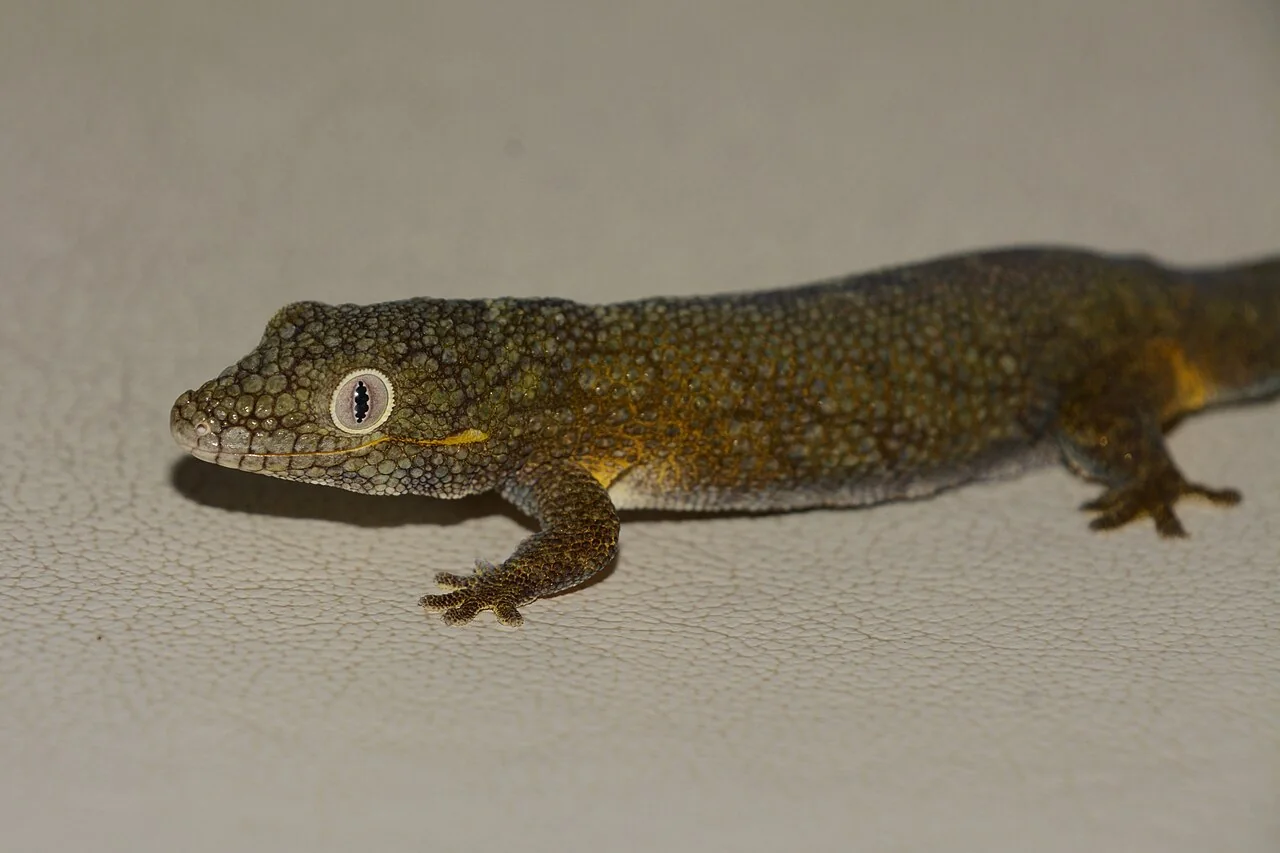
The pale stripe between the mouth and ear helps distinguish agricolae from vieillardi; trade names alone remain insufficient [2][3]. The taxonomic database recognises agricolae as a distinct species, described in 2001 [1]. Keeping a side-view photograph with the previous keeper’s designation is particularly useful: a later identification correction must be traceable to the same individual, without erasing its history or automatically assigning its descendants to another strain.
Adult size, lifespan and lifestyle
Up to 55 mm from snout to vent according to Endemia; this measurement excludes the tail entirely [2].
No specifically documented average or maximum lifespan has been established in the sources retained.
Arboreal; daytime activity reported in the field, whereas captive guides place more emphasis on night-time activity [2][3].
Making a small enclosure actually usable
Thin supports are central to the setup described by Matt Parks: they allow a complete grip with the toes and tail [3]. Sketching several continuous routes before fixing the decor avoids large empty stretches. Twig diameter matters as much as twig number. Providing access to every container from a branch and leaving room to clean without uprooting plants is a practical design choice, not a measurement taken from the natural environment.
Climate: understanding the differences
Pangea also proposes localised heating at 27–29 °C, whereas 402 Exotics emphasises avoiding sustained heat above approximately 27 °C [3][4]. These experiences do not justify heating the terrarium uniformly. The decision therefore depends on the gradient actually achieved, the room and shelter locations. Measuring the most exposed twig after several hours of lighting can detect heat accumulation that the room’s morning temperature does not reveal.
Hydration and light
The keeper 402 Exotics uses misting to allow drinking and maintains a shallow dish; it recommends a light cycle with shaded areas [4]. The gecko’s small size requires looking at access, not simply the presence of this equipment. A leaf may retain droplets while a neighbouring support is already drying. This contrast can be observed directly. No numerical UV index specific to this species is sufficiently documented here to state a target value.
Foods and monitoring intake
The two breeding setups consulted combine a complete preparation for omnivorous geckos with very small prey; Pangea specifically lists fruit flies and young crickets [3][4]. A tiny portion makes signs of consumption easier to read. To compare two presentations, keep the same location and record the prepared texture. Supplements must be considered alongside the complete food’s composition and lighting: adding different powders without knowing their contribution does not automatically improve the menu.
Observing living camouflage
Endemia describes animals remaining on twigs and in foliage while resting, with at least partly daytime activity [2]. Not seeing movement at a particular time therefore does not justify concluding that the animal is lethargic. Observing at several times without touching the branch provides more relevant information. Doors and cable openings deserve careful checking: the animal’s slenderness makes it misleading to assume that a terrarium intended for a larger gecko is sufficiently closed [4].
Breeding: what is established
The species is oviparous [1]. The sources retained do not allow a numerical laying and incubation timetable specific to a documented population to be proposed. This profile therefore does not turn durations published for the genus into a promise of results. A breeding project must provide separate setups for monitoring juveniles, parent identification and the possibility of removing a partner. Simple coexistence observed in a photograph does not demonstrate lasting compatibility.
Monitoring a species with scattered data
Weight measurements must be interpreted in light of the scale’s actual precision, essential for such a small animal. A photograph taken under the same conditions helps document body shape without imposing repeated handling. Endemia notes the possible effects of fires, mining and introduced species on habitats [2]. Traceability of a captive strain provides different information: it documents the animal kept, but replaces neither a population study nor conservation action.
Checklist
- Check the animal’s identity and retain its provenance.
- Install and measure the refuges before arrival.
- Plan individual monitoring of meals, sheds and movement.
Observations to record
- Meals
- Weight
- Sheds
- Temperature
- Humidity
- Behaviour
The app provides individual animal records. Check which features are available for your animal in the released version.
Related guides
Original guides in French
Sources
Document-based overview; not a substitute for veterinary advice.
- The Reptile Database — Eurydactylodes agricolae
Source accessed - Endemia — Eurydactylodes agricolae
Source accessed - Matt Parks, Pangea — Eurydactylodes Care & Information
Source accessed - 402 Exotics — Eurydactylodes care guide
Source accessed