
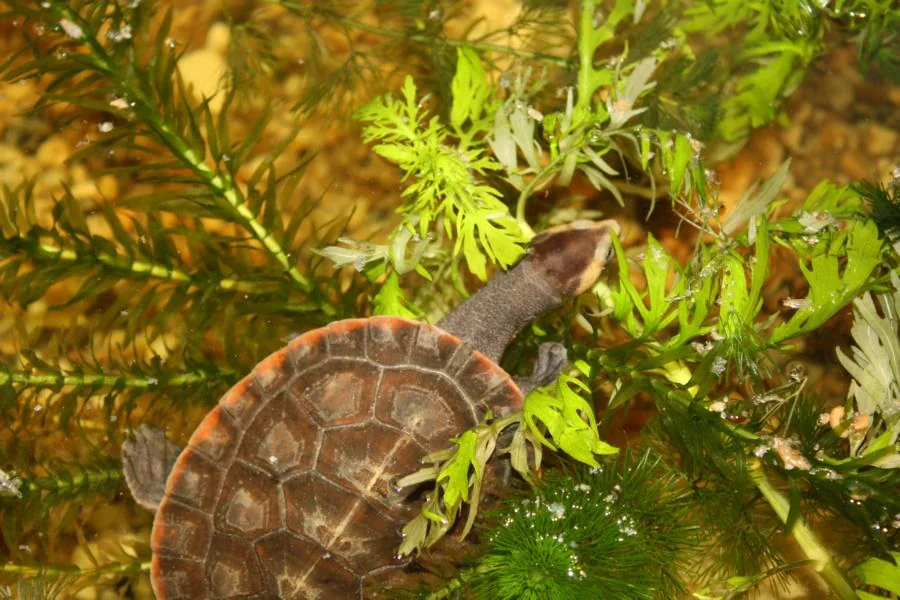
Scientific name
Emydura subglobosa
Emydura subglobosa is a pleurodiran turtle: it folds its neck sideways. [1][2] Its colourful underside attracts attention, but its main space requirement is that of an adult swimmer. This profile concerns the identified species, without treating all Australian short-necked turtles as requiring a single protocol.
Origin
Southern New Guinea and northern Australia; The Reptile Database currently distinguishes the subspecies subglobosa and worrelli and notes that their boundaries remain disputed. [1]
- Side-necked turtle
- Aquatic
- Large aquarium
Documentary overview: identity checked; natural observations and captive practices attributed separately. Undocumented limits remain explicit.
At a glance
| SIZE | Up to ≈25,5 cm Carapace, female [2]. |
|---|---|
| LIFESPAN | Not quantified No species-specific record retained. |
| LIFESTYLE | Strong swimmer Water and dry basking [2]. |
Adult size
ADW gives carapace lengths of 13,3–17,3 cm for males and 15,2–25,5 cm for females; these are descriptive ranges, not guaranteed sizes. [2]
Lifespan
No firmly documented species-specific lifespan is retained here: ADW's family-level extrapolations are not presented as a record for this species.
Lifestyle
Aquatic, swimming and foraging in water, with basking out of the water. [2]
Housing
SUGGESTED FOOTPRINT
150 × 60 cm — Specialist target for a large adult [3].
Herpeton suggests a footprint of 150 × 60 cm as a target for a large adult; Austin recommends at least 75 US gallons, approximately 284 litres. These are specialist recommendations, not a shared standard. [3][4]
Care parameters
WATER
24–28 °C — Herpeton; sources differ [3][4].
PLATFORM
32–35 °C — Herpeton [3].
Humidity
Accessible dry area — Filtered water and a fully emerged platform [3][4].
Water
24–28 °C according to Herpeton [3] Austin gives cooler guidelines: keep the source of the recommendation visible, then adapt it with a professional [4].
Dry basking area
32–35 °C according to Herpeton [3] Surface measurement separate from the water measurement.
Feeding
AQUATIC DIET
Formulated food and varied animal resources, with individual assessment [4].
Origin and variation
The current reference retains worrelli as a subspecies and treats angkibaanya as a synonym of the nominate form. [1] Older labels should remain in the history rather than being deleted without explanation. A commercial locality or a pink tint is not enough to determine the subspecies. Uncertain identification should be flagged before comparing growth data or considering breeding.
Adult size, lifespan and lifestyle
ADW gives carapace lengths of 13,3–17,3 cm for males and 15,2–25,5 cm for females; these are descriptive ranges, not guaranteed sizes. [2]
No firmly documented species-specific lifespan is retained here: ADW's family-level extrapolations are not presented as a record for this species.
Aquatic, swimming and foraging in water, with basking out of the water. [2]
Movement and tank layout
ADW describes rivers, swamps and flooded areas, with much of life spent in water. [2] Providing useful swimming length matters as much as the stated volume. Assess the tank against adult carapace size: turns, side passages and the route to the surface must remain clear. A neck folded sideways makes narrow gaps between furnishings and the tank wall particularly undesirable.
Filtration and maintenance access
Herpeton recommends established biological filtration and monitoring ammonia and nitrites. [3] The filter layout should allow waste removal without overturning every hide at each intervention. To assess an improvement, compare results before and after cleaning using the same test. Visually clear water and a noisy pump are not two pieces of evidence that biological filtration is working well.
A genuinely dry exit
Austin stresses a heated platform and UVB for this basking turtle. [4] Check that the whole body fits out of the water without the support sinking. An animal may reach the ramp yet never manage to dry completely. Observation from a distance reveals this difference, allowing the support's shape to be adjusted instead of automatically increasing heating power.
Aquatic feeding
Austin lists fish, invertebrates and formulated foods from his captive experience. [4] Variety across categories does not make all combinations nutritionally equivalent. Define an identifiable dietary base with a professional, then record the quantities actually consumed. Food waste must be removable: a decorative cavity that accumulates leftovers complicates both meal monitoring and water management.
Reproduction without generalisation
Egg-laying is confirmed by the reference. [1] ADW describes females leaving the water to lay eggs, but several other paragraphs in its account concern Emydura or Chelidae more broadly. [2] Maturity ages and very long lifespans for these groups are therefore not automatically applied here. A breeding project requires, among other things, a suitable nesting site and verification of the parents' identities.
Colours and comparable observations
Austin and ADW note that juveniles' very bright colours fade with age. [4][2] Photographs under consistent lighting help distinguish changes in lighting, natural changes and recent abnormalities. This comparison complements observations of appetite, swimming and the shell; it does not replace a veterinary examination when an unusual change persists.
Cohabitation and responsibility
Specialist recommendations differ on cohabitation: Austin favours communities of certain turtles, whereas Herpeton notes possible aggression. [4][3] This profile does not turn the first opinion into a guarantee of compatibility. Have a real means of separation ready before any introduction, retain captive-origin documentation and do not collect from or release into the wild. Check local requirements before acquisition, without inferring permission from the species name alone.
Checklist
- Keep the origin label.
- Allow room for adult turns.
- Test the platform at full load.
Observations to record
- Shell
- Swimming
- Meals
- Water
The app provides individual animal records. Check which features are available for your animal in the released version.
Related guides
Original guides in French
- Emydura subglobosa : préparer l’aquarium avant l’adoption
- Aquaterrarium pour tortue aquatique : préparer un habitat fonctionnel
- Alimentation d’une tortue aquatique : identifier les besoins avant le menu
- Lampe pour terrarium : éclairage UVB, LED, chauffage et distances
- Hygiène des reptiles et amphibiens : gestes et prévention
Sources
Document-based overview; not a substitute for veterinary advice.
- The Reptile Database — Emydura subglobosa
Source accessed - Animal Diversity Web — Emydura subglobosa
Source accessed - Herpeton Academy — Emydura subglobosa
Source accessed - Austin’s Turtle Page — Red-Bellied Shortneck
Source accessed