
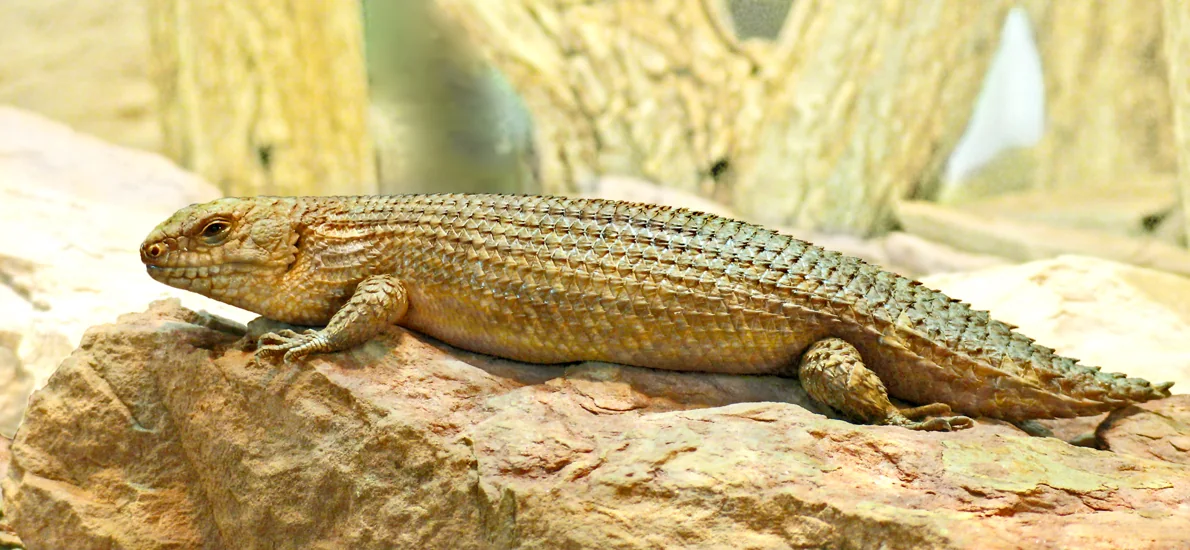
Scientific name
Egernia stokesii
Other names: Silubosaurus stokesii
This Australian skink uses its spiny tail when wedging itself into a crevice. Its group living is real, as are the aggressive interactions observed in captivity [2][3].
Origin
Australia: mainland and island populations distributed across several states; RDB distinguishes stokesii, badia and zellingi [1].
- Terrestrial
- Social
- Omnivorous
At a glance
An Australian spiny-tailed skink; a captive study shows why group living requires individual monitoring [1][2][3].
| ADULT SIZE | ≤ 19,4 cm · badia Snout to vent; maximum specific to this subspecies [1]. |
|---|---|
| ACTIVITY | Social life Competition and aggression observed [3]. |
| DIET | Omnivorous Plants and invertebrates [2][3]. |
Adult size
RDB gives up to 19,4 cm snout–vent length for badia; maxima differ between subspecies and exclude the tail [1].
Lifespan
AnAge compiles a captive maximum of 18,2 years; this record is neither an average nor a biological limit [4].
Lifestyle
Uses rock crevices and hollow wood; documented social life, with possible competition for resources [2][3].
Housing
ARRANGING ITS HABITAT
Crevices and hollow wood — Inspectable shelters, stable supports and individual access to resources [2][3].
Crevice-like shelters, securely installed supports and resources accessible to each individual; the social structure requires actual monitoring [2][3].
Care parameters
BASKING · ZSL STUDY
35 °C — Study condition, not a demonstrated optimum [3].
NIGHT · ZSL STUDY
22–25 °C — Context of the seven juveniles monitored [3].
Humidity
Not quantified — The protocol describes misting without a percentage target [3].
Basking zone studied
35 °C [3] A condition of the London Zoo study, without validation of a universal optimum.
Night in the study
22–25 °C [3] Values published for the seven juveniles monitored.
Humidity
Not quantified The protocol describes misting without a target percentage [3].
Feeding
FEEDING AND MONITORING
Omnivorous menu; observe each individual’s access, because prey can intensify competition [2][3].
Recognising the limits of a label
The former name Silubosaurus stokesii appears in the synonymy. The name aethiops also appears in the history, but not among the three subspecies retained at the top of the current database [1]. Keeping an old designation in the archives can be useful, provided it is not presented as a fourth accepted taxon. To compare size, also record the population and method: body length is not length including the tail.
Adult size, lifespan and lifestyle
RDB gives up to 19,4 cm snout–vent length for badia; maxima differ between subspecies and exclude the tail [1].
AnAge compiles a captive maximum of 18,2 years; this record is neither an average nor a biological limit [4].
Uses rock crevices and hollow wood; documented social life, with possible competition for resources [2][3].
Arranging crevices without creating traps
Belfast Zoo describes use of hollows in wood and spaces between rocks, where the lizard can inflate itself to resist extraction [2]. This strategy makes shelter access particularly important during a necessary check. Building shelters that can be opened and are securely fixed avoids having to pull out a wedged animal. Several access points and visual screens also allow resting choices to be observed without dismantling all the decor on every search.
What a research setup shows
Baines and colleagues studied seven juveniles at London Zoo, in their usual setup, to analyse social interactions [3]. The thermal values given here describe that context; the experiment did not compare several temperatures to determine an optimum. Reproducing only the number displayed on a thermostat would therefore not reproduce their environment. A useful record combines the zones actually available, times of use and each individual’s access to exposed supports.
Humidity, light and accessibility
The study used UVB lighting with shaded areas, a water dish and regular misting, without providing a humidity target [3]. Converting this frequency into a humidity percentage would be misleading. In practice, recording where substrate remains moist and which shelters are used helps describe how the decor functions. Inspection must include small cavities: suitable ambient conditions in the centre do not prove that every corner offers the same conditions.
Omnivorous ration and food competition
Belfast Zoo describes a diet combining plants and small invertebrates [2]. In the London experiment, crickets prompted more aggression than the plant foods offered [3]. This explains why group feeding warrants individual observation. Preparing several serving points and checking who eats distinguishes food refusal from blocked access. Preference for a prey item does not demonstrate that it constitutes a complete ration; balance of the menu remains a separate question.
Social life: observe the effects on each individual
The heaviest animals in the study generally occupied dominant positions; biting and chasing were among the behaviours recorded [3]. The word “social” therefore does not mean absence of conflict. To monitor a group, identify each individual and record forced movements, exclusion from shelters or missed meals. Planning functional separation before any incident is a practical consequence of these observations, not a guarantee that every combination will succeed.
Breeding and juveniles: know what is missing
Viviparity is confirmed in the taxonomic database [1]. The juveniles monitored in London came from the same breeding group, documenting a precise captive context [3]. Their study does not provide a complete gestation protocol or breeding timetable applicable to every setup. Before a breeding project, this information therefore needs supplementing with lineage data and experienced monitoring. No incubation of external eggs needs to be planned for this species.
Measuring a trend, not just a group
The AnAge captive maximum is a historical reference point, with data quality rated acceptable by the database [4]. It does not establish the age of an animal acquired as an adult. Individual photographic and weight monitoring remains valuable even when all lizards seem to eat. If one individual declines while the group remains active, examining its access to resources and requesting clinical assessment avoids automatically attributing the problem to its secretive temperament.
Checklist
- Identify the animal and retain its provenance.
- Check measurements and refuges before arrival.
- Plan individual monitoring of meals and body condition.
Observations to record
- Meals
- Weight
- Sheds
- Temperature
- Humidity
- Behaviour
The app provides individual animal records. Check which features are available for your animal in the released version.
Related guides
Original guides in French
Sources
Document-based overview; not a substitute for veterinary advice.
- The Reptile Database — Egernia stokesii
Source accessed - Belfast Zoo — Gidgee skink
Source accessed - Baines et al. (2020) — Dominance and aggression in captive gidgee skinks
Source accessed - AnAge — Egernia stokesii
Source accessed