
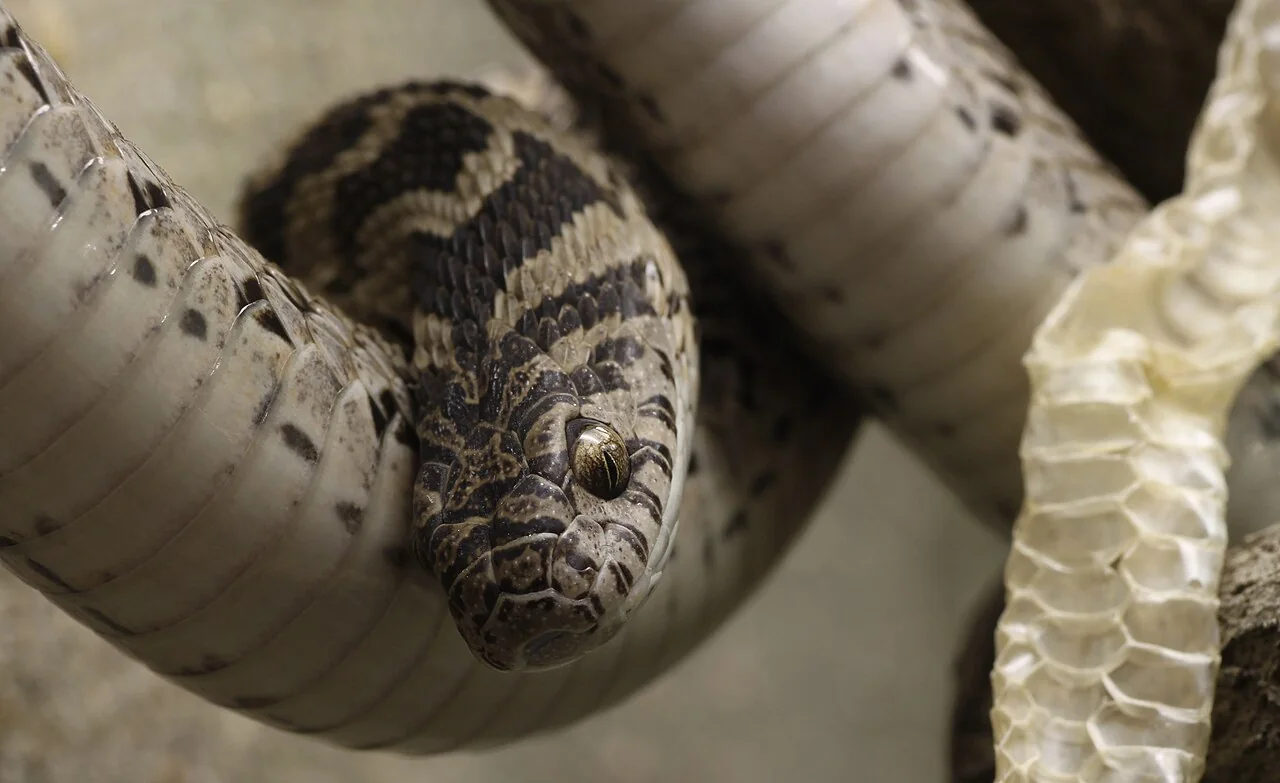
Scientific name
Dasypeltis scabra
Other names: Coluber scaber · Anodon typus · Rachiodon scaber
Dasypeltis scabra specialises in eating bird eggs. Its small head and slender body do not automatically make it easy to keep: a supply of suitable eggs must be secured before purchase. [3][4] Identity also deserves checking, because several species were long grouped under this name.
Origin
Sub-Saharan Africa, with populations particularly in South Africa and Namibia. Older maps of the complex must not be reused without examination. [1][2]
- Eggs only
- Identity to check
- Supply essential
Documentary overview: identity checked; natural observations and captive practices attributed separately. Undocumented limits remain explicit.
At a glance
| SIZE | ≈ 60–100 cm Guide; convention unspecified [4]. |
|---|---|
| LIFESPAN | Not established here No sufficiently verifiable record. |
| LIFESTYLE | Ground and branches Access to nests [3]. |
Adult size
Herpeton gives adults generally as 60–100 cm, without explaining the measurement convention; this reference point is presented neither as snout–vent measurement nor as a documented maximum. [4]
Lifespan
No verifiable series or maximum lifespan is retained here. Durations stated in husbandry guides are not equated with established records.
Lifestyle
Moves on the ground and climbs stones or trees, particularly to reach nests. [3]
Housing
SPECIALIST REFERENCE POINT
90 × 45 × 60 cm — One adult, with cover and supports [4].
Herpeton proposes at least 90 × 45 × 60 cm for an adult, with cover and climbing routes; adapt to build and behaviour. [4]
Care parameters
HEATING
30–32 °C — Herpeton [4].
COOL
22–24 °C — Herpeton [4].
Humidity
40–60 % — Specialist air reference point; localised moist refuge [4].
Heating surface
30–32 °C according to Herpeton [4] A localised value on a support, not uniform enclosure temperature.
Cool refuge
22–24 °C according to Herpeton [4] Check actual access to the refuge.
Air humidity
40–60 % according to Herpeton [4] Provide a localised moist option without saturating all the ground.
Feeding
SUITABLE EGGS
Supply to secure before purchase [4].
The name and its current boundaries
Coluber scaber, Anodon typus and Rachiodon scaber appear among the species’ former names. [1] However, an old name associated with a group is insufficient to confirm its identity today. Provenance, usable photographs and the seller’s history must be retained. Do not silently correct a label: uncertain identification must remain visible, especially before reproductive or climate data are transferred.
Adult size, lifespan and lifestyle
Herpeton gives adults generally as 60–100 cm, without explaining the measurement convention; this reference point is presented neither as snout–vent measurement nor as a documented maximum. [4]
No verifiable series or maximum lifespan is retained here. Durations stated in husbandry guides are not equated with established records.
Moves on the ground and climbs stones or trees, particularly to reach nests. [3]
Why colour alone is insufficient
Bates’s study published in 2023 compares 153 Namibian specimens and confirms the distinction between D. scabra and D. loveridgei using several characteristics, particularly patterns and head scalation. [2] The work concerns examined specimens, not commercial resemblance. A single dorsal photograph does not reproduce this examination. It must be complemented by provenance and, if uncertain, advice from someone competent in this group.
Swallow an egg, expel its shell
Skærup Zoo explains that the egg is swallowed whole and then opened internally; its contents continue through while the shell is expelled. [3] This normal mechanism must not automatically be confused with pathological meal regurgitation in another snake. Observing from a distance and describing what was expelled is more useful than handling the animal to check. Unusual or repeated expulsion must nevertheless be reported to the veterinarian.
Secure meals before acquisition
The Herpeton guide emphasises fresh, unfertilised eggs suited to the animal; small individuals may require eggs from very small birds. [4] Check regular availability, provenance and the sizes actually accepted by the snake offered. Occasional access to quail eggs does not necessarily solve juvenile feeding. Ask for evidence of recent meals and plan a lasting solution before reserving the animal.
Organising cover and height
Climbing ability is described by the zoo. [3] In the terrarium, connecting supports and retaining protected retreats helps provide a route rather than an exposed branch in empty space. Decor openings must be checked against body size. An imitation nest is useful only if it remains accessible for cleaning and creates neither a sharp edge nor a recess where broken egg could accumulate.
Measurable climate and maintenance
The displayed temperatures and humidity are attributed specialist recommendations, not an optimum measured for every provenance. [4] Check heated support, refuge and air separately; guard and thermostat-control the heating. Plan removal of a spilled egg without dismantling everything. Substrate observation complements the hygrometer: an air measurement does not reveal whether a recess remains continuously wet. Keeping access to the various shelters also facilitates shedding checks.
Breeding: also plan the feeding eggs
The species lays eggs. [1] The zoo mentions summer clutches but provides no incubation protocol usable for every provenance. [3] Captive breeding therefore requires more than pairing: juveniles must have access to appropriately sized foods, sometimes difficult to obtain. No cooling, annual output or hatching timetable is proposed here. Supply for the offspring must be organised before the breeding project.
Responding to refusal without improvising
An isolated refusal does not distinguish unsuitable food, environmental change or a health problem. Keeping the size and origin of eggs offered, actual observed intake and a comparable weight trend helps prepare a consultation. Do not turn the mouth into an access point for force-feeding at home. Ask for documented captive origin, without collection or release, and check applicable obligations before acquisition.
Checklist
- Check available eggs.
- Ask for the latest observed meals.
- Keep provenance and identity.
Observations to record
- Eggs accepted
- Weight
- Sheds
- Behaviour
The app provides individual animal records. Check which features are available for your animal in the released version.
Related guides
Original guides in French
Sources
Document-based overview; not a substitute for veterinary advice.
- The Reptile Database — Dasypeltis scabra
Source accessed - Bates (2023) — The enigmatic Namibian egg-eating snake Dasypeltis loveridgei: a valid species recovered from synonymy
Source accessed - Skærup Zoo — Æg spisende slange, Dasypeltis scabra
Source accessed - Herpeton Academy — Rhombic Egg-Eater
Source accessed