
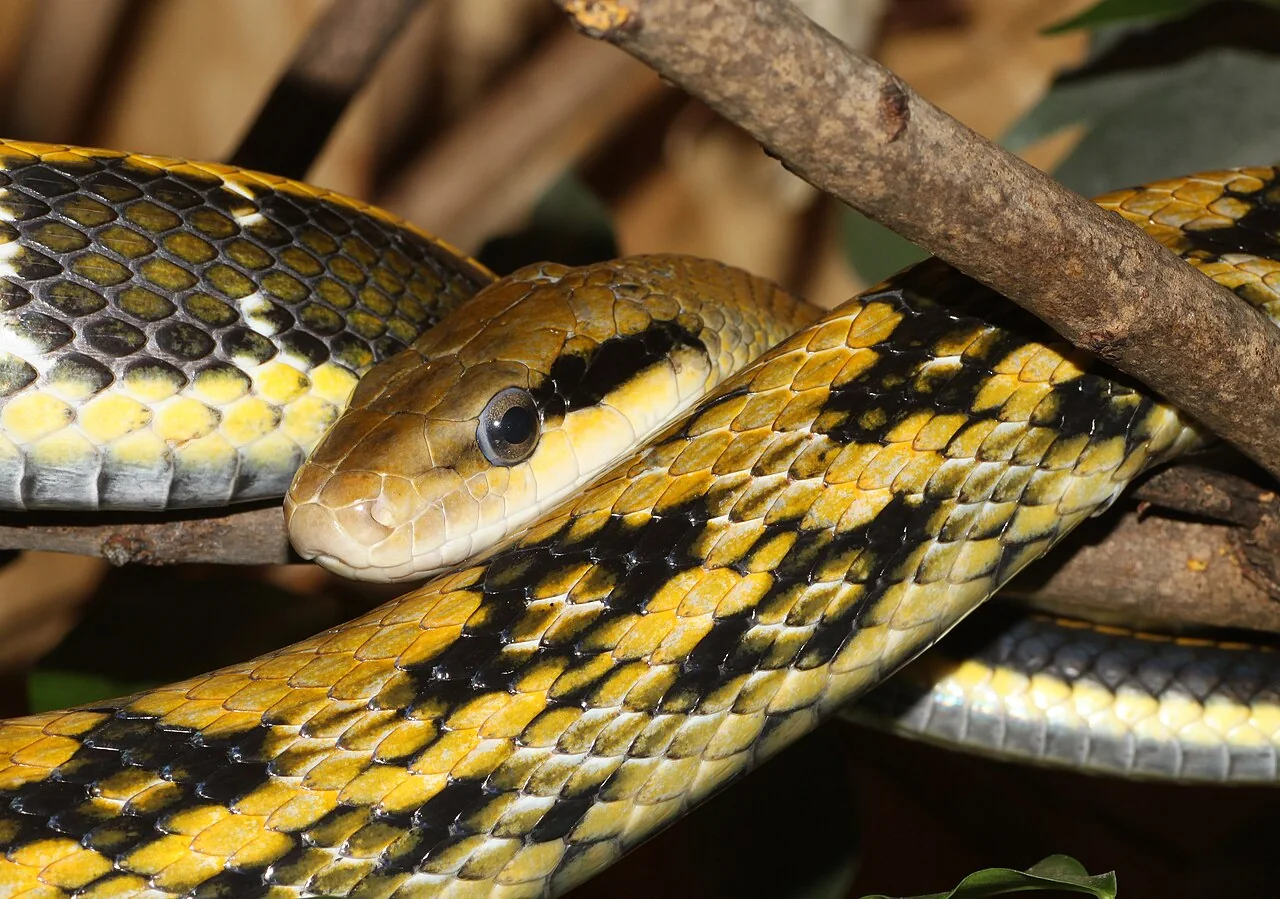
Scientific name
Elaphe taeniura
Other names: Orthriophis taeniurus · Couleuvre asiatique à queue rayée
Elaphe taeniura is the name adopted by the Reptile Database; Orthriophis taeniurus is among its synonyms. [1]
Origin
Asia, from eastern India to China and Southeast Asia. [1]
- Semi-arboreal
- Asia
- Provenance
At a glance
| ADULT SIZE | Up to 2,5 m Maximum stated by La Palmyre [2]. |
|---|---|
| LIFESPAN | 15 years Zoo indication; context and method not specified [2]. |
| LIFESTYLE | Ground and branches Partial use of trees documented [1]. |
Adult size
Up to 2,5 m according to La Palmyre Zoo; size varies between populations. [2]
Lifespan
La Palmyre states 15 years without specifying whether this is an average, a maximum or the measurement context. [2]
Lifestyle
Partly arboreal, with differences between populations. [1][3]
Housing
CLARIFY PROVENANCE
Ground, shelters and height — Branches, a bark shelter and a pool documented for E. t. taeniura. No universal enclosure volume validated here [3].
Schulz describes branches, bark and a large pool for E. t. taeniura; the dimensions of his historical setup do not constitute a universal minimum. [3]
Care parameters
DAY · OBSERVATION
25–28 °C — E. t. taeniura in captivity; air/surface not specified [3].
NIGHT · OBSERVATION
20–22 °C — Same historical account; not all populations [3].
Humidity
Not established — No adult target sufficiently documented for the whole species in the selected sources.
Day, captive observation
25–28 °C. [3] Historical data for E. t. taeniura, without distinguishing air from surface.
Heating spot
Not established for the whole species. Identify the subspecies before setting a protocol.
Humidity
No general target established here. The published incubation figure does not concern the adult habitat.
Night, captive observation
20–22 °C. [3] Same population and same account.
Feeding
AN APPROPRIATE DIET
Schulz reports acceptance of mice in captivity. La Palmyre describes varied natural prey: rodents, birds, amphibians and eggs. [2][3]
Feeding
Schulz reports acceptance of mice in captivity. La Palmyre describes varied natural prey: rodents, birds, amphibians and eggs. [2][3]
Behaviour and precautions
The 1987 account mainly concerns E. t. taeniura. Its temperatures are not presented as universal instructions for cave forms or other localities. [3]
Useful records
Record mass, accepted or refused meals, sheds and probe locations. A measurement benefits from being accompanied by its time and zone. Compare observations over time; an unusual change warrants veterinary advice.
Specifying locality: the example of the Taiwanese form
The Bebesaurus account concerns Elaphe taeniura friesei. It describes a semi-arboreal snake using vertical and horizontal branches, with hides and a water container that allows bathing. These observations must not be presented as validation for every form of taeniura. [4]
Recording the known subspecies or locality separately from the animal’s name avoids applying a care sheet to the wrong provenance. No automatic overwintering is suggested on the basis of this example alone.
Checklist
- Check closures and supports.
- Identify every measurement zone.
- Keep provenance data.
Observations to record
- Meals
- Weight
- Sheds
- Temperatures
The app provides individual animal records. Check which features are available for your animal in the released version.
Related guides
Original guides in French
Sources
Document-based overview; not a substitute for veterinary advice.
- The Reptile Database — Elaphe taeniura
Source accessed - Zoo de La Palmyre — Couleuvre asiatique à queue rayée
Source accessed - Klaus Dieter Schulz (1987) — Elaphe taeniura, a remarkable snake from Asia
Source accessed - Bebesaurus — Elaphe taeniura friesei, serpent ratier ligné de Taïwan
Source accessed