
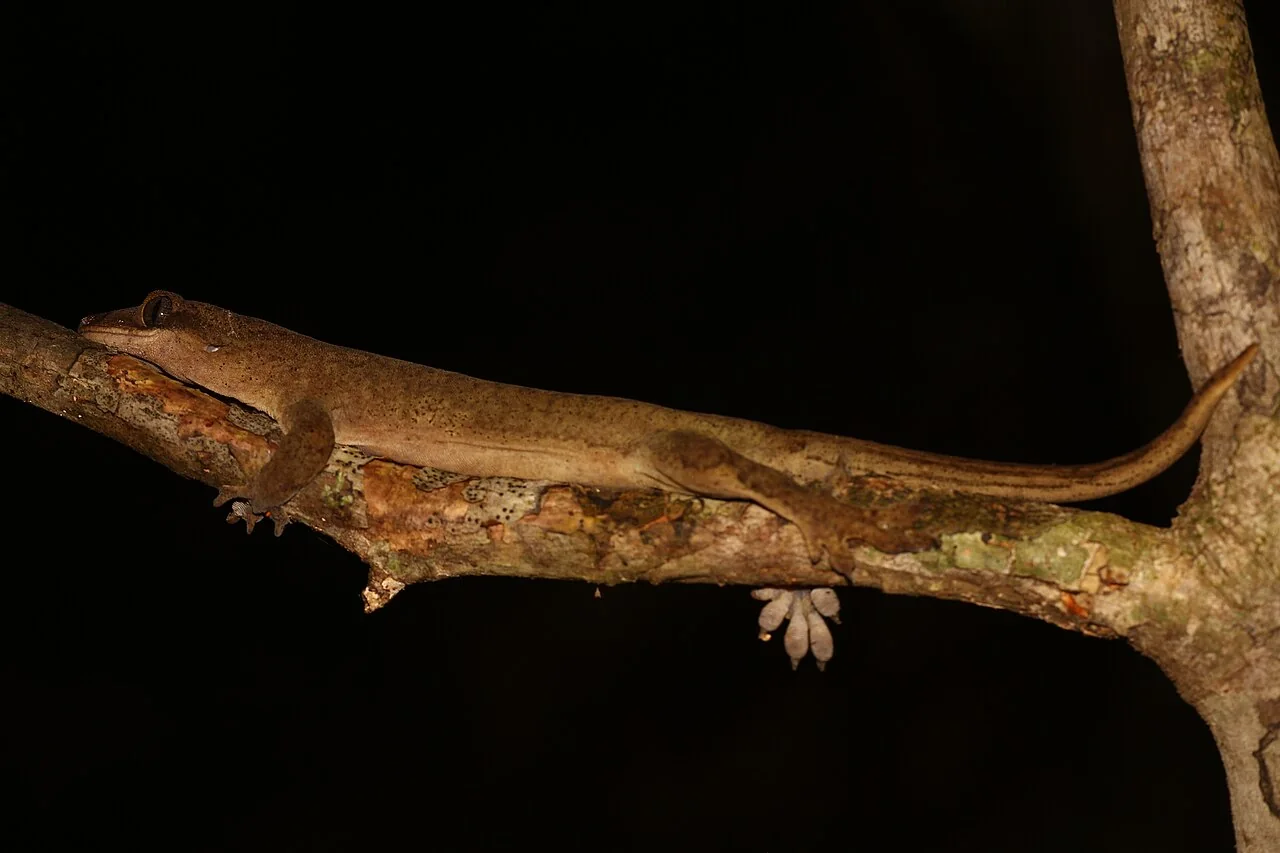
Scientific name
Correlophus sarasinorum
Other names: Rhacodactylus sarasinorum
Correlophus sarasinorum is a forest gecko from southern New Caledonia. Its former name Rhacodactylus sarasinorum remains frequent in husbandry documents [1][2].
Origin
The far south of Grande Terre, in New Caledonia’s South Province; scattered populations in forest fragments [4].
- Arboreal
- Nocturnal
- Omnivorous
At a glance
A nocturnal gecko from southern New Caledonia, associated with closed forest formations [1][4].
| ADULT SIZE | 25–28 cm Total length, including the tail [2]. |
|---|---|
| ACTIVITY | Nocturnal Arboreal [2]. |
| DIET | Omnivorous Prey and a fruit component [2]. |
Adult size
25–28 cm total length according to IGA; this length includes the tail [2].
Lifespan
15–20 years stated by Reptile Supply as a captive estimate; no individual longevity register is provided [3].
Lifestyle
Nocturnal and arboreal; coloration may be sparsely patterned or bear pale spots and a collar [2].
Housing
ARRANGING ITS HABITAT
Large vertical enclosure — Differing minima between guides; provide branches and retreats [2][3].
Minima differ: IGA 40 × 40 × 60 cm, Reptile Supply approximately 61 × 61 × 122 cm for one individual. This profile prioritises structuring a large vertical enclosure [2][3].
Care parameters
DAY · WARM SEASON
26–29 °C — IGA seasonal reference point [2].
NIGHT · WARM SEASON
22–24 °C — Seasonal reference point, not year-round [2].
Humidity
Day–night cycle — IGA: approximately 60 % during the day, 80–90 % at night; ventilate [2].
Day during the warm season
26–29 °C [2] IGA seasonal reference point; retain cooler retreats.
Night during the warm season
22–24 °C [2] Seasonal values, not a fixed year-round instruction.
Humidity
≈ 60 % day; 80–90 % night [2] Husbandry cycle described by IGA; check ventilation and surface drying.
Feeding
FEEDING AND MONITORING
Suitable omnivorous feeding, with observation of consumption and body condition [2].
Taxonomy and appearance
The taxonomic database and IGA confirm the current combination Correlophus sarasinorum [1][2]. Forms with white spots or a collar and less-patterned individuals are not presented as separate species. A trade name must therefore remain attached to the animal’s description, without becoming a scientific synonym. Keeping a dated photograph of the head, back and tail helps avoid identification errors between documents.
Adult size, lifespan and lifestyle
25–28 cm total length according to IGA; this length includes the tail [2].
15–20 years stated by Reptile Supply as a captive estimate; no individual longevity register is provided [3].
Nocturnal and arboreal; coloration may be sparsely patterned or bear pale spots and a collar [2].
Fragmented natural habitat
Endemia places the populations in the far south of Grande Terre, among fragments of closed forest. The cited assessment highlights the effects of fires, mining activities and introduced ungulates on these habitats [4]. This information does not translate into a mineral-substrate recipe to copy. In captivity, the functions sought are supports, cover and shelters; decorative resemblance to a landscape does not prove that these functions are present.
Choosing housing with the differences in mind
The two practical sources do not propose the same minimum [2][3]. Rather than presenting an arbitrary average as consensus, this profile retains their reference points. The editorial choice is to plan for generous space, with an upper area able to accommodate shelters and a feeding station. Check the routes between these elements and maintenance access. A single upper branch can become an unavoidable passage, even in a large enclosure.
Seasonal climate and measurement points
IGA describes a seasonal cycle; the warm-season values given here should not be maintained all year by default. It also notes problems associated with temperatures persistently above 30 °C [2]. Interpretation requires knowing where measurements are taken. Keeping separate records of air near a refuge, the lit support and night-time conditions avoids confusing a small warm area with the climate of the entire terrarium.
Water and ventilation
The humidity variations described accompany misting and nocturnal activity [2]. Reptile Supply also provides access to water in an elevated container [3]. During maintenance, check that it is stable and that food does not fall into it. A dark refuge must remain usable after watering. Occasionally photographing the decor before and after drying provides information that the maximum recorded by a hygrometer alone does not convey.
Meals and body condition
The practices described combine insects and preparations for omnivorous geckos [2][3]. IGA draws attention to voracious feeding and weight gain [2]. Good monitoring therefore distinguishes appetite from the quantity supplied. Recording leftovers and remaining prey, as well as the composition of the complete food, helps adjust a plan with a competent person. No ration percentage, target weight or numerical supplementation is inferred from a photographed animal.
Behaviour and breeding
Oviparity is taxonomically confirmed [1]. IGA describes clutches of one or two eggs buried in a sheltered location, but also sometimes serious conflicts between breeding animals [2]. The presence of a male and a female therefore does not guarantee a compatible pair. The cautious choice for a project without breeding is individual housing. If a clutch appears, document its location and the female’s condition; a breeding timetable does not replace an assessment of her condition.
Monitoring and useful limitations
Comparing observations obtained at similar times is particularly useful for this nocturnal animal. An absence of movement at midday does not have the same meaning as a sustained change in activity at the usual feeding time. The sources consulted provide neither a robust lifespan series nor complete experimental nutritional requirements [2][3]. The profile leaves these limits visible and preserves differences between sources rather than producing a supposedly certain protocol.
Checklist
- Prepare several accessible shelters before arrival.
- Check measurements at locations the animal actually uses.
- Keep origin information and individual observations.
Observations to record
- Meals
- Weight
- Sheds
- Temperature
- Humidity
- Behaviour
The app provides individual animal records. Check which features are available for your animal in the released version.
Related guides
Original guides in French
Sources
Document-based overview; not a substitute for veterinary advice.
- The Reptile Database — Correlophus sarasinorum
Source accessed - Andrea Vaccari et Emanuele Scanarini, IGA — Correlophus sarasinorum
Source accessed - Reptile Supply — How to Care for Your Sarasinorum Gecko
Source accessed - Endemia — Correlophus sarasinorum
Source accessed