
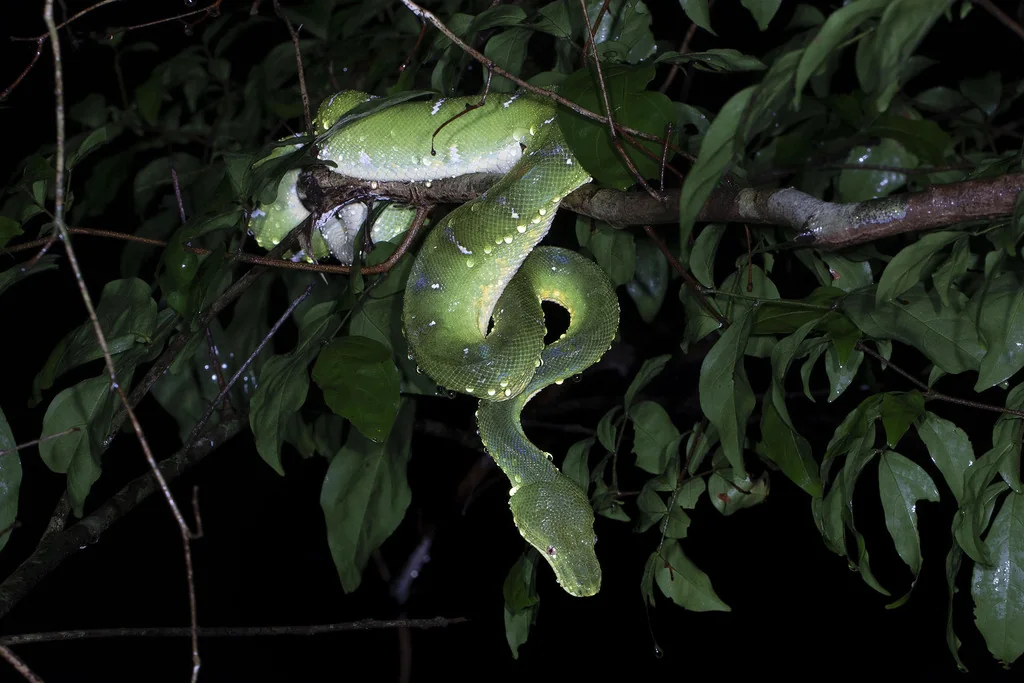
Scientific name
Corallus caninus
Other names: Boa canina
The northern emerald tree boa needs a network of perches, cover and measurements at the right levels. It must first be distinguished from Corallus batesii, often associated with the same common names in older sources. [1][3]
Origin
Guiana Shield and neighbouring regions of north-eastern South America. [1]
- Arboreal
- Boa
- Experienced project
C. caninus separated from C. batesii; cover uses one current framework; clinical source used for setup and feeding.
At a glance
| ADULT SIZE | 1,5–2 m Ueno total length [2]. |
|---|---|
| LIFESPAN | Not established Older data sometimes mixed with C. batesii. |
| LIFESTYLE | Arboreal Nocturnal and an ambush hunter [1][2]. |
Adult size
1,5–2 m total length in the Ueno Zoo profile. [2]
Lifespan
No sufficiently robust species-specific average retained in the current sources consulted.
Lifestyle
Arboreal and nocturnal; ambush posture from branches. [1][2]
Housing
A SUITABLE HABITAT
Perch network — Horizontal supports and cover [4].
A stable perch network and cover; plan maintenance without pulling the animal off its support. [3][4]
Care parameters
WARM SPOT · DAY
29–32 °C — Northern ReptiFiles framework [3].
COOL AREA · DAY
22–24 °C in shade — Same framework [3].
Humidity
75–90 % — Reference point with ventilation [3].
Localised heating
29–32 °C ReptiFiles framework explicitly devoted to the northern taxon. [3]
Shade
22–24 °C Cool zone from the same framework, to distinguish from general ambient conditions. [3]
Humidity
75–90 % ReptiFiles reference point associated with effective ventilation and surface drying. [3]
Feeding
MONITORED FEEDING
Thawed rodents among other foods; record regurgitations [4].
Identifying the northern emerald tree boa
The Reptile Database distinguishes Corallus caninus from Corallus batesii and provides diagnostic characteristics and a current distribution. [1] An older profile broadly including western Amazonia may therefore concern both taxa. Green colour is insufficient to resolve identification. Keep documents and verifiable provenance before comparing captive results. Juveniles do not necessarily bear adult coloration, as also described by the taxonomic reference; an isolated photograph must be interpreted with its age and context.
Adult size, lifespan and lifestyle
1,5–2 m total length in the Ueno Zoo profile. [2]
No sufficiently robust species-specific average retained in the current sources consulted.
Arboreal and nocturnal; ambush posture from branches. [1][2]
Size and life on branches
Ueno gives a total length of 1,5–2 m and describes a nocturnal snake of lowland rainforests. [2] This build must be considered in movement and perch strength. The empty height of a tank is not a route. Drawing the supports, their junctions and covered zones allows a check that every level is accessible. Also provide visual access to concealed places so the snake need not be moved daily to confirm its presence.
Usable perches and maintenance
Chicago Exotics particularly recommends horizontal branches thick enough to support the body’s coils, with vegetation providing cover. [4] ReptiFiles emphasises the value of removable perches for interventions. [3] Testing fixings before arrival and making the water container accessible independently of the main support facilitates maintenance. The setup must support the animal’s weight after a meal as well as during movement. A structure can look stable in a photograph yet rotate when the snake bears on its end.
Measuring a climate in three dimensions
The ReptiFiles framework devoted to the northern taxon proposes heating at 29–32 °C, ambient conditions of 24–28 °C and a shaded zone of 22–24 °C. [3] This is a practice framework, not a single measurement applicable throughout the tank. Marking probes on a vertical plan allows checks of what the snake actually encounters. Values from another profile must not be added to create an artificially broad range. Document every lamp, branch or ventilation change.
Humidity, surfaces and water
ReptiFiles associates its 75–90 % reference point with air circulation and surfaces able to dry. [3] The clinic also emphasises substrate monitoring in this humid context. [4] Scheduling water additions therefore requires actual checks, not just a timer. Recording humidity at several times and examining branches, ground and undersides of decor detects persistent saturation. Plan how to clean and renew water before multiplying plants or hard-to-reach installations.
Feeding: meals adapted to the snake
Ueno lists birds and rodents among its foods. [2] Chicago Exotics uses rodents and other suitable captive prey and recommends properly prepared dead prey. [4] These observations do not justify frequent feeding. Ask for the precise history of the juvenile or adult acquired, then record meals actually swallowed and any regurgitation. Regurgitation must be described with temperatures, prey and recent events; increasing heat or immediately offering another meal is not a response inferred from this profile.
Birth of juveniles and documentary limits
Corallus caninus gives birth to live young according to The Reptile Database. [1] Older publications under this name may include C. batesii; this difficulty also affects reproductive and lifespan figures. Presenting their average as specific to all northern emerald tree boas would be misleading. A breeding project must therefore specify parent identification, their condition and preparation of housing for every juvenile. No seasonal-conditioning timetable or incubation protocol is invented here.
Precautions and individual monitoring
This boa suits a person able to maintain an arboreal environment and intervene methodically. ReptiFiles advises against pulling an individual gripping its perch. [3] Preparing transport, examination and cleaning before an emergency reduces the need to improvise. The manual log can bring together meals, refusals, sheds, weighings and observed positions. A change in posture or breathing warrants factual description. Setup measurements and photographs will help the veterinarian; they complement observation without turning a humidity figure into a diagnosis.
Checklist
- Distinguish caninus and batesii before acquisition.
- Test supports, cover and maintenance access.
- Measure perches, shade and air separately.
Observations to record
- Manual log of meals and any regurgitations.
- Vertical probe map.
- Dated sheds, positions and interventions.
The app provides individual animal records. Check which features are available for your animal in the released version.
Related guides
Original guides in French
Sources
Document-based overview; not a substitute for veterinary advice.
- The Reptile Database — Corallus caninus
Source accessed - Tokyo Zoological Park Society, Ueno Zoo — Emerald tree boa
Source accessed - ReptiFiles — Northern Emerald Tree Boa, avec Zion McAndrews
Source accessed - Chicago Exotics Animal Hospital — Emerald Tree Boa Care
Source accessed