
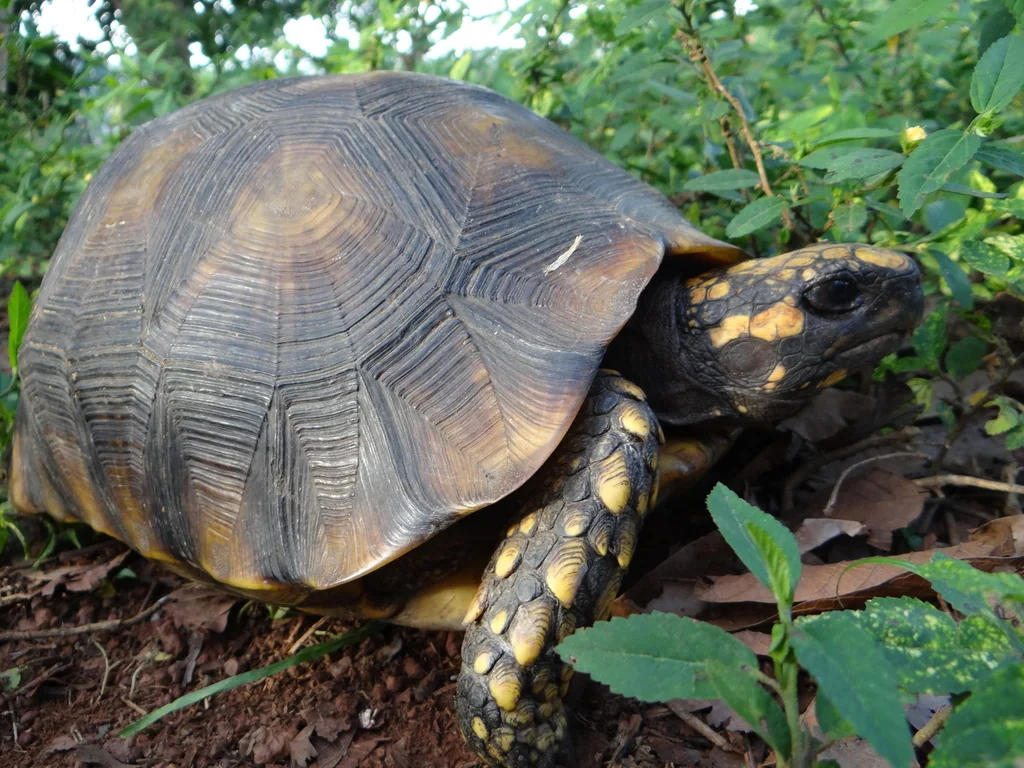
Scientific name
Chelonoidis denticulatus
Other names: Chelonoidis denticulata · Geochelone denticulata
Chelonoidis denticulatus is a large forest-dwelling terrestrial tortoise from South America. The older spelling Chelonoidis denticulata remains common in publications. [1] This profile does not confuse it with C. carbonarius: floor space, shaded refuges and maintenance of a humid environment must be planned for a heavy adult.
Origin
South American tropical forests, particularly the Amazon basin and the Guianas; older island records require distinguishing origin from introductions. [1][3]
- Large tortoise
- Tropical forest
- Long commitment
Documentary overview: identity checked; natural observations and captive practices attributed separately. Undocumented limits remain explicit.
At a glance
| SIZE | Often 40–50 cm Adult length, method unspecified [2]. |
|---|---|
| LIFESPAN | Can exceed 50 years Zoological guideline [3]. |
| LIFESTYLE | Forest-dwelling terrestrial Shade and moist ground [2]. |
Adult size
The UWI university account commonly gives 40–50 cm at maturity, with much larger individuals; it does not specify a straight or curved measurement method. [2]
Lifespan
The National Aquarium gives a lifespan that can exceed 50 years; this is a zoological guideline, not a guaranteed average survival. [3]
Lifestyle
Forest-dwelling and terrestrial, foraging on the ground and using visual interactions with other individuals. [2][3]
Housing
ADULT FLOOR SPACE
≈6 m² suggested minimum — Specialist guide; provide more for the long term [4].
Herpeton suggests approximately 6 m² minimum for an adult, with more for permanent housing. A small juvenile terrarium is not the final enclosure. [4]
Care parameters
DAYTIME AIR
25–28 °C — Herpeton [4].
WARM ZONE
30–32 °C — Localised heating [4].
Humidity
75–90 % — Specialist guideline with drainage and ventilation [4].
Daytime air
25–28 °C according to Herpeton [4] Attributed captive guideline, with shaded areas.
Locally warm area
30–32 °C according to Herpeton [4] Broad, guarded heating suited to body size.
Relative humidity
75–90 % in this guide [4] Combine with drainage and air circulation, without uniformly soaking the ground.
Feeding
FOREST OMNIVORE
Varied plants, fruit and occasional animal resources; not a fruit-only diet [3][5].
An old name that remains useful
The Reptile Database uses denticulatus and lists Geochelone denticulata and Chelonoidis denticulata in the nomenclatural history. [1] These names should facilitate bibliographic searches, not artificially multiply catalogue species. In an animal's documents, retain both forms when a correction is needed. Uncertain identification involving the red-footed tortoise warrants checking before applying a profile.
Adult size, lifespan and lifestyle
The UWI university account commonly gives 40–50 cm at maturity, with much larger individuals; it does not specify a straight or curved measurement method. [2]
The National Aquarium gives a lifespan that can exceed 50 years; this is a zoological guideline, not a guaranteed average survival. [3]
Forest-dwelling and terrestrial, foraging on the ground and using visual interactions with other individuals. [2][3]
Understanding the forest floor
UWI describes humid-forest ecology, with shade and fallen plant resources. [2] To represent this environment, distinguish walking surfaces, retreats and moisture-retaining areas. A terrarium filled with mud is not equivalent to a forest. The setup must allow monitoring of the underside of the shell, removal of leftovers and local replacement of degraded materials.
Adult space and weight
Zoological sources note the possibility of very large individuals. [2][3] Doors, pools and passages must be designed for this bulk, not just for the juvenile's photograph. Spare floor space avoids removing refuges to retain a corridor. The project must also include a safe way to move an adult for an examination without carrying it at arm's length.
Humidity, heat and light
The values suggested here come from a specialist husbandry guide. [4] They are neither constant temperatures throughout Amazonia nor a reason to heat the enclosure uniformly. Measuring the exposed surface and refuge air separately makes the gradient visible. High humidity must be interpreted alongside substrate condition and ventilation; a single number does not describe airflow.
A varied forest diet
The National Aquarium describes fallen fruit, leaves, grasses and occasional animal resources. [3] Gdańsk also mentions fungi and invertebrates. [5] This does not justify a diet restricted to sugary fruit, even if the animal readily accepts it. Variety must be organised into a reproducible diet, with monitoring of consumption and body condition. A zoo animal's favourite food is not a complete nutritional formula.
Behaviour and separation
UWI describes gatherings sometimes associated with available resting places or a shared food resource, without a simple, constant social organisation. [2] Gathering under a shelter therefore does not demonstrate a need for group living. Access to resting areas and meals must be observed for each animal. If separation requires rebuilding the enclosure, it is not genuinely available when needed.
Egg-laying and development time
The National Aquarium reports common clutches of 4–8 eggs and incubation periods of 100–200 days, without providing a single protocol. [3] Gdańsk presents a narrower range in its account. [5] This variation must be retained rather than promising a hatching date. Egg-laying is a biological event to document; egg count represents neither fertility nor the number of young that will survive.
Conservation and lasting commitment
The National Aquarium highlights pressure from hunting and habitat destruction. [3] Avoiding wild collection and requesting verifiable captive origin are priorities. Precise legal status must be checked with the authorities at the time of acquisition. This tortoise requires space, heating, organisation and succession planning over a long period; the availability of a juvenile does not demonstrate that these conditions are met.
Checklist
- Plan for the heavy adult.
- Check drainage and shade.
- Require traceable captive origin.
Observations to record
- Size
- Weight
- Ground
- Meals
The app provides individual animal records. Check which features are available for your animal in the released version.
Related guides
Original guides in French
Sources
Document-based overview; not a substitute for veterinary advice.
- The Reptile Database — Chelonoidis denticulatus
Source accessed - University of the West Indies — Yellow-footed Tortoise, Behaviour
Source accessed - National Aquarium — South American Yellow-Footed Tortoise
Source accessed - Herpeton Academy — Yellow-Footed Tortoise
Source accessed - Gdańsk Zoo — Yellow-footed Tortoise
Source accessed