
Scientific name
Leiopython albertisii
Other names: Bothrochilus albertisii · Liasis albertisii
This iridescent python needs space, cover and careful management of interventions. The name currently retained by The Reptile Database is Leiopython albertisii; Bothrochilus albertisii appears in its synonymy. [1]
Origin
New Guinea and neighbouring islands; detailed distribution to interpret in light of revisions of the genus. [1]
- Python
- Tropical forest
- Nocturnal activity
Current taxonomy; institutional natural history; commercial practice with explicit thermal gaps.
At a glance
| ADULT SIZE | Up to 3 m Institutional upper figure, length convention unspecified [2]. |
|---|---|
| LIFESPAN | Undocumented No species-specific average retained. |
| LIFESTYLE | Ground and branches Nocturnal activity [2]. |
Adult size
Butantan reports up to 3 m in females, without specifying TL or SVL; this upper figure is not an average. [2]
Lifespan
No sufficiently supported species-specific lifespan in the sources consulted.
Lifestyle
A nocturnal hunter that uses the ground and can climb. [2]
Housing
A FOREST HABITAT
Routes and shelters — Branches, cover and differentiated substrate; no validated minimum retained [3].
A large secure space with ground-level routes, solid branches and differentiated shelters; no validated minimum dimensions retained. [3]
Care parameters
WARM SPOT · DAY
To validate — No complete daytime range in the source retained [3].
COOL AREA · DAY
To validate — Complete settings remain necessary before arrival.
Humidity
Humid shelters — No target percentage retained; also provide drier options [3].
Heat
Gradient to document The commercial reference does not give a complete usable daytime range. Do not invent an instruction. [3]
Humidity
Differentiated moist refuges Water-retentive substrate and drier options, according to the commercial profile. [3]
Water
Accessible container Replace soiled water immediately; soaking is reported. [3]
Feeding
A CARNIVOROUS DIET
Mammals, birds and lizards in natural history; rodents used in captivity [2][3].
Recognising the species and retaining provenance
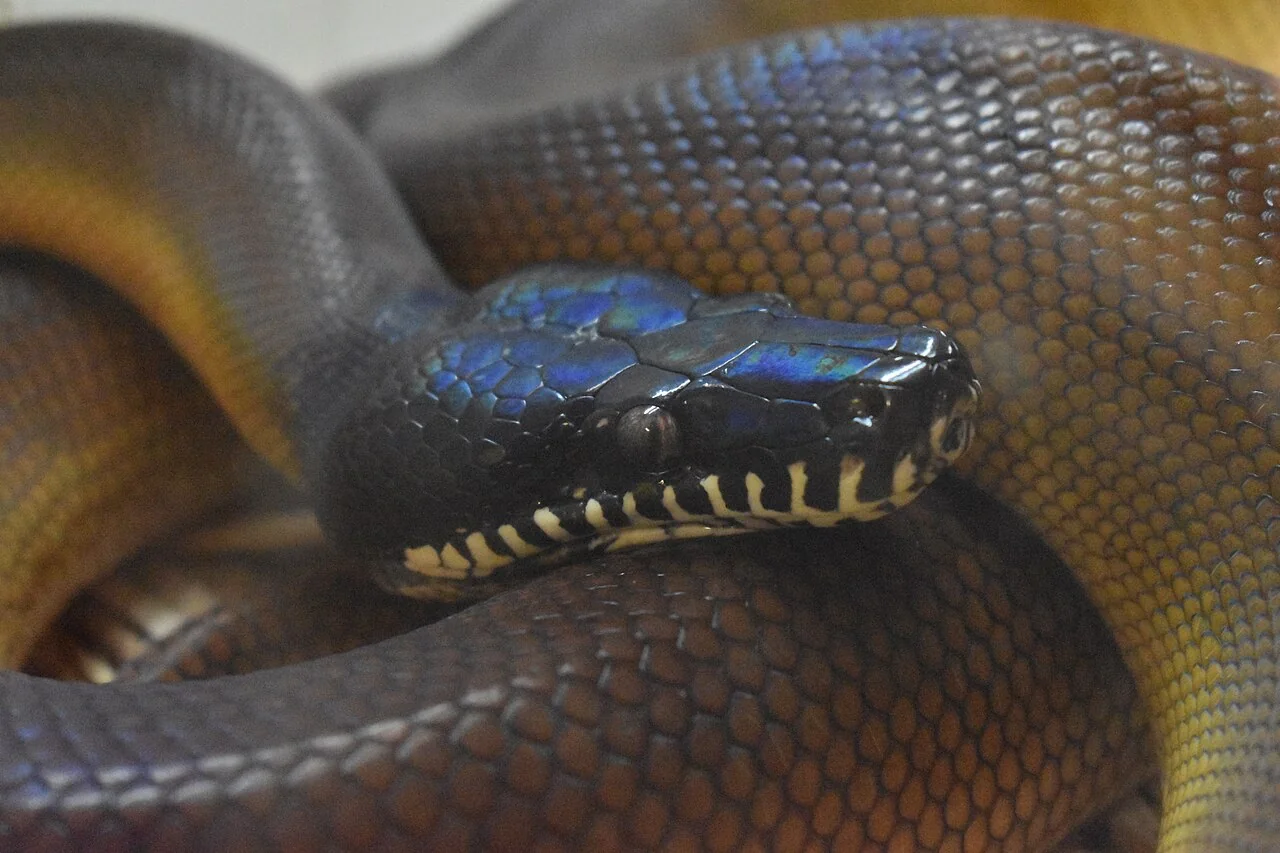
Schleip’s description presents a dark head and white labial scales, the origin of the common name. [4] Butantan describes a bronze-to-black back and iridescent reflections. [2] Studies incorporated by The Reptile Database have changed the group’s boundaries: biakensis and huonensis are among those placed in synonymy in this reference. [1] A “white lip” label is therefore insufficient. Keeping the invoice, name used at transfer, stated origin and dated photographs allows an identification to be corrected later without losing the history.
Adult size, lifespan and lifestyle
Butantan reports up to 3 m in females, without specifying TL or SVL; this upper figure is not an average. [2]
No sufficiently supported species-specific lifespan in the sources consulted.
A nocturnal hunter that uses the ground and can climb. [2]
A forest environment, not just a humidity figure
The Brazilian institution places the species in tropical forests and swampy environments, sometimes near watercourses. Its museum individual uses leaf litter and water in particular. [2] These observations do not describe every population. To prepare a habitat, map access to shelters, the container and supports before adding plants. Hidden areas must be inspectable without demolishing the decor; a spectacular but inaccessible setup makes monitoring much less reliable.
Organising space and surfaces
LLLReptile, a commercial source of practice, recommends climbing supports, hiding places and moisture-retentive materials, including coconut fibres and bark. [3] Their selection also depends on ease of cleaning. As a preparation method, fix elements before arrival, check that no branch tips and plan removal of the container without moving the snake. Size the project for the adult animal and its movements; cage models sold by the source do not constitute a biological standard.
Measuring heat and humidity
The commercial profile gives qualitative indications and a night-time limit expressed without an explicit unit; we do not derive a complete thermal range from it. [3] It therefore remains necessary to have settings validated by a professional familiar with this species. The log can distinguish air temperature, accessible surface and shelter interior, with time and location. Recording humidity before and after adding water shows drying duration. An isolated percentage describes neither ventilation nor actual substrate condition.
Feeding: start with the individual
Butantan distinguishes the small mammals and birds eaten by adults from the lizards favoured by juveniles. [2] LLLReptile reports captive use of mice and rats. [3] These two pieces of information do not make all hatchlings equivalent. Before acquisition, request a precise history of independent feeding, prey type and presentation. Then record acceptances and refusals in the same register, without automatically increasing the ration at the first slowdown. No weight percentage or universal schedule is proposed here.
Behaviour and interventions
Butantan describes active food-searching and defensive reactions, including hissing and biting. [2] This species suits a prepared project, with a person able to intervene without haste. Defining equipment location, room closure and the cleaning procedure in advance reduces improvisation. Observation from a distance must remain possible. A reaction to opening can be recorded with its context; the label “aggressive” explains less than a description of posture and timing.
Breeding: established facts and limitations
The species is oviparous according to The Reptile Database. [1] Butantan describes a female coiled around her eggs. [2] We do not turn this observation into a cooling, mating or incubation protocol. A breeding project requires data specific to the breeding animals, health monitoring and separate setups for juveniles. Older publications may concern a broader taxonomic scope: their name and provenance must be checked before their results are reused.
Daily monitoring and decisions
Prepare a manual table bringing together meals, sheds, weights measured under comparable conditions, maintenance and observations. A photograph of the setup with probes helps explain a change after moving decor. Precisely recording prolonged soaking, a refusal or unusual breathing does not, by itself, diagnose its cause. If condition changes, pass the history and actual measurements to the veterinarian. This profile is a documented basis for preparation; it does not replace settings that remain insufficiently established.
Checklist
- Confirm identity and keep provenance documents.
- Prepare maintenance access and closures.
- Have missing parameters clarified before arrival.
Observations to record
- Manual log of meals and refusals.
- Dated photographs of sheds and the setup.
- Measurements with probe locations.
The app provides individual animal records. Check which features are available for your animal in the released version.
Related guides
Original guides in French
Sources
Document-based overview; not a substitute for veterinary advice.
- The Reptile Database — Leiopython albertisii
Source accessed - Instituto Butantan — Píton-de-lábios-brancos, 8 novembre 2024
Source accessed - LLLReptile — White Lipped Python, pratique commerciale
Source accessed - Wulf Schleip — Leiopython albertisii, description historique
Source accessed