
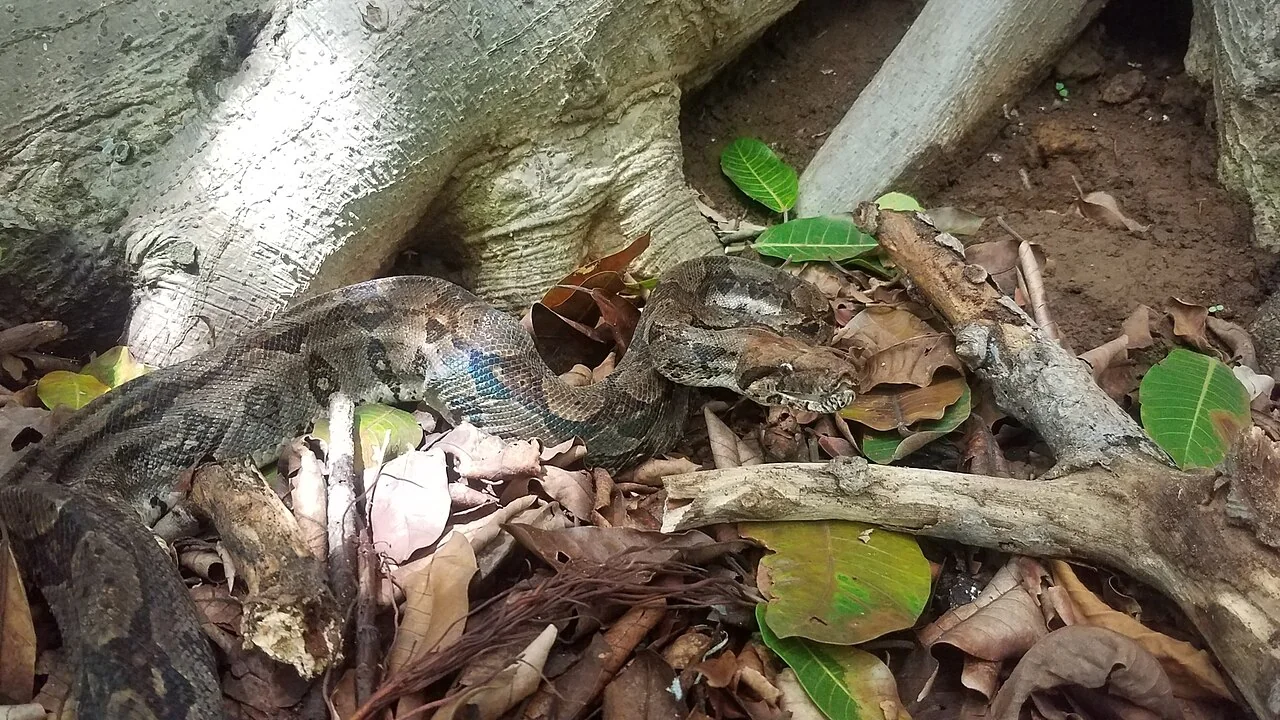
Scientific name
Boa imperator
Boa imperator is recognised separately from Boa constrictor. Older care sheets that combine the two therefore need careful reading. [1]
Origin
Mexico, Central America and northwestern South America, depending on the population. [1]
- Constrictor
- Climber
- Large-bodied
At a glance
| ADULT SIZE | Up to 4 m Published upper limit, not typical size. [2] |
|---|---|
| LIFESPAN | 20 years stated A zoological reference without a demonstrated maximum. [2] |
| LIFESTYLE | Nocturnal and climbing Nocturnal activity and branches. [2] |
Adult size
La Palmyre gives up to 4 m; this is an upper limit, not a universal typical adult size. [2]
Adult weight
Oregon Zoo generally states 13–33 pounds, or around 5,9–15 kg, without details by sex or locality. This broad zoological range does not define a healthy weight for an individual. [4]
Lifespan
20 years stated by La Palmyre, without a detailed distinction between environments or a demonstrated maximum. [2]
Lifestyle
Nocturnal activity and use of trees are described by the zoo. [2]
Experienced keeper
The size, strength and long-term space requirements justify prior experience; the boa’s locality and identity remain important. Editorial assessment. [1][4]
Housing
PLAN FOR ADULT SIZE
Suitable individual housing — Actual body size, individual housing and full stretching. [5][9]
Individual housing with floor space and strong branches; size it for the animal’s actual length and future growth. The Boa spp. guide that includes imperator requires room to stretch out fully. [5][9]
Care parameters
WARM AIR · BOA SPP. GUIDE
30–32 °C — 30–32 °C in the Boa spp. guide that includes imperator. [5][6]
COOL AIR · BOA SPP. GUIDE
24–26 °C — 24–26 °C in the same guide. [6]
NIGHT
Individualised plan — No automatic temperature reduction suggested; the guide does not separate every locality.
Humidity
55–75 % — ReptiFiles guide explicitly including imperator; a reference shared across Boa spp., to be put in context. [5][7]
Warm-zone air
30–32 °C in the Boa spp. guide that includes imperator. [5][6] A published group-level reference, not validation for every locality; this figure describes the air.
Cool-zone air
24–26 °C in the same guide. [6] Keep a cooler area accessible; use a thermostat and separate measurements.
Humidity
55–75 %, with variation according to ReptiFiles. [7] A guide shared across Boa spp., to be put in context for the animal; substrate must not be muddy.
Night
To be tailored to the chosen plan. No automatic temperature reduction or breeding induction is suggested.
Feeding
PROPORTIONATE PREY
Whole thawed prey; size and frequency to be defined according to body size, age and condition. The Boa spp. schedule is not a locality-specific prescription. [8]
Complete habitat
Plan the adult enclosure before acquisition. The ReptiFiles guide explicitly covers several Boa, including imperator; it proposes snake length × half that length × half that length for the enclosure dimensions and recommends more space. Commercial dimensions do not replace checking that the snake can stretch out. [5][9]
Substrate, water and lighting
A moisture-retaining substrate, such as coconut fibre or a suitable soil mix, needs ongoing maintenance. Paper makes temporary observation easier. [10] A stable container that allows bathing and a humid hide provide further choices. [7]
Maintain darkness at night. The guide’s UVB recommendations are extrapolated from Boa constrictor to its genus; no precise UVI is therefore presented here as validated for imperator. [11]
Feeding and frequency
Whole thawed prey, proportionate to the body. The guide suggests meals further apart with age, but acknowledges different growth rates among boas; its group schedule does not become a prescription for a particular locality. [8]
Keep a record of the diet already accepted and the size and mass of prey, then discuss frequency according to body condition. Do not try to reach the large weights quoted by zoos: they do not describe an ideal growth target.
Reproduction: live young
La Palmyre reports a gestation of 5–8 months and the birth of fully formed young. [2] There is therefore no incubation protocol for laid eggs to copy from a python.
Observed mating does not prove pregnancy. Planning monitoring of the female and individual housing for the young is a separate, supported project; this profile does not recommend pairing or cooling.
Health and interventions
Noisy breathing, oral discharge or regurgitation are reasons to seek veterinary advice described in the general ARAV care sheet. Its older Boa constrictor scope does not validate every setting for imperator. [3]
Daily monitoring
Oregon Zoo describes a predator able to explore trees and bushes; an enclosure must account for this activity. [4] Record the supports used, meals actually swallowed, sheds and readings at the animal’s height.
Keep provenance and former names on the documents: Boa imperator is separated from Boa constrictor in the taxonomic database consulted. A colour name alone is not enough to determine locality. [1]
Checklist
- Assess the space available for adulthood.
- Document the stated origin.
- Check the strength of supports.
Observations to record
- Growth
- Weight
- Meals
- Sheds
The app provides individual animal records. Check which features are available for your animal in the released version.
Related guides
Original guides in French
Sources
Document-based overview; not a substitute for veterinary advice.
- The Reptile Database — Boa imperator
Source accessed - Zoo de La Palmyre — Boa imperator
Source accessed - Robert Nathan, DVM / ARAV, Chicago Exotics — General care of Boa constrictors
Source accessed - Oregon Zoo — Central American boa (Boa imperator)
Source accessed - ReptiFiles — Guide Boa spp., périmètre incluant explicitement Boa imperator
Source accessed - ReptiFiles — Boa spp., chauffage
Source accessed - ReptiFiles — Boa spp., humidité
Source accessed - ReptiFiles — Boa spp., alimentation
Source accessed - ReptiFiles — Boa spp., dimensions du logement
Source accessed - ReptiFiles — Boa spp., substrat
Source accessed - ReptiFiles — Boa spp., éclairage et limites de transposition UVB
Source accessed