
Scientific name
Epicrates cenchria
Epicrates cenchria is distinct from Epicrates maurus, another boa sometimes sold under a similar name. [1]
Origin
Amazon Basin and Guiana Shield. [2]
- Terrestrial
- Humidity
- Iridescence
At a glance
| ADULT SIZE | 1,2–1,8 m Smithsonian range. [2] |
|---|---|
| LIFESPAN | Up to 20 years Maximum cited in captivity. [2] |
| LIFESTYLE | Mostly on the ground Branches are also used. [1][2] |
Adult size
Around 1,2–1,8 m according to the Smithsonian. [2]
Adult weight
No adult range by sex and length is sufficiently documented in the selected sources. Do not use the masses of another Epicrates as a target.
Lifespan
Up to 20 years in captivity according to the Smithsonian; this is not an average. [2]
Lifestyle
Mostly terrestrial, with use of branches. [1][2]
Experienced keeper
The balance between humidity, ventilation and temperature, particularly in juveniles, requires regular readings and a proven enclosure. Editorial assessment. [3][5]
Housing
SHELTERS AND BRANCHES
≈ 180 × 90 × 90 cm — ReptiFiles adult reference; adapt to body size. [3]
ReptiFiles suggests around 180 × 90 × 90 cm for an adult, with shelters and strong supports. [3]
Care parameters
WARM SURFACE · DAY
30–32 °C — Local heating according to ReptiFiles [3].
AMBIENT AIR · DAY
≈ 26–29 °C — Conversion of 78–84 °F; night at 22–24 °C [3].
Humidity
70–90 % — Reference from the veterinary table devoted to Epicrates cenchria [4].
Warm resting surface
30–32 °C. [3] Local ReptiFiles reference, to be distinguished from ambient air.
Daytime ambient air
Around 26–29 °C. [3] Correct conversion of the published 78–84 °F; the printed °C conversion is inconsistent.
Humidity
70–90 %. [4] Range from the veterinary table, not permanent substrate saturation.
Night
22–24 °C. [3] ReptiFiles night-time reference.
Feeding
AN APPROPRIATE DIET
Thawed rodents; juveniles every 7–10 days, adults every 14–21 days in the clinical care sheet. References to be individualised. [5]
Identity and complete habitat
Epicrates cenchria is separated from Epicrates maurus in the current taxonomic database. Older care sheets that extend its distribution into Central America sometimes combine distinct species. [1]
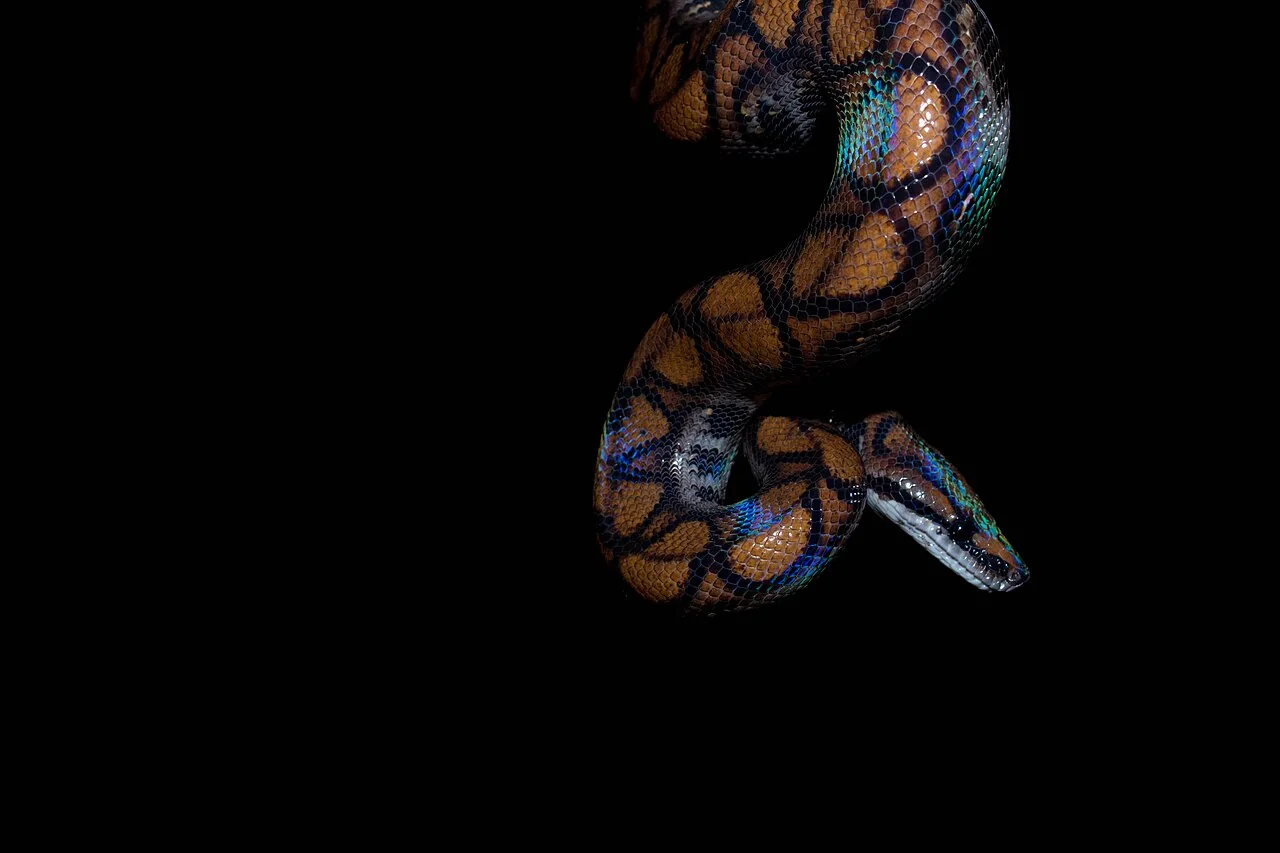
The Smithsonian describes it in humid Amazonian habitats, on the ground but also on branches. Its reflections come from the microstructure of the scales and vary with lighting. [2] Provide strong supports and shelters; the ReptiFiles enclosure volume is an adult reference, to be enlarged according to actual length. [3]
Heat, humidity and lighting
The cover temperatures follow ReptiFiles. Its printed conversion for ambient air is inconsistent: 78–84 °F corresponds to around 26–29 °C, not 29–30 °C. [3]
The archived veterinary table gives 70–90 % humidity. [4] ReptiFiles makes more distinctions between day, night and young animals; these frameworks are not averaged. The clinic suggests 70–80 % and low-level UVB without a UVI target. [5] Have a coherent protocol clarified for the life stage concerned.
Substrate and water
ReptiFiles describes moisture-retaining ground, a humid hide and a container that allows bathing. Remove soiling and keep ventilation functional. [3]
Record humidity at a known time and note spraying. The presence of a container indicates neither that the water is clean nor that the air is humid enough; these are two elements to check separately in the log.
Contextualised feeding
The Smithsonian feeds its boas rats. [2] Chicago Exotics suggests whole thawed prey, every 7–10 days for juveniles and every 14–21 days for adults. This clinical rhythm must be contextualised according to body size and condition. [5]
Not all the advice on this older page is reproduced: its introduction uses overly broad taxonomy and distribution. [1][5] Monitoring accepted meals and weight allows an individual plan to be discussed, without inventing a universal percentage.
Reproduction: birth of young
The Smithsonian describes live-bearing reproduction with a gestation of around five months and independent newborns. [2] There are no laid eggs to place in an incubator as there are with a python.
Preparation must focus on the female’s condition, identification of the parents and accommodation for the young. No seasonal reduction or breeding-mass target is prescribed in this profile; ordinary husbandry parameters are not enough to manage reproduction.
Health and daily observation
The clinic highlights sensitivity to excessive temperatures and the need for suitable humidity. [5] Abnormal breathing, regurgitation, retained shed or a marked change in general condition must be reported to the veterinarian.
Record air and surface temperature separately, humidity, mass, meals and sheds. Photographing the enclosure after any major change helps explain the readings. Documentary limits are deliberately retained: they show what still needs clarification for this animal.
Checklist
- Check closures and supports.
- Identify every measurement zone.
- Keep provenance data.
Observations to record
- Meals
- Weight
- Sheds
- Temperatures
The app provides individual animal records. Check which features are available for your animal in the released version.
Related guides
Original guides in French
Sources
Document-based overview; not a substitute for veterinary advice.
- The Reptile Database — Epicrates cenchria
Source accessed - Smithsonian’s National Zoo — Brazilian rainbow boa
Source accessed - ReptiFiles — Brazilian Rainbow Boa Care Sheet
Source accessed - Doneley et al. — Reptile Medicine and Surgery in Clinical Practice, tableau 1.5, p. 7–8
Source accessed - Chicago Exotics — Brazilian rainbow boa care
Source accessed