
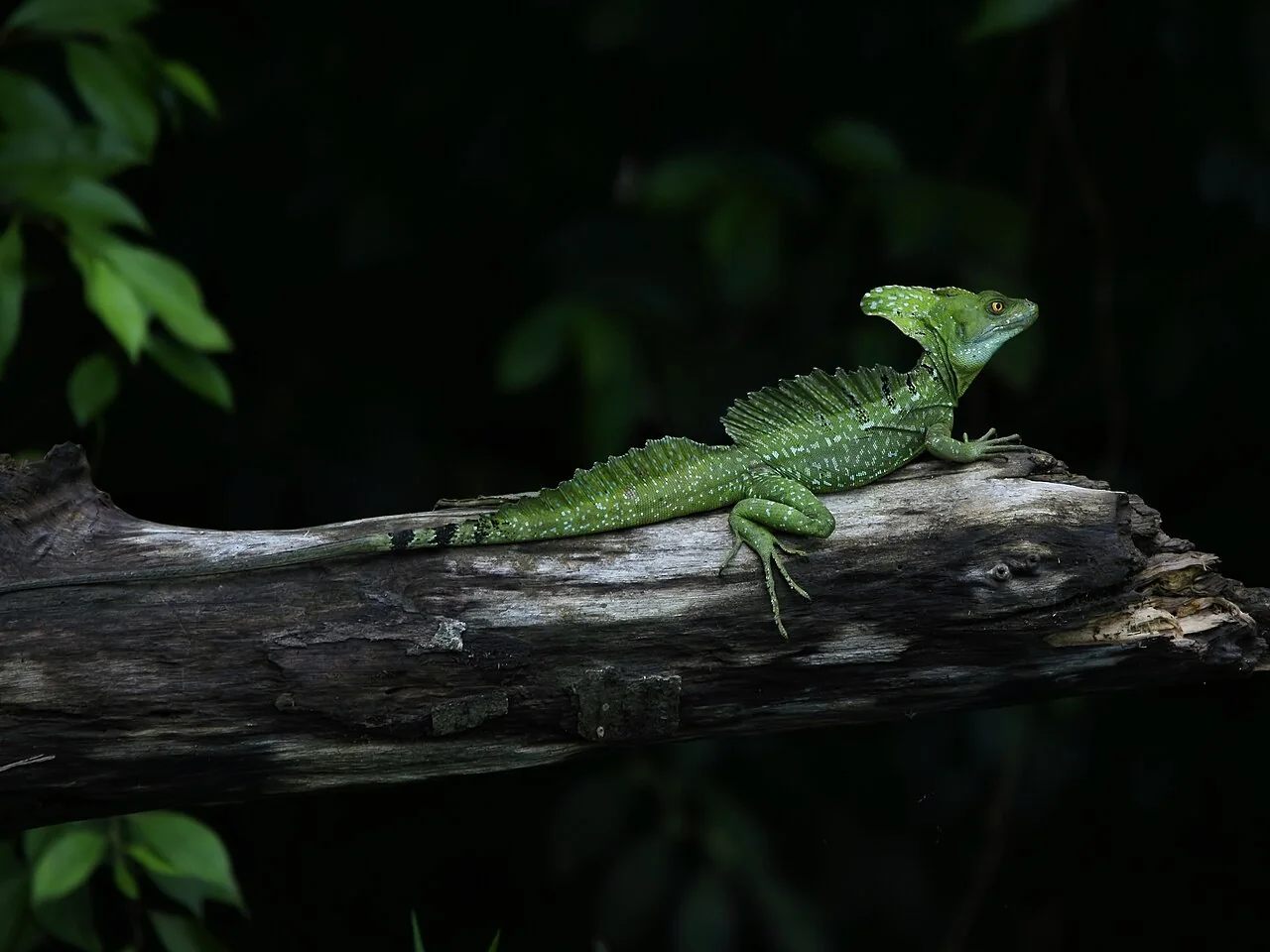
Scientific name
Basiliscus plumifrons
The green basilisk combines a long tail, climbing and a strong association with water. Its ability to flee quickly should guide enclosure design as much as its spectacular appearance [2].
Origin
Tropical forests of Honduras, Nicaragua, Costa Rica and Panama, often near watercourses [1][2].
- Diurnal
- Semi-aquatic
- Climber
At a glance
A Central American basilisk associated with trees near water; its total length includes a long tail [1][2].
| ADULT SIZE | Up to 90 cm Total maximum published by the Smithsonian [2]. |
|---|---|
| ACTIVITY | Diurnal Trees and water, with rapid escape movements [2]. |
| DIET | Omnivorous Invertebrates and a reported plant component [2][3]. |
Adult size
Up to 90 cm total length according to the Smithsonian; this is a published maximum size, not snout–vent length [2].
Lifespan
The institutional sources retained provide no verifiable captive lifespan; no average is stated here.
Lifestyle
Diurnal, semi-arboreal and semi-aquatic; escape movements can combine running, jumping and swimming [2][3].
Housing
ARRANGING ITS HABITAT
Branches and pool — A large, tall setup; accessible pool and solid supports [2][4].
A large, tall setup with solid branches, plant cover and an accessible pool; size it around the adult and its routes, without reusing a small standard tank [2][4].
Care parameters
AIR · DAY
25–30 °C — Reptiliendoktor reference point [4].
NIGHT
22 °C — Indicative value from the same guide [4].
Humidity
Day–night cycle — Guide: 70 % during the day, 90 % at night; check ventilation [4].
Daytime air
25–30 °C [4] Reptiliendoktor keeping reference point, distinct from the irradiated zone.
Night
22 °C [4] Indicative value from the same profile.
Humidity
70 % day; 90 % night [4] Proposed reference points, to interpret alongside ventilation and surface condition.
Feeding
FEEDING AND MONITORING
Varied prey; distinguish the natural diet from zoo menus, without inferring a universal ration [2][3].
Identify and anticipate size
Adult males have more developed crests than females and juveniles [2]. Purchasing a small individual must therefore not determine the dimensions of its permanent habitat. Keeping a total-length measurement and, when obtainable without unnecessary restraint, a snout–vent measurement allows proper comparison of data. Publications do not always use the same indicator. The current database places the species in the Corytophanidae; some zoological profiles retain an older presentation within the Iguanidae [1][2].
Adult size, lifespan and lifestyle
Up to 90 cm total length according to the Smithsonian; this is a published maximum size, not snout–vent length [2].
The institutional sources retained provide no verifiable captive lifespan; no average is stated here.
Diurnal, semi-arboreal and semi-aquatic; escape movements can combine running, jumping and swimming [2][3].
Branches, pool and opportunity to retreat
Frankfurt Zoo describes trees at the water’s edge [3]. To translate this relationship into a setup, provide supports for descending into and climbing out of the pool, as well as a dry area that is actually accessible. Branches must withstand the lizard’s weight and momentum. Before arrival, test removal of the water container, access to any filter and cleaning beneath the perches. Decor that cannot be maintained quickly loses its practical value.
Measuring a gradient and arranging lamps
The Reptiliendoktor profile distinguishes daytime air, night and a strongly irradiated zone; it mentions UV and refuges that screen the animal [4]. Its high basking-point value is not reproduced as a single instruction, because the measurement method is insufficiently described. Choose the setup with a specialist and check the surface that is actually accessible. Mesh, the highest branches and temperature changes after several hours alter effective exposure, even with a lamp of identical wattage.
Clean water and humidity
Natural proximity to water and swimming ability are well attested [2][3]. This does not mean that an enclosed pool cleans itself. Providing visible waste removal and easy access to technical components facilitates maintenance. Recording air humidity, condensation and substrate condition separately avoids confusing a high percentage with a healthy setup. Pool depth must remain consistent with access routes and the individual’s actual ability to get out.
A menu beyond the insectivore label
The Smithsonian feeds its animals insects and earthworms; Frankfurt also describes a plant component in the species’ diet [2][3]. This information does not define a universal proportion. A captive ration must be built around varied prey and suitable supplementation, then adjusted to body condition. Documenting foods actually eaten matters more than a list of suggestions. The mention of small vertebrates in the wild does not require their routine provision in captivity.
Behaviour and interventions
Escaping towards water is natural behaviour, not a demonstration to provoke [3]. Placing the setup in a quiet area and organising interventions reduces surprises when opening it. Identifying places where the animal collides or tries to pass through glass provides a concrete indication for reconsidering visual screens. A stationary animal may simply be watching its surroundings; its condition must be assessed alongside appetite, posture, breathing and climbing ability, without interpretation from a single sign.
Clutches and preparation for juveniles
Frankfurt reports 8–15 eggs per clutch and hatching after 65–85 days, without giving incubation conditions on that page [3]. These times must therefore not be used to programme an incubator. The female buries her eggs according to the Smithsonian [2]. Preparing an accessible laying area and a separate setup for juveniles before any pairing avoids improvisation. The published numbers describe a biological possibility; they are neither a production target nor a criterion of good health.
Monitoring and limits of this overview
This species requires resting surfaces, water and airspace to be monitored together. A photographic record of the decor helps explain a behavioural change after moving a branch. Also retain measurements with the exact time and location. The sources consulted allow the natural environment and several practices to be described, but do not establish an average captive lifespan or a universal minimum volume. A concrete project must include access to care and the space needed once adult size is reached.
Checklist
- Check the animal’s identity and retain its provenance.
- Install and measure the refuges before arrival.
- Plan individual monitoring of meals, sheds and movement.
Observations to record
- Meals
- Weight
- Sheds
- Temperature
- Humidity
- Behaviour
The app provides individual animal records. Check which features are available for your animal in the released version.
Related guides
Original guides in French
Sources
Document-based overview; not a substitute for veterinary advice.
- The Reptile Database — Basiliscus plumifrons
Source accessed - Smithsonian National Zoo — Green crested basilisk
Source accessed - Zoo Frankfurt — Green Basilisk
Source accessed - Reptiliendoktor — Haltungsempfehlungen für Echsen, Basiliscus plumifrons
Source accessed