
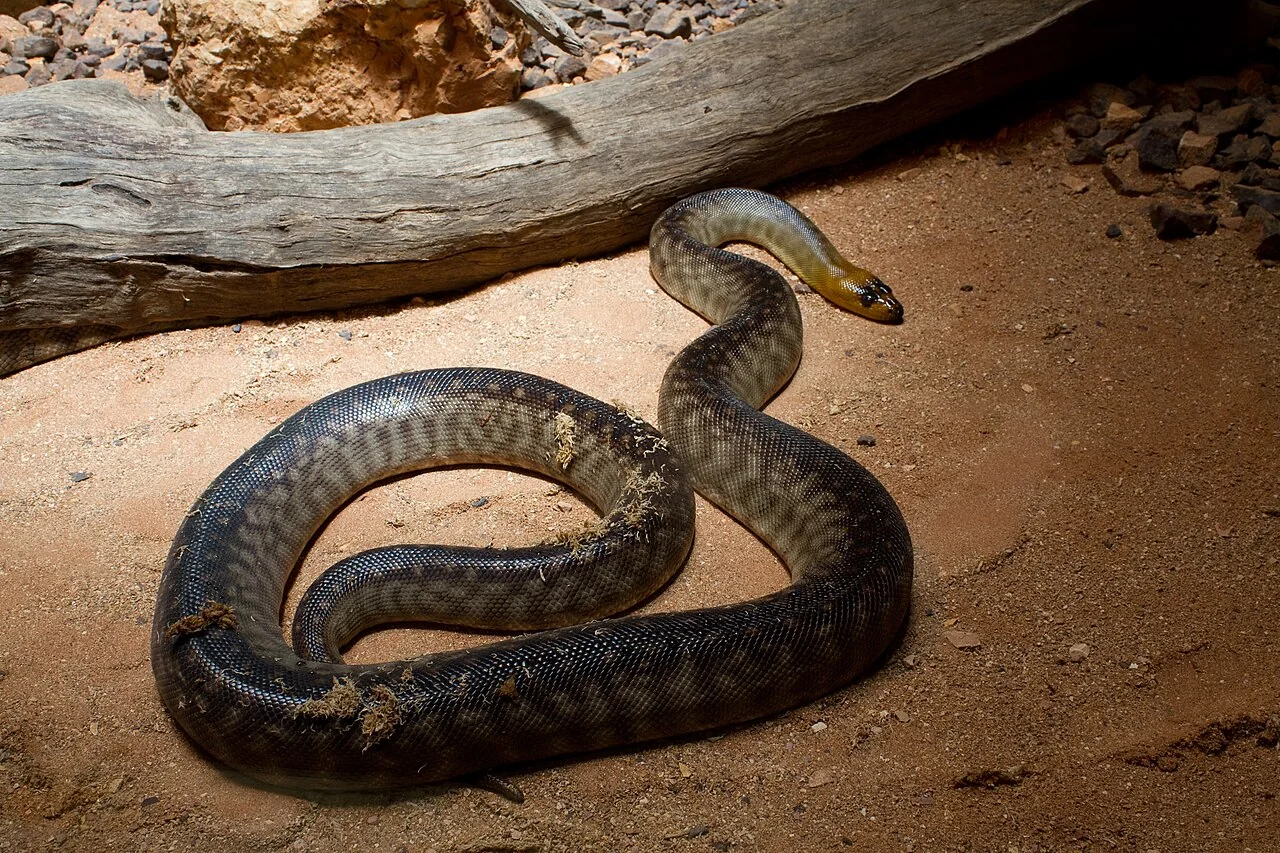
Scientific name
Aspidites ramsayi
Other names: Aspidiotes ramsayi
The woma is a terrestrial Australian python associated with sandy soils and shelters. Its burrowing ability and varied natural diet require a considered habitat and a reliable individual history. [2][3]
Origin
Arid Australian regions, with several population groups; their distribution cannot be reduced to one commercial locality. [1][2]
- Burrowing
- Arid Australia
- Terrestrial
Average TL and maximum separated; captive reproductive data from small numbers; no invented humidity target.
At a glance
| ADULT SIZE | Approximately 1,5 m Average TL; individuals reported up to 2,7 m [2]. |
|---|---|
| LIFESPAN | 20 years or more San Diego Zoo indication, not an average survival time [3]. |
| LIFESTYLE | Terrestrial Mainly nocturnal; shelters and burrows [2]. |
Adult size
Approximately 1,5 m average total length; individuals reported up to 2,7 m in the government profile. [2]
Lifespan
20 years or more stated by San Diego Zoo; an educational indication, not an average survival time. [3]
Lifestyle
Mainly terrestrial and nocturnal, using burrows or logs as shelters. [2]
Housing
A HABITAT FOR BURROWING
Loose ground and shelters — Allow burrowing with stable decor [4].
Usable floor area, shelters and substrate allowing burrowing behaviours. [4]
Care parameters
WARM SPOT · DAY
32–35 °C — Practical reference point for Aspidites [4].
COOL AREA · DAY
To be clarified — No sufficiently established species-specific cool range.
Humidity
Not quantified — Do not equate an arid climate with a uniform microclimate [2].
Warm spot
32–35 °C Real Aussie Reptiles practical reference point for Aspidites. [4]
Cool area
To be clarified The profile retained gives no reliable value for this zone. [4]
Humidity
No percentage retained An arid environment does not mean absence of water or a uniform microclimate.
Feeding
CHECK MEALS ACCEPTED
Juveniles may be difficult to start on rodents; keep the breeder’s log [4].
The name and size measurement
Aspidites ramsayi is accepted by The Reptile Database. [1] The Western Australian government profile gives an average total length of 1,5 m and reports individuals reaching 2,7 m. [2] The second figure is a reported maximum, not a prediction for every juvenile. Asking for the lineage’s origin and retaining the animal’s measurements allows its future housing to be considered. A locality label must be documented; it does not automatically create another species.
Adult size, lifespan and lifestyle
Approximately 1,5 m average total length; individuals reported up to 2,7 m in the government profile. [2]
20 years or more stated by San Diego Zoo; an educational indication, not an average survival time. [3]
Mainly terrestrial and nocturnal, using burrows or logs as shelters. [2]
Understanding a python of sandy soils
The government profile describes sandy plains and spinifex dunes in particular. [2] San Diego Zoo explains that the woma can use its head to enlarge a shelter. [3] The decor must therefore offer more than a large empty surface. Provide protected routes and inspectable refuges, then observe their use. An absence of daytime emergence is not, by itself, an indicator of a problem in this mainly nocturnal snake; observations must also cover its active period.
Installing substrate and safe supports
Real Aussie Reptiles recommends ground that allows burrowing and supports wide enough for occasional exploration. [4] Practical substrate choice must also allow soiling to be removed and changes in appearance to be noticed. Fixing heavy elements independently of the loose layer prevents movement beneath the decor from destabilising them. Check that the snake can reach several shelters without being blocked by the container. No universal minimum depth is invented from a photograph of natural habitat.
Heat: one reference point, zones still to validate
The husbandry source proposes 32–35 °C at the basking point for Aspidites. [4] It does not document a complete cool range specific to the woma. This limitation must be resolved before arrival with a competent adviser, rather than filled with a figure borrowed from the black-headed python. On the setup plan, identify the measured point, shelters and accessible surfaces. Taking readings at the same times helps understand differences linked to room temperature.
Water and humidity in an arid habitat
The woma uses natural shelters; outdoor climate is therefore not a direct measure of humidity around its body. [2] No sufficiently supported target percentage is provided by the references retained. Preparing a stable container, monitoring water availability and recording substrate changes nevertheless allows rigorous maintenance. When measuring humidity, also record temperature and location. This method distinguishes a one-off reading near water from a description of the entire terrarium.
Feeding and individual acceptance
The government document mentions small mammals, ground-dwelling birds and lizards. [2] The husbandry source warns that some young Aspidites do not readily start feeding on rodents and recommends obtaining their feeding history. [4] This is a concrete point to check before transfer. Then record prey, presentation and acceptance; do not reduce monitoring to the number of meals supplied. This profile imposes neither a prey weight nor an identical rhythm on all individuals, owing to a lack of specific validation.
Breeding: contextualise observations
The species is oviparous. [1] The government profile specifies that several of its reproductive details rely on a small number of captive animals. [2] San Diego Zoo describes the female coiled around her clutch and the juveniles’ independence after hatching. [3] We do not reproduce a timetable as a seasonal-conditioning instruction. Before a project, plan health monitoring, parental condition assessment and individual housing for hatchlings. Dates from a Southern Hemisphere breeding setup do not automatically become a timetable to apply in France.
Monitoring, handling and cautious decisions
San Diego Zoo reports that prey trapped in burrows can injure the python. [3] This natural history does not justify recreating such fights in captivity. Organise interventions and prioritise a factual record: meals, refusals, sheds, measurements, photographs and decor changes. A defensive reaction or refusal must be placed in context. If body condition or breathing changes, prepare these data for the veterinarian. Unknown average lifespan, target weight and microclimate remain explicit.
Checklist
- Document provenance and meals already accepted.
- Secure decor above loose substrate.
- Have the full thermal framework clarified before arrival.
Observations to record
- Manual log of meals and refusals.
- Comparable photographs and weights.
- Localised measurements and shelter condition.
The app provides individual animal records. Check which features are available for your animal in the released version.
Related guides
Original guides in French
Sources
Document-based overview; not a substitute for veterinary advice.
- The Reptile Database — Aspidites ramsayi
Source accessed - Gouvernement d’Australie-Occidentale — Fauna profiles, Woma Python
Source accessed - San Diego Zoo Wildlife Alliance — Woma Python
Source accessed - Real Aussie Reptiles — Aspidites species, pratique d’élevage
Source accessed