
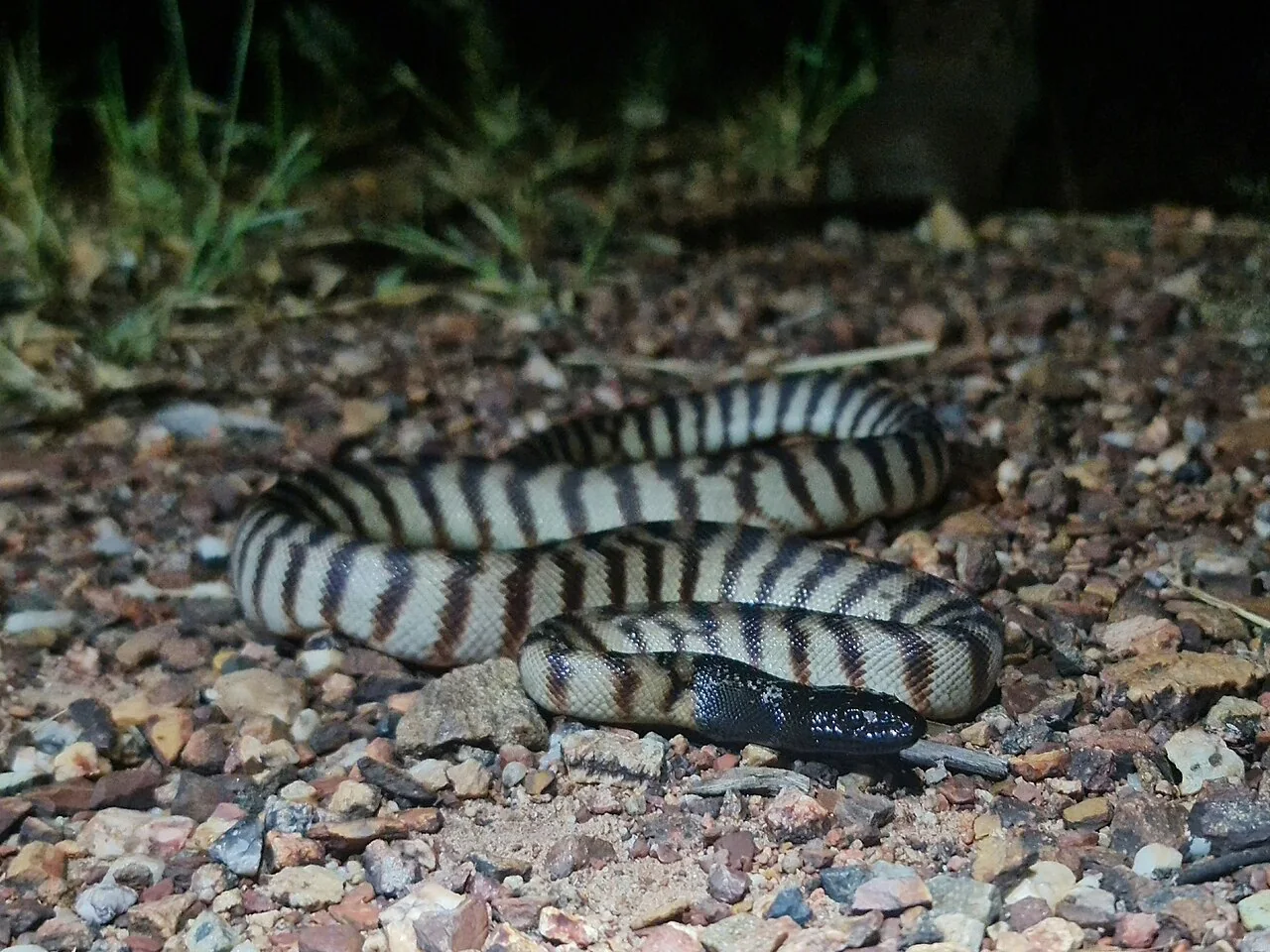
Scientific name
Aspidites melanocephalus
Other names: Aspidiotes melanocephalus
Its black head contrasts with a pale barred body. This Australian python mainly uses the ground and readily consumes other reptiles in the wild: its setup and feeding must account for this natural history. [2][3]
Origin
Northern Australia, from Western Australia to Queensland. [1][2]
- Terrestrial
- Australia
- Large python
Basking-point differences made explicit; educational figures not presented as cohorts.
At a glance
| ADULT SIZE | Up to 3 m Perth Zoo upper figure, measurement convention not explained [2]. |
|---|---|
| LIFESPAN | 20–25 years PZDA educational indication, without a published cohort [3]. |
| LIFESTYLE | Mostly on the ground Activity often nocturnal in warm periods [3]. |
Adult size
Up to 3 m according to Perth Zoo; the page does not explicitly specify TL or SVL. [2]
Lifespan
20–25 years given in the PZDA educational profile, without a published survival series. [3]
Lifestyle
Mainly terrestrial; activity often nocturnal during warm periods. [3]
Housing
INDIVIDUAL HOUSING
Ground and shelters — Separation recommended outside breeding; cannibalism reported [4][3].
Individual housing, accessible shelters and extensive floor area; the herpetological society recommends separation outside breeding. [4]
Care parameters
WARM SPOT · DAY
32–35 °C — Keeper’s reference point; WAHS proposes a warmer framework, not to be merged [5][4].
COOL AREA · DAY
Approximately 25 °C — WAHS reference point; measure the entire setup [4].
Humidity
Not quantified — Ventilation and condensation to monitor [4].
Localised heating
32–35 °C, a keeper’s reference point Real Aussie Reptiles proposes this range; other profiles are warmer. [5]
Cool end
Approximately 25 °C WAHS reference point; this value alone does not validate the entire setup. [4]
Humidity
No single target retained The WAHS profile emphasises ventilation and monitoring condensation. [4]
Feeding
A RATION TO MONITOR
Rodents and poultry used in captivity; beware of overfeeding [4].
An identity distinct from the woma
The Reptile Database accepts Aspidites melanocephalus; Aspidiotes is a former generic spelling. [1] Perth Zoo describes a shiny black head and a yellow-to-beige body crossed by darker bands. [2] This snake is not a colour form of Aspidites ramsayi. Keeping the scientific name and transfer information preserves this distinction when trade names circulate. The zoo page states up to three metres without specifying its measurement convention: do not present this upper figure as a guaranteed ordinary size.
Adult size, lifespan and lifestyle
Up to 3 m according to Perth Zoo; the page does not explicitly specify TL or SVL. [2]
20–25 years given in the PZDA educational profile, without a published survival series. [3]
Mainly terrestrial; activity often nocturnal during warm periods. [3]
Habitats and position choices
The Perth Zoo Docent Association educational profile mentions rocks, hollow logs, termite mounds, vegetation and proximity to watercourses. [3] Perth Zoo reports that the snake can warm its head at the entrance to its shelter. [2] A hide placed away from every useful thermal zone does not reproduce this choice. To prepare the terrarium, map shelters and ground-level passages. Decor must leave continuous routes and remain inspectable; its presence is not judged solely from a front view.
Individual housing and maintenance
The West Australian Herpetological Society recommends separating individuals outside breeding; the PZDA profile reports captive cannibalism. [4][3] This precaution therefore has a species-specific basis. Plan housing for each snake before purchase, including when a pair is offered together. Secure supports firmly and provide removal of containers through an easily accessible door. Cleaning should not require simultaneous restraint of two animals or moving all the decor to find a hidden individual.
Heating: make differences visible
Real Aussie Reptiles uses a basking point of 32–35 °C, whereas the WAHS profile gives 35–40 °C and approximately 25 °C at the opposite end. [5][4] These are different practice frameworks, not a study establishing one optimal value. The choice must be validated for the equipment and individual; we do not advise automatically aiming for the highest value. Record surface, air and shelter temperatures, guard access to heaters and note every probe change.
Substrate, water and air exchange
The keeper Real Aussie Reptiles describes a substrate that allows burrowing. [5] The herpetological society emphasises a ventilated setup and a stable water container. [4] No sufficiently cross-checked species-specific humidity percentage is retained here. For practical monitoring, distinguish a temporarily moist area from waterlogged substrate throughout the housing. Recording condensation and its duration helps detect a change in balance. A photograph of substrate after maintenance can also reveal a regularly leaking or overturned container.
Feeding and overfeeding risk
Reptiles occupy an important place in the natural diet described by the zoological sources. [2][3] WAHS reports captive use of appropriately sized mice, rats or chickens and warns against obesity. [4] An individual that frequently accepts prey does not necessarily need a ration increase. Ask for its history, then record each meal and changes in body shape. Juvenile feeding-start difficulties must be resolved with an experienced person, without improvising the introduction of wild animals as prey.
Breeding: observe without manufacturing a recipe
The PZDA profile describes a clutch and a female coiled around the eggs; it also reports fights between males. [3] These facts justify preparation separate from everyday keeping. We do not propose cooling or an incubator temperature inferred from a published duration. Plan separate spaces, monitoring of parental body condition and identification of juveniles. Data from successful breeding in one setup do not prove that the same timetable suits every provenance.
Precautions and observations to pass on
WAHS notes that a large individual can inflict a significant bite despite having no venom. [4] Organising interventions to keep doors, tools and containers within reach limits rushed actions. A manual log can bring together meals, sheds, weight, defecation and shelter choices. In the event of a concerning change, also pass parameters and their measurement locations to the veterinarian. Avoid calling a fast “normal” solely because the species can go without food: the individual’s trend remains necessary for assessment.
Checklist
- Plan secure individual housing.
- Compare thermal settings with the actual equipment.
- Obtain the feeding history before arrival.
Observations to record
- Meals, weight and body shape in a manual log.
- Soaking duration and substrate condition.
- Dated thermal map and setup changes.
The app provides individual animal records. Check which features are available for your animal in the released version.
Related guides
Original guides in French
Sources
Document-based overview; not a substitute for veterinary advice.
- The Reptile Database — Aspidites melanocephalus
Source accessed - Perth Zoo — Black-headed Python
Source accessed - Perth Zoo Docent Association — Black-headed Python, 2023
Source accessed - West Australian Herpetological Society — Black Headed Python, 2015 ; copie Big Sky Reptiles
Source accessed - Real Aussie Reptiles — Aspidites species, pratique d’élevage
Source accessed