
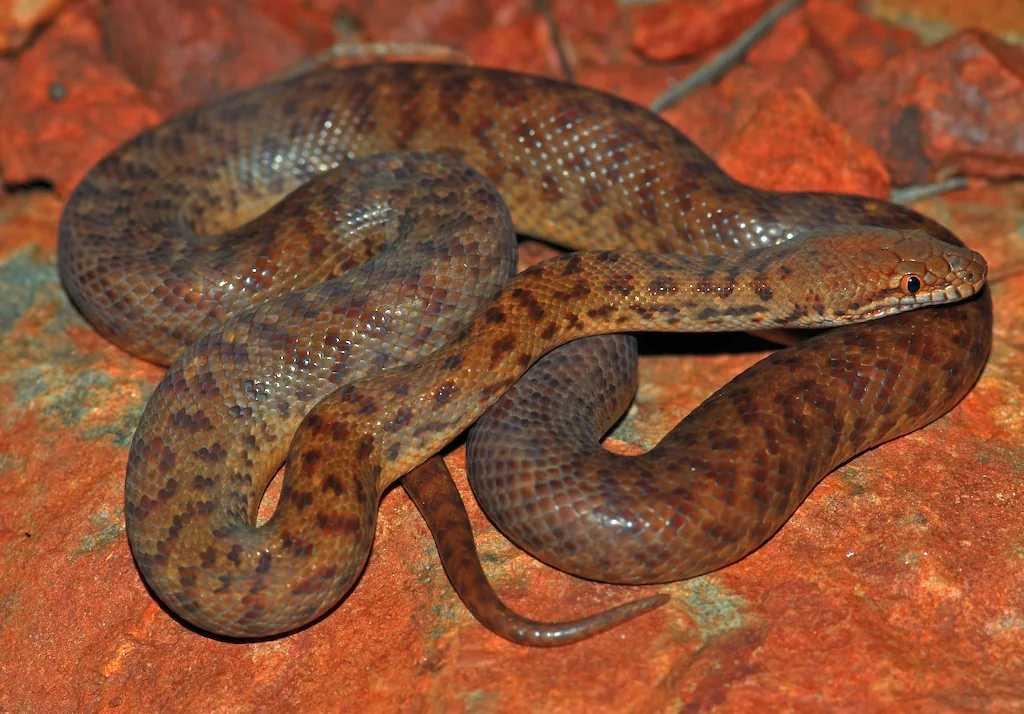
Scientific name
Antaresia perthensis
Other names: Liasis perthensis
The pygmy python is a small Australian python associated particularly with rocky refuges and termite mounds. Its small size removes neither escape risks nor the need to check its feeding before arrival. [2][3]
Origin
North-western Western Australia, including the Pilbara; despite its name, it does not live around Perth. [1][2]
- Small python
- Western Australia
- Shelters
Species-specific museum, taxonomy and natural history overview; genus-level clinical framework explicitly distinguished.
At a glance
| ADULT SIZE | 40 cm on average Total length; stated maximum of 60 cm [3]. |
|---|---|
| LIFESPAN | Not established Over 20 years stated for the genus, without a species-specific average [4]. |
| LIFESTYLE | Ground and shelters Rocky areas and termite mounds [2][3]. |
Adult size
AROD gives 40 cm average total length and 60 cm maximum. [3]
Lifespan
The clinic states over 20 years for the Antaresia group; no average specific to perthensis is provided. [4]
Lifestyle
Terrestrial, using termite mounds and rocky areas in particular. [2][3]
Housing
A SECURE HABITAT
Accessible shelters — Genus-level clinical reference points; check every gap [4].
A secure habitat, shelters and opportunities to burrow; the clinical reference points cover several Antaresia. [4]
Care parameters
WARM SPOT · DAY
32–35 °C — Clinical basking point shared by Antaresia [4].
COOL AREA · DAY
24 °C — Cool end from the same clinical framework [4].
Humidity
Not quantified — The clinic distinguishes species’ needs [4].
Heating spot
32–35 °C A clinical reference point shared by Antaresia, to adapt to the individual. [4]
Cool end
24 °C Value from the same profile, measured at snake height. [4]
Night
21 °C or above A group-level clinical reference point, not a field measurement for perthensis. [4]
Humidity
Not quantified The clinic specifies that needs depend on the species. [4]
Feeding
A FEEDING START TO VERIFY
Small lizards, particularly geckos, in the natural diet; obtain the individual history [2][3].
A small species to identify correctly
The Reptile Database recognises Antaresia perthensis and documents its former combinations in Liasis and other genera. [1] The Western Australian Museum describes it as light brown to reddish brown. [2] AROD gives an average total length of approximately 40 cm, with a stated maximum of 60 cm. [3] This measurement must not be confused with snout–vent length. Photographing the individual and retaining its stated origin is more useful than a general label such as “small Australian python”.
Adult size, lifespan and lifestyle
AROD gives 40 cm average total length and 60 cm maximum. [3]
The clinic states over 20 years for the Antaresia group; no average specific to perthensis is provided. [4]
Terrestrial, using termite mounds and rocky areas in particular. [2][3]
The importance of natural shelters
The museum reports its presence in termite mounds, where it finds geckos among other prey; AROD also mentions rocky areas and scrub. [2][3] A termite mound represents a network of microhabitats, not simply dry decor. For the setup, consider covered passages and available shelters in several zones. The practical aim is for the snake to move without having to remain exposed. Do not collect a termite mound or wild prey to reproduce this description literally.
Setting up and securing a small python
Veterinarian Izidora Sladakovic’s profile explicitly covers pygmy pythons, but also other Antaresia. It recommends furnishings allowing hiding, climbing and burrowing, and warns against accessible adhesives. [4] Small size requires detailed inspection of cable openings, rails and grilles. Test the empty setup, then photograph closure points to retain a reference after every maintenance session. The volume stated on a box describes neither its gaps nor its actual available area.
A thermal framework whose scope remains visible
The clinical framework shared by Antaresia proposes localised heating at 32–35 °C, a cool end at 24 °C and a night-time temperature of at least 21 °C. [4] This is not an experimental study specific to perthensis. Keep this qualification in the project and check results with the professional caring for the animal. Measuring at body height and inside refuges distinguishes a thermostat setting from the temperature actually available; the number displayed on the device is insufficient.
Water, substrate and humidity without a false percentage
The same clinic specifies that humidity depends on the species, without providing a value specific to the pygmy python. [4] We therefore do not add an invented comfort target. Provide access to water and record substrate condition, soiling and drying phases. Humidity readings benefit from an accompanying time and location. If a change is needed, date it and observe its effects; simultaneously altering ventilation, watering and heating prevents understanding of what actually changed.
Feeding: check the start
The natural history sources emphasise consumption of small lizards, particularly geckos. [2][3] This makes an individual history essential when a juvenile is sold as feeding on rodents. Ask for the latest dates, presentation and prey actually swallowed, not merely offered. The clinical profile provides a general carnivorous framework for Antaresia without demonstrating an identical menu for every perthensis. [4] A refusal must be described with its context; do not improvise force-feeding or a dietary conversion from general advice.
Breeding and preparation for juveniles
The Reptile Database and AROD describe an oviparous species. [1][3] These sources do not provide a complete, updated captive protocol from which to set incubation temperature, seasonal conditioning or the first ration. Breeding must therefore have a separate record. Preparing individual identifiers and secure setups before any birth allows each first shed and meal to be linked to the correct juvenile. The parents’ modest size does not permit an entire clutch to be treated as a single animal.
Precautions and a useful log
For this small snake, simple monitoring can be highly precise: meal dates, observed sheds, comparable weighings and descriptions of shelters used. Avoid repeated handling solely to check its presence; make hides inspectable from the design stage. Any unexpected absence requires closures to be checked immediately. A weight or behavioural change must be communicated with measured conditions rather than a predetermined conclusion. This profile’s documentary limits remain visible to guide questions before acquisition.
Checklist
- Check the smallest gaps and exclude accessible adhesives.
- Obtain the independent feeding history.
- Clarify individual-specific parameters with a professional.
Observations to record
- Manual journal of accepted prey.
- Weights measured under comparable conditions.
- Sheds, shelters used and closure checks.
The app provides individual animal records. Check which features are available for your animal in the released version.
Related guides
Original guides in French
- Python pygmée : préparer l’arrivée d’Antaresia perthensis
- Quelle taille de proie choisir pour un serpent ?
- Mon serpent refuse de manger : quoi vérifier et quand appeler
- Chauffage du terrarium : choisir le thermostat et vérifier le montage
- La mue du serpent : observer le déroulement et repérer un problème
Sources
Document-based overview; not a substitute for veterinary advice.
- The Reptile Database — Antaresia perthensis
Source accessed - Western Australian Museum — Pygmy python
Source accessed - Stewart Macdonald, AROD — Pygmy python
Source accessed - Dr Izidora Sladakovic, Avian and Exotics Service — Antaresia python care, 2021
Source accessed