
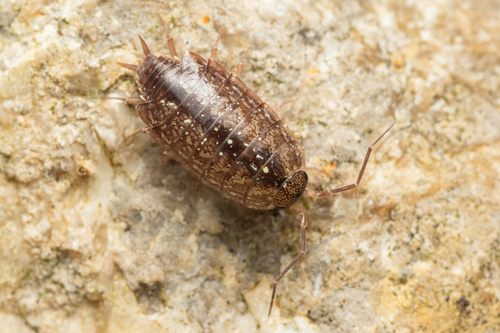
Scientific name
Philoscia affinis
Philoscia affinis was long overlooked in British records because of its resemblance to P. muscorum. Re-examination of old collections corrected part of that history. [1][2]
Origin
Occurrence documented in northern France, Belgium, Great Britain and Ireland in Gregory’s work; the British map shows a western tendency. [2]
- Microscopic identification
- Open woodland
- Grassy coast
Natural-history synthesis; no validated captive protocol in the selected sources.
At a glance
Philoscia affinis was long confused with P. muscorum. Re-examination of old collections clarified its British occurrence. [1][2]
| ADULT SIZE | Not provided Biometrics not adopted from the passages consulted. |
|---|---|
| LIFESPAN | Not established No supported individual lifespan in the selected sources. |
| LIFESTYLE | In litter Open woodland and tall coastal vegetation. [1] |
Adult size
No length range adopted: distinguishing criteria are better documented than biometrics in the passages consulted.
Lifespan
Individual lifespan not established in the selected sources.
Lifestyle
A species of litter, stones and wood on the ground; BMIG highlights open woodland and tall coastal vegetation. [1]
Housing
NATURAL ENVIRONMENT
Wood and stones on the ground — Natural context; no captive setup or density validated in this source collection. [1]
Natural-history observation takes priority. The sources validate no captive setup, density or breeding protocol.
Care parameters
CAPTIVE CLIMATE
Not established — No validated husbandry range in the selected sources.
Humidity
Natural environment — Documented woodland and coastal shelters; no air percentage inferred. [1]
Habitat
Open woodland and coastal areas [1] Do not reduce an Atlantic distribution to a fixed relative humidity.
Captive parameters
Not established by the selected documents Retain site conditions as observation data without turning them into an optimum.
Feeding
DIET AND CALCIUM
Ration and calcium supply not established in the documents consulted. Resemblance to P. muscorum does not validate transferring a protocol. [1][2]
Scope of this profile
Natural-history synthesis; no validated captive protocol in the selected sources.
The head provides a clue, not certainty
Pigmentation of the head and body edges helps guide identification, but BMIG requires microscopic examination of a male’s seventh leg for reliable identification. [1] An overview photo therefore cannot always decide. In the log, use a provisional identification when no decisive character has been examined.
What old collections change
Gregory connected new records with specimens previously filed under P. muscorum. The work shows that a recent first confirmation does not necessarily mean recent arrival. [2] This distinction matters for any strain or site history: entering observation and identification dates in two separate fields avoids telling an unproven colonisation story.
Shelters and setup
Field shelters include accumulated litter, stones and dead wood. [1] No comparative trial here allows a substrate mix or ventilation rate to be chosen. This profile’s purpose is to help observe and identify; it does not recommend taking a population to test a generic setup. A culture already held deserves particularly rigorous provenance records.
Diet and calcium
The documents opened give no ration specific to P. affinis or calcium quantity. Morphological similarity to P. muscorum is not enough to import every practice attributed to the latter. If feeding is observed, specify the support and material condition; do not equate an animal hidden beneath a leaf with one consuming it.
Humidity and reproduction
An affinity for certain woodlands and coasts does not provide a hygrometer setting. Likewise, local coexistence of the two Philoscia mentioned in the study does not demonstrate that a mixed culture would be interpretable. [2] Juvenile counts, reproduction dates and lifespan are not quantified here. Keeping groups separate helps preserve their descendants’ identities.
Monitoring and observation quality
Prioritise clear photographs, a scale, location and discovery circumstances. BMIG also mentions a few recent horticultural sites; these call for documenting plant transfers without assuming every urban observation is an introduction. [1] An identification corrected later must remain visible in the history so older biological notes can be reinterpreted under the correct name.
Checklist
- Distinguish collection and identification dates.
- Keep provisional identifications.
- Avoid mixed groups.
Observations to record
- Diagnostic characters
- Identification history
- Shelter, location and life stage
The app provides individual animal records. Check which features are available for your animal in the released version.
Sources
Document-based overview; not a substitute for veterinary advice.