
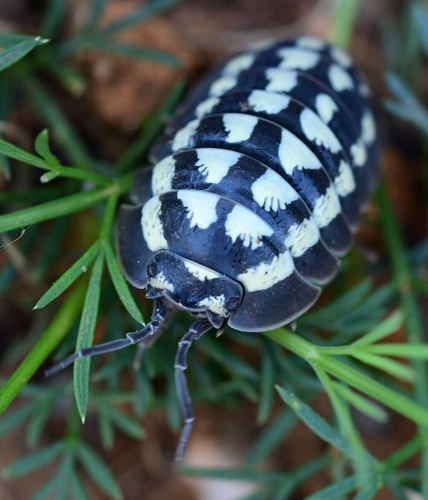
Scientific name
Armadillidium gestroi
Other names: Armadillidium quadriseriatum · Armadillidium albigauni · Armadillidium gestroi
This large, dark, spotted Armadillidium is an accepted species in GBIF/Catalogue of Life. The catalogue brings A. quadriseriatum and A. albigauni together under this name, among others. [1]
Origin
Italy in the breeding account consulted; do not turn this national origin into a precise locality for every group in the trade. [2]
- Conglobation
- Italy
- Shelters under leaves
Taxonomy checked; husbandry and assessment of reproductive speed attributed to a commercial breeder.
At a glance
Armadillidium gestroi is a recognised, dark, spotted species. The captive practices presented come from Insektenliebe [1][2].
| DOCUMENTED SIZE | Around 20 mm Descriptive indication from Insektenliebe [2]. |
|---|---|
| LIFESPAN | To be documented No supported individual lifespan in the selected sources. |
| LIFESTYLE | Under leaves Behaviour observed in Insektenliebe’s collection [2]. |
Adult size
Around 20 mm in the Insektenliebe profile; a descriptive commercial measurement, without a detailed population series. [2]
Lifespan
No supported individual lifespan adopted from the sources consulted.
Lifestyle
The breeding account describes animals readily hiding beneath leaves and a colony that renews itself more slowly than some other rolling woodlice. [2]
Housing
SETUP AND SHELTERS
Litter and wood — Food-providing soil, leaves, decaying hardwood and bark; keep shelters accessible [2].
A closed, ventilated enclosure covered in litter over food-providing soil, with flat bark; retain slightly humid shelters and a less humid area. [2]
Care parameters
BREEDER REFERENCE
21–24 °C — Approximate practice reported by Insektenliebe [2].
Humidity
Humid shelters — Slightly moist cover and a less humid part; check the soil beneath leaves [2].
Temperature
21–24 °C in Insektenliebe’s culture [2] A commercial experience value explicitly presented as approximate.
Shelter
Slightly moist soil beneath the cover [2] Check beneath the leaves; a dry-looking surface is not enough.
Feeding
DIET AND CALCIUM
Leaves and decaying wood as a base, calcium and small supplements; check perishable leftovers according to the breeder [2].
Scope of this profile
Taxonomy checked; husbandry and assessment of reproductive speed attributed to a commercial breeder.
Identifying without multiplying species
GBIF keeps former names in synonymy. [1] This profile therefore groups the species under A. gestroi and does not turn an old combination into a standalone entry. Any selected-strain name received with the colony must remain in its traceability record. Keeping a photograph of the initial label allows a later identification change to be understood without losing the group’s history.
Setup and access to shelters
Insektenliebe uses food-providing soil, decaying leaves and soft hardwood; coconut fibre alone is not considered a sufficient dietary base. [2] To make checks easier, place an identifiable shelter near each area, then leave the remaining litter in place. A clearly organised setup avoids having to search for every animal at every opening.
Diet and calcium supply
The breeder maintains leaves and decaying wood, adds calcium and checks small perishable supplements the following day. [2] In monitoring practice, writing down what was added and what remains helps identify unusual consumption. Do not interpret lack of interest in a supplement as certain fasting when edible litter is still available.
Climate: checking where the animals are
The shelter must retain moisture while offering a less humid alternative. The commercial account rules out direct sun and uncontrolled heating. [2] Recording measurements at enclosure level with their times allows hot days to be compared with other days. A single room reading is not enough to characterise all the litter.
Discreet reproduction
Insektenliebe reports relatively slow multiplication in its own collection; this comparison is not a brood count applicable to every strain. [2] Date the first young, record where they are observed and keep photos taken at intervals. Patience does not remove the need to check resources; above all, it avoids changing several parameters solely because an arbitrarily expected population has not been reached.
Daily monitoring and documentary limits
Bringing behavioural observations, interventions and visible abnormalities together in one note allows the chronology to be reviewed. Explicitly state ‘not observed’ when animals remain hidden rather than declaring an event absent. Taxonomic identification and commercial advice answer two different questions: the catalogue confirms a name but does not validate a breeding protocol or a reproduction promise.
French references: Armadillidium gestroi
Reference found in the following French catalogues: Isopodshop [3]; Insectorus [5]. Catalogue presence, including out-of-stock listings, does not measure sales.
Isopodshop suggests 18-26 °C for husbandry. This is a commercial reference, not a demonstrated safe range. [3]
Insectorus states 20-26°C. This commercial range does not demonstrate safety thresholds. [5]
Insectorus states 2cm in adulthood, without explaining the measurement method. [5]
These sellers’ figures remain separately attributed: combining them does not create a newly validated husbandry range.
Checklist
- Keep former taxonomic labels.
- Prepare leaves, soft wood and calcium.
- Identify a check shelter without disturbing the whole enclosure.
Observations to record
- Manual shelter checks
- Food offered and leftovers
- First young observed
- Setup changes
The app provides individual animal records. Check which features are available for your animal in the released version.
Sources
Document-based overview; not a substitute for veterinary advice.
- GBIF / Catalogue of Life — Armadillidium gestroi
Source accessed - Insektenliebe — Caring for Armadillidium gestroi
Source accessed - Armadillidium gestroi — Isopodshop
Source accessed - World Marine, Freshwater and Terrestrial Isopod Crustaceans database — Armadillidium gestroi
Source accessed - Armadillidium gestroi — Insectorus
Source accessed