
Scientific name
Porcellio scaber
Other names: Porcellio scaber
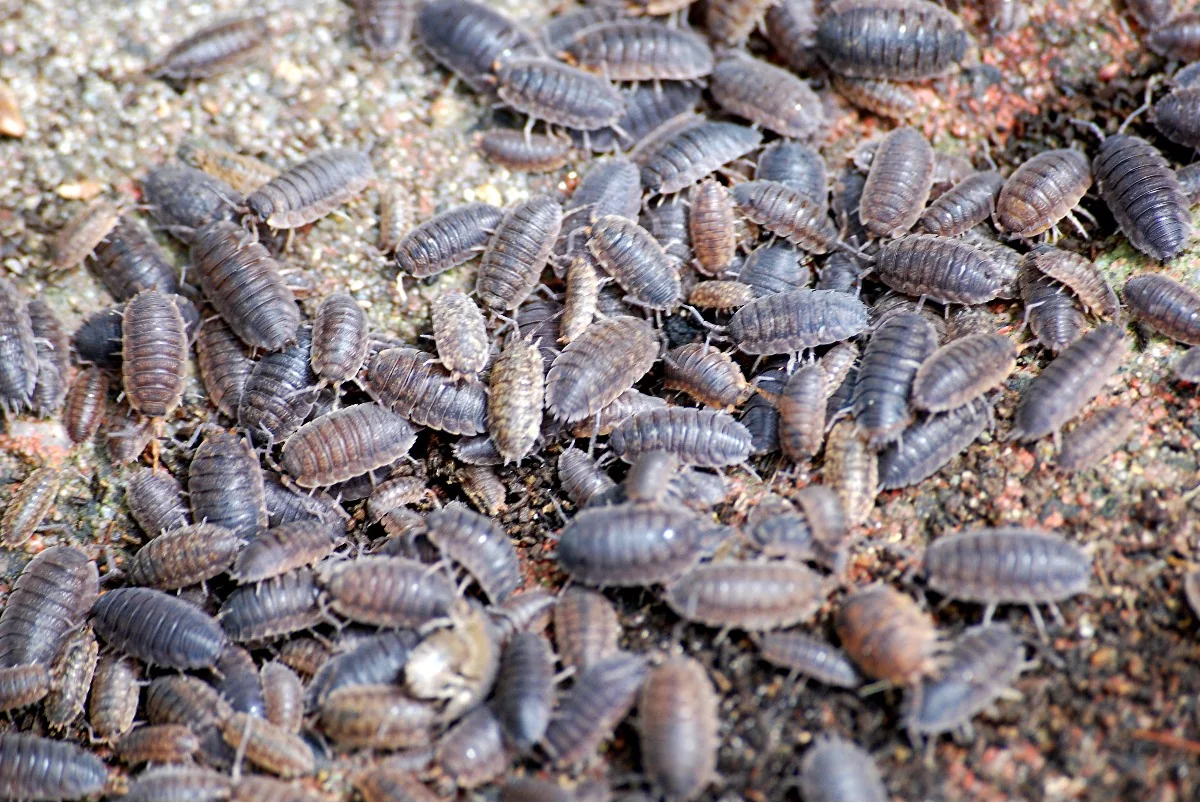
Porcellio scaber is a terrestrial woodlouse with a granular back, described by Latreille in 1804. Its colouring can vary greatly within the same species. [1]
Origin
A widely distributed species, notably in Great Britain and Ireland where the BMIG describes it under stones and dead wood; this current distribution does not identify the provenance of a captive strain. [1]
- Terrestrial woodlouse
- Detritivore
- Litter and shelters
- Colony life
At a glance
Porcellio scaber: a woodlouse with a granular back and variable colouring, commonly found beneath stones and dead wood [1].
| DOCUMENTED SIZE | Up to 17 mm Body length, BMIG synthesis [1]. |
|---|---|
| LIFESPAN | ≈ 2–3 years ADW estimate; limited data [5]. |
| LIFESTYLE | In litter Stones, wood and other shelters [1]. |
Adult size
Up to 17 mm in body length in the British Myriapod and Isopod Group’s synthesis. [1]
Lifespan
Animal Diversity Web reports an estimate of 2–3 years while stressing the lack of species-specific data; this is not a guaranteed captive lifespan. [5]
Lifestyle
Uses many habitats, can climb walls and trees, and retreats beneath stones or wood. [1]
Housing
AN ENVIRONMENT TO OBSERVE
Litter and shelters — A closed enclosure with humid retreats and suitable ventilation [4].
A closed, ventilated container offering litter and humid shelters matches the practices described by The Bio Dude. [4] Laboratory box dimensions do not constitute a validated minimum for home husbandry.
Care parameters
STUDY CONTEXT
≈ 20 °C — Laboratory culture; not a validated optimum for home husbandry [2].
Humidity
Distinct zones — Maintain a humid shelter and a less humid zone, with suitable ventilation [4].
Temperature
Around 20 °C in the laboratory culture described by Drobne and Drobne. [2] An experimental condition, not demonstration of an optimum. Measure the enclosure rather than inferring its temperature from the room.
Environmental moisture
Access to humid shelters and a less humid area. [4] Observe the substrate separately from air-humidity values.
Ventilation
Moderate ventilation in The Bio Dude’s breeding guide. [4] Keep the position of openings in the enclosure description and note any change.
Rhythm and light
Mainly nocturnal activity according to the ADW university synthesis. [5] Note observation times to compare checks made in similar contexts.
Feeding
ADDITIONS AND LEFTOVERS
Maintain a base of leaves and decaying wood; record supplements and their leftovers [4].
Identifying the common rough woodlouse
The BMIG describes a strongly tuberculate back, a continuous outline and two segments in the antennal flagellum. Mottled forms do not necessarily show the longitudinal lines of some similar species. [1]
Orange or mottled colouring does not create a new species. In captive breeding, keep the scientific name, strain name and origin separately. If identification is uncertain, keep that uncertainty visible in the log.
Installing litter and shelters
The Bio Dude’s guide suggests dead leaves, decaying wood, bark and cork shelters, with a moisture gradient. Describing the composition and depth actually installed allows setups to be compared. [4]
The species can climb some surfaces. [1] Check the lid, joints and mesh; also check leaves and wood pieces moved during maintenance to avoid unintentionally transferring animals.
Feeding: distinguishing additions from consumption
In Drobne and Drobne’s experiments, feeding was quantified by weighing leaves before and after exposure. Consumption varied greatly between individuals, even under controlled conditions. [2]
For the home log, record food offered, an amount if known, then observed leftovers. The Bio Dude describes a base of leaves and decaying wood, supplemented by plant and protein additions and a calcium source. [4] No universal ration per number of woodlice is inferred here.
Moulting and growth: what changes in an individual
In P. scaber, moulting first renews the rear part of the body, then the front. Some calcium from the old cuticle is recovered and reused to mineralise the new one: this recycling has been studied directly in the species. [6]
Young mancae leave the maternal marsupium before their last pair of walking legs is fully developed. Subsequent moults accompany their development. External sexual characteristics appear before the individual is necessarily mature. [7]
Growth varies between individuals and with food resources in Zimmer’s experiments. A juvenile’s size or sexing alone therefore cannot establish its first reproduction date. [7]
Temperature and reproduction: what research measures
Horváthová and colleagues studied development in the marsupium and juvenile growth at 15 and 22 °C, under two oxygen concentrations. Development was slower in the cold conditions. [3]
This experiment shows the importance of context; it provides neither a certain birth date for a home colony nor an instruction to alter enclosure oxygen. Recording the first observation of young and the conditions measured that day is more useful than an automatic countdown.
Understanding activity and observations
The ADW synthesis describes nocturnal activity and movements linked to moisture conditions. [5] A check at a different time or under another shelter is therefore not directly comparable to the previous one.
To track a trend, keep a simple, repeatable method: the same observed area, a recorded time, an optional photograph. The absence of visible individuals does not prove the colony has disappeared.
Maintaining, splitting and documenting
Log leaf additions, removal of leftovers, water additions and substrate changes. During an incident, first describe the facts and recent modifications; observations alone do not determine a cause of death.
To start a second group, record the source enclosure, date and the genuinely known number transferred. An estimate must remain identified as such. Archive old enclosures without erasing their descendants’ provenance.
Bioactive terrarium: keeping real records
The Bio Dude presents P. scaber as a detritivore used in bioactive setups but urges caution with delicate or soft-bodied animals. [4] Its presence is not enough to validate a particular cohabitation.
The profile distinguishes natural-history observations [1], laboratory experiments [2][3] and commercial breeding practices [4]. A parameter published in a study does not automatically become a husbandry prescription.
Frequently asked questions
Is it the same animal as every orange variety? Colour alone cannot assign a species; use the scientific name and documented identification. [1]
Must the whole colony be counted every week? The log can work with an unknown population and dated observations. A partial count must specify the area checked.
Can the number of young be predicted? The selected studies do not allow colony production to be predicted solely from its starting population. Keep records of young observed without automatically adding them together.
French references: Porcellio scaber
Reference found in the following French catalogues: Isopodshop [8]; Insectorus [10]. Catalogue presence, including out-of-stock listings, does not measure sales.
Isopodshop suggests 18-24 °C for husbandry. This is a commercial reference, not a demonstrated safe range. [8]
Insectorus states 18-26°C. This commercial range does not demonstrate safety thresholds. [10]
Insectorus states 1.5cm in adulthood, without explaining the measurement method. [10]
These sellers’ figures remain separately attributed: combining them does not create a newly validated husbandry range.
Checklist
- Document the group’s name and provenance.
- Prepare shelters, litter and areas with different moisture levels. [4]
- Check openings and record container dimensions.
- Record an initial reading and the observation method.
Observations to record
- Food and leftovers
- Water additions
- Enclosure readings
- Young observed
- Maintenance and transfers
The app provides individual animal records. Check which features are available for your animal in the released version.
Related guides
Original guides in French
Sources
Document-based overview; not a substitute for veterinary advice.
- British Myriapod and Isopod Group — Porcellio scaber
Source accessed - Drobne & Drobne (2014) — Reference values for feeding parameters of Porcellio scaber
Source accessed - Horváthová et al. (2015) — Temperature, oxygen and development in Porcellio scaber
Source accessed - Josh Halter / The Bio Dude — Scaber Isopod Care Sheet (guide commercial)
Source accessed - Animal Diversity Web / University of Michigan — Porcellio scaber
Source accessed - Neues et al. (2011) — Amorphous and crystalline calcium carbonate distribution in the tergite cuticle of moulting Porcellio scaber
Source accessed - Zimmer (2002) — Postembryonic ontogenetic development in Porcellio scaber: the significance of food
Source accessed - Porcellio scaber — Isopodshop
Source accessed - World Marine, Freshwater and Terrestrial Isopod Crustaceans database — Porcellio scaber
Source accessed - Porcellio Scaber — Insectorus
Source accessed