
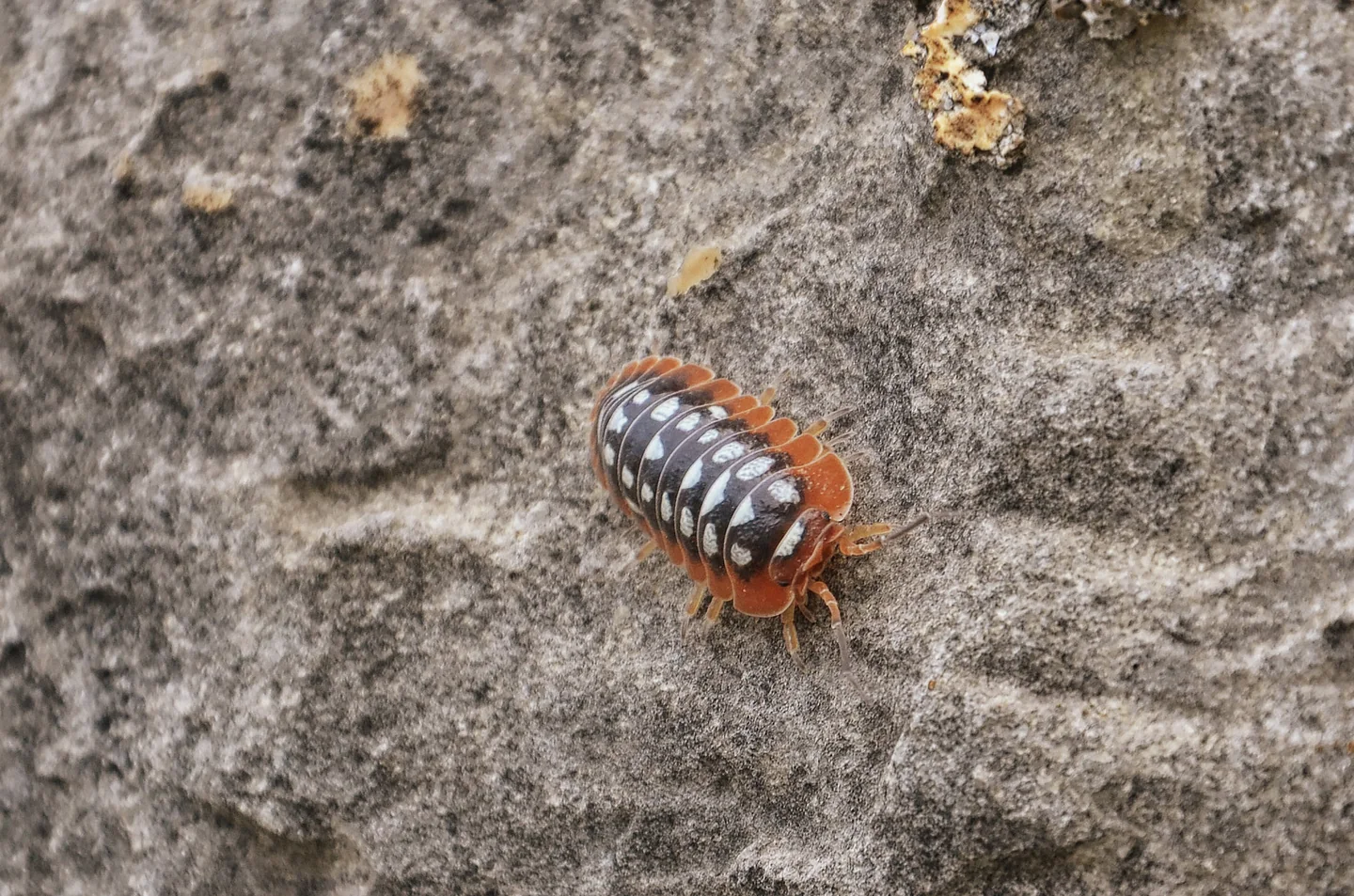
Scientific name
Armadillidium klugii
Other names: Armadillidium albanicum · Armadillidium inflatum · Armadillidium cetinjense · Armadillidium klugii · Armadillidium klugii « Montenegro »
Armadillidium klugii is a woodlouse in the Armadillidiidae family. This profile covers the species; ‘Montenegro’ is a provenance name used in captive breeding. [1][2]
Origin
Eastern edge of the Adriatic and Ionian Seas, from Croatia to Corfu and the neighbouring mainland, according to Schmalfuss’s revision. [1]
- Terrestrial woodlouse
- Detritivore
- Colony life
- Humid shelters
At a glance
A woodlouse from the eastern shores of the Adriatic and Ionian Seas; ‘Montenegro’ supplements the species name [1][2].
| DOCUMENTED SIZE | Up to 21 mm Revision maximum, not an average [1]. |
|---|---|
| LIFESPAN | To be documented No validated lifespan in the selected sources. |
| LIFESTYLE | Ground-dwelling Litter and shelters [2]. |
Adult size
Maximum length of 21 mm in the material studied by Schmalfuss; this maximum does not represent an average size. [1]
Lifespan
Lifespan is not established by the selected sources. The persistence of a colony through successive generations does not measure an individual’s lifespan.
Lifestyle
Lives on the ground, retreating under shelters and into litter; breeders’ guides describe individuals sometimes visible on the surface. [2][3]
Housing
AN ENCLOSURE WITH SHELTERS
Ventilated and furnished — Leaves, decaying wood and areas with different moisture levels [2].
Closed, ventilated enclosure or terrarium offering litter, shelters and areas with different moisture levels. Podhaus describes an enclosure of around 5,7 litres to start a group of ten; this is a breeder’s example, not a validated minimum. [2]
Care parameters
BREEDER REFERENCE
23–28 °C — The Bio Dude; captive practice, not a demonstrated optimum [3].
Humidity
A gradient — A humid shelter and a less humid area, with suitable ventilation [2][3].
Temperature
23–28 °C: range suggested by The Bio Dude, converted from 74–82 °F. [3] Commercial practice reference, not an experimental optimum. Record the temperature inside the enclosure and keep the thermometer’s location on record.
Humidity
A humid shelter and a less humid area; avoid uniformly waterlogged substrate. [2][3] Air humidity displayed by a hygrometer alone does not describe the water present in the substrate.
Ventilation
Air circulation and humid shelters must work together. [2] Adapt water additions to the drying actually observed, the container and the room.
Light
Maintain shaded shelters. [3] No validated species-specific UVB protocol is established by the selected documents; this profile does not prescribe a lamp to stimulate reproduction.
Feeding
A LITTER-BASED DIET
Leaves and decaying wood, measured supplements and available calcium [3].
Recognising the species and keeping its origin
Rows of spots and coloured borders vary. Related species can look alike: a photograph of the back is not always enough for identification. The 2013 revision places A. albanicum, A. inflatum and A. cetinjense within A. klugii. [1]
Keep the scientific name, the label received and the seller in the log. A ‘Montenegro’ label alone documents neither a precise collection locality nor a strain’s entire history. To retain this traceability, record mixing and transfers.
Preparing substrate and shelters
The Podhaus guide combines substrate, dead leaves, decaying wood, cork and a water-retaining moss area. Distribute shelters so the animals have several retreats. [2]
Before setup, check gaps around the lid, rails and ventilation. An opening that retains adults is not validated for juveniles: test the assembly and record its actual dimensions.
Feeding and checking leftovers
The Bio Dude describes dead leaves and decaying wood as the dietary base, with small plant and protein supplements and an available calcium source. [3]
Record what is added separately from the leftovers observed. Podhaus advises limiting supplement portions so they do not linger in the enclosure. [2] A photograph before removal helps compare subsequent additions.
Moulting, marsupium and sexing: understanding observations
In woodlice, moulting generally takes place in two stages: the rear part of the body is renewed before the front. Two temporarily different halves therefore do not necessarily represent a permanent colour variation. This is a general mechanism, not a moulting schedule specific to A. klugii. [4]
The female carries the eggs and then the first young in a ventral pouch, the marsupium. The early stages, called mancae, continue developing before and after emergence. These general references do not give a species-specific age of maturity. [4]
For A. klugii, the scientific revision describes the male’s first pleopod and certain legs, among other features. These are ventral characters; an impression based on silhouette alone does not provide reliable sexing. [1]
Reproduction and the first young
The guides describe sometimes slow establishment and a variable reproductive rate. [2][3] No guaranteed time to the first young, brood size or universal age of maturity is adopted here.
In the log, record ‘young observed’ on the discovery date. Keep a photo if possible, without treating young seen again a few days later as new births. The total population can remain unknown.
Monitoring the colony and its changes
During a check, record the condition of both substrate zones, leaf availability, leftovers, visible activity and any deaths. ‘Not observed’ is preferable information to an invented estimate.
When splitting a colony, assign a name to the new group and record the source colony, date and number actually transferred if counted. Keep the history even if the original enclosure is later emptied.
Cohabitation and the limits of recommendations
The Bio Dude notes possible consumption of tender plants and vulnerability to predation in inhabited terrariums. [3] The presence of woodlice therefore guarantees neither suitable cohabitation nor self-maintenance of the terrarium.
The enclosure dimensions and husbandry settings in this profile are attributed to their authors. Taxonomy comes from a scientific revision; the cited captive practices come from breeders. Their evidence levels remain distinct.
Frequently asked questions
Is Montenegro a different species? No: the scientific name of the colony concerned remains Armadillidium klugii; the name received is retained as additional information. [2]
Is heating needed to obtain young? This profile does not recommend automatic heating. First measure the enclosure and assess conditions as a whole; the selected sources cannot guarantee reproduction through a single setting.
How many woodlice are in my enclosure? A count of visible individuals is not a full census. Keep the method and date of each count or estimate.
French references: Armadillidium klugii « Montenegro »
Reference found in the following French catalogues: Isopodshop [7]. Catalogue presence, including out-of-stock listings, does not measure sales.
Isopodshop suggests 18-26 °C for husbandry. This is a commercial reference, not a demonstrated safe range. [7]
These sellers’ figures remain separately attributed: combining them does not create a newly validated husbandry range.
Checklist
- Keep the original label and name the colony.
- Prepare litter, shelters and a humid retreat. [2]
- Check closures and ventilation.
- Record enclosure conditions before arrival.
Observations to record
- Additions and leftovers
- Substrate zones
- Dated measurements
- Young observed
- Transfers
The app provides individual animal records. Check which features are available for your animal in the released version.
Sources
Document-based overview; not a substitute for veterinary advice.
- Schmalfuss (2013) — Revision of the Armadillidium klugii-group
Source accessed - Podhaus — Armadillidium klugii « Montenegro Clown » (pratique d’éleveur)
Source accessed - Josh Halter / The Bio Dude — Clown Isopod Care Sheet (guide commercial)
Source accessed - British Myriapod and Isopod Group — An Introduction to Woodlice, reproduction et mue (portée générale)
Source accessed - Armadillidium cetinjense — Isopodshop
Source accessed - World Marine, Freshwater and Terrestrial Isopod Crustaceans database — Armadillidium klugii
Source accessed - Armadillidium klugii « Montenegro » — Isopodshop
Source accessed