
Scientific name
Porcellionides pruinosus
Other names: Porcellionides pruinosus
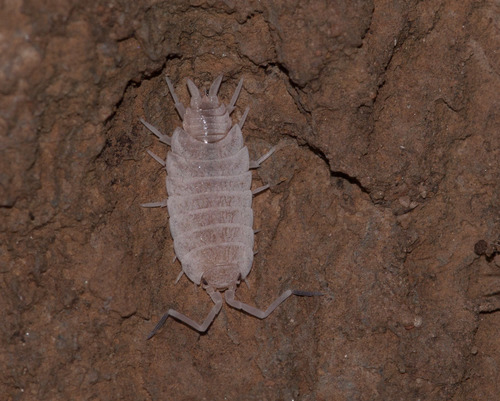
This fast woodlouse, often sold under colour names, occurs particularly in decaying organic matter. The name also covers a scientific problem: very similar populations belong to a species complex. [1][2]
Origin
Distribution documented particularly in Great Britain and Ireland; this finding does not define its native range. Worldwide reports require caution because of the pruinosus complex. [1][2]
- Fast
- Synanthropic
- Identity to document
Documentary synthesis: natural-history data and husbandry limits distinguished.
At a glance
Fast and often found in decaying matter, this woodlouse belongs to a species complex that is difficult to distinguish. [1][2]
| ADULT SIZE | Up to 12 mm Body length according to BMIG. [1] |
|---|---|
| LIFESPAN | Not established No supported individual lifespan in the selected sources. |
| LIFESTYLE | On the ground, fast Compost and agricultural outbuildings in particular. [1] |
Adult size
Up to 12 mm in body length according to BMIG. [1]
Lifespan
Individual lifespan is not established by the sources consulted; a colony’s persistence does not measure its founders’ ages.
Lifestyle
Silhouette narrowed at the rear, long legs and rapid escape; common in compost, manure and agricultural outbuildings. [1]
Housing
ATTRIBUTED BREEDING PRACTICE
Ventilated litter — Two wetting areas and calcium in the Springtails US method. [3]
Springtails US uses litter, ventilation, two wetting areas and calcium. Breeder practice, without comparative validation. [3]
Care parameters
CAPTIVE CLIMATE
Not established — No validated husbandry range in the selected sources.
Humidity
Localised wetting — Breeder practice: a humid area and a less wet area, without an air percentage. [3]
Temperature
No validated range adopted Record measurements at shelter level without inferring a setting solely from the term ‘cosmopolitan’.
Substrate
Two wetting areas [3] The humid/drier distinction concerns the substrate; it does not translate into an air-humidity percentage.
Feeding
DIET AND CALCIUM
Leaves as a base, supplements and calcium in Springtails US practice. [3] Natural occurrence in manure does not prescribe adding it fresh.
Scope of this profile
Documentary synthesis: natural-history data and husbandry limits distinguished.
Colour does not determine a species
The surface may show a blue-grey bloom over a purplish-brown background; BMIG also notes orange animals. Pale legs and pale antennal rings contribute to the characteristic appearance. [1] Keep the strain name on the label, but do not create a species profile for every colour. An overview photograph makes traceability stronger than a nickname alone.
Setting up an easily monitored culture
Provide easy-to-lift shelters and a clear rim allowing the container to be opened without dispersing animals. The movement speed described by BMIG warrants methodical inspection. [1] The commercial protocol consulted includes protected vents. [3] To compare two interventions, change only one element at a time: wetting, shelter placement or food amount, then record the date.
Foods and calcium
The breeder uses leaves as a base, with food supplements and calcium available. [3] Natural occurrence in manure is not an instruction to introduce fresh manure into a culture. Separate renewed background material from small added portions in the log. Disappeared food may have been fragmented or buried; describe what is seen rather than an assumed amount ingested.
Water and temperature
No source adopted here sets a temperature/humidity pair applicable to every lineage sold under this name. The taxonomic complex reinforces this limitation. [2] Describe the substrate after wetting and before the next addition, distinguishing surface from accessible depth. Avoid turning a seller’s ‘easy’ description into unlimited tolerance of change.
Reproduction and identifying young
Springtails US describes rapid multiplication in culture. [3] This finding provides no universal maturity age, brood size or gestation period. Repeated births do not prove the strain’s taxonomic identity either. The Canadian work recalls the difficulty of visually separating P. pruinosus and P. floria. [2] Keep named groups separate and date the first observations of young.
Useful records
Record confirmed losses, observed moults, activity changes and introductions of furnishings. Link every entry to the group identifier, especially after an exchange between breeders. Lifespan remains unquantified here; the number of generations must not be converted into an individual age.
French references: Porcellionides pruinosus
Reference found in the following French catalogues: Isopodshop [4]. Catalogue presence, including out-of-stock listings, does not measure sales.
Isopodshop suggests 20-26 °C for husbandry. This is a commercial reference, not a demonstrated safe range. [4]
These sellers’ figures remain separately attributed: combining them does not create a newly validated husbandry range.
Checklist
- Keep the group’s original label.
- Prepare inspectable shelters.
- Separate similar-looking strains.
Observations to record
- Group and commercial origin
- Apparent consumption
- Soil moisture, activity, young
The app provides individual animal records. Check which features are available for your animal in the released version.
Sources
Document-based overview; not a substitute for veterinary advice.
- British Myriapod and Isopod Group — Porcellionides pruinosus
Source accessed - The Canadian Entomologist — Distribution and diversity of terrestrial isopods in Canada
Source accessed - Springtails US — Isopod Care Information, Porcellionides pruinosus
Source accessed - Porcellionides pruinosus — Isopodshop
Source accessed - World Marine, Freshwater and Terrestrial Isopod Crustaceans database — Porcellionides pruinosus
Source accessed