
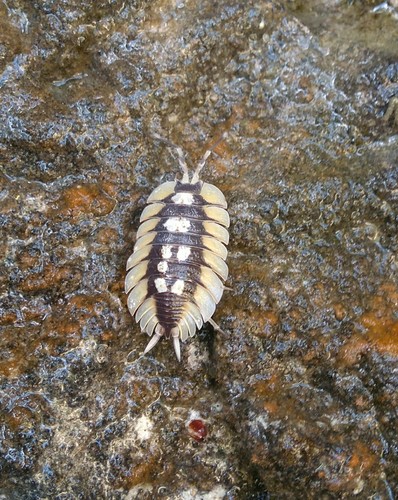
Scientific name
Porcellio expansus
Other names: Porcellio expansus
Porcellio expansus Dollfus, 1892 is a species recognised in Iberfauna, the Museo Nacional de Ciencias Naturales database. It belongs to the Porcellionidae, among terrestrial isopod crustaceans. It is therefore not an insect. [1]
Origin
Schmalfuss’s catalogue places its distribution in the province of Tarragona, in north-eastern Spain. [2]
- Large Porcellio
- Broad lateral plates
- Demanding to keep
Identity and range documented by natural history sources; captive parameters and observations attributed to commercial keepers. No extrapolated lifespan or breeding output.
At a glance
Porcellio expansus is a recognised species documented in the province of Tarragona. Large measurements including appendages must be distinguished [1][2][4].
| DOCUMENTED SIZE | Up to 35 mm Body according to Insektenliebe; appendages measured separately [3][4]. |
|---|---|
| LIFESPAN | To be documented No supported individual lifespan in the selected sources. |
| LIFESTYLE | Flattened, ground-dwelling Outline described in the Insektenliebe profile [3]. |
Adult size
Up to 35 mm in body length in Insektenliebe’s presentation; commercial lengths including antennae and uropods are not directly comparable. [3][4]
Lifespan
No sufficiently documented individual lifespan retained from the sources consulted.
Lifestyle
Insektenliebe describes a very flattened body and particularly broad lateral plates; adults develop a more imposing outline than juveniles. [3]
Housing
SETUP AND SHELTERS
Moist shelter and air — A ventilated, mostly less-moist setup with an accessible moist refuge according to Insektenliebe [3].
The keeper Insektenliebe recommends a well-ventilated, predominantly dry setup with a small accessible moist area and shelters. This gradient is a husbandry practice, not a measurement of the natural climate. [3]
Care parameters
BREEDER REFERENCE
18–26 °C — Richard’s Inverts practice, not safety thresholds [4].
ANOTHER PRACTICE
23–28 °C — Insektenliebe: a distinct commercial value, not a demonstrated optimum [3].
Humidity
A gradient — The cited practice maintains a small moist area; no relative-humidity target inferred [3][4].
Temperature
18–26 °C at Richard’s Inverts [4] Commercial reference point: Insektenliebe lists 23–28 °C. These differing proposals define neither a safety threshold nor a demonstrated optimum. [3]
Humidity
Substrate gradient and air circulation [3][4] No relative-humidity percentage is set from these qualitative descriptions.
Feeding
DIET AND CALCIUM
Leaves and decomposed wood as the base, calcium and supplements such as fish food according to Richard’s Inverts [4].
Scope of this profile
Identity and range documented by natural history sources; captive parameters and observations attributed to commercial keepers. No extrapolated lifespan or breeding output.
Identify what is actually being measured
Richard’s Inverts reports very large males whose total length exceeds 50 mm when appendages are included. This figure does not represent body length alone. [4] To compare two animals, specify whether the measurement ends at the body or includes the extensions; do not present different methods as variation in growth.
Choose food-providing soil
Richard’s Inverts places dead leaves and decomposed wood at the centre of the diet. It also recommends calcium, in the form of limestone or cuttlebone, and supplements such as fish food. [4] This proposal describes its keeping practice; it provides neither a calculated daily ration nor a validated frequency for each age.
Observe the shelters
According to Insektenliebe, the animals use stones, crevices and shelters and become more active in the evening. Acclimatised individuals may also be visible during the day. [3] A single observation time is therefore insufficient to define their full activity pattern.
Breeding: a sometimes slow start
Royal-Isopods describes a slow start for its “orange” form, intended for experienced keepers. [5] No age at maturity, brood size or interval between broods is established here.
Choosing a colony
Richard’s Inverts states that it breeds its stock in captivity and rates the difficulty as high. [4] Before acquisition, ask for the conditions already used by the supplier and the strain’s provenance. A colour name must remain associated with the scientific name, without being turned into a new species.
French references: Porcellio expansus
Reference found in the following French catalogues: Isopodshop [6]. Catalogue presence, including when out of stock, does not measure sales.
Isopodshop proposes 20-26 °C for keeping. This is a commercial reference point, not a demonstrated safety range. [6]
These sellers’ figures remain separately attributed: combining them does not create a newly validated husbandry range.
Checklist
- Prepare the moist refuge before arrival.
- Distinguish body length from length including appendages.
- Ask the supplier for the strain’s conditions.
Observations to record
- Humid shelter condition
- Leaf-litter consumption
- Presence of juveniles
The app provides individual animal records. Check which features are available for your animal in the released version.
Sources
Document-based overview; not a substitute for veterinary advice.
- Iberfauna — Porcellio expansus Dollfus, 1892
Source accessed - Schmalfuss — World catalog of terrestrial isopods, version révisée du catalogue de 2003
Source accessed - Insektenliebe — Porcellio expansus, fiche commerciale de maintien
Source accessed - Richard’s Inverts — Giant Spanish Isopod, Porcellio expansus
Source accessed - Royal-Isopods — compte rendu Porcellio expansus « orange »
Source accessed - Porcellio expansus — Isopodshop
Source accessed - World Marine, Freshwater and Terrestrial Isopod Crustaceans database — Porcellio expansus
Source accessed