
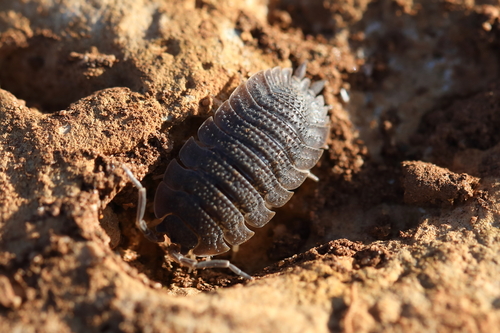
Scientific name
Porcellio echinatus
Other names: Porcellio echinatus
Porcellio echinatus is a distinct species in the world catalogue. The trade highlights its dorsal sculpture, but nicknames evoking spines or rough skin are not enough to confirm a group’s identity. [1][3]
Origin
Southern Portugal and Spain, northern Morocco and northwestern Algeria in the catalogue; Cifuentes also documents detailed Iberian records. [1][2]
- Iberia and the Maghreb
- Dorsal sculpture
- Breeding documented commercially
Natural-history or taxonomic sources distinguished from breeding accounts; captive limits explicit.
At a glance
Porcellio echinatus is an Iberian–Maghreb species with marked dorsal sculpture. The captive references presented come from an identified seller. [1][3]
| ADULT SIZE | Not provided No openly accessible biometric series adopted. |
|---|---|
| LIFESPAN | Not established No supported individual lifespan in the selected sources. |
| LIFESTYLE | Terrestrial Portuguese captive strain described by the seller. [3] |
Adult size
No adult measurement from an openly accessible scientific series is adopted; sculpture and photography must be accompanied by a scale.
Lifespan
No individual lifespan established through a cohort in the selected sources.
Lifestyle
The seller consulted describes a captive strain originating from Portugal; this culture provenance does not represent the species’ entire ecology. [3]
Housing
ATTRIBUTED BREEDING PRACTICE
Leaves and decaying wood — Richard’s Inverts recommends moderate ventilation; attributed commercial practice. [3]
Richard’s Inverts recommends ventilation and moisture described as moderate, with leaves and decaying wood. These seller terms require observation of the actual enclosure. [3]
Care parameters
COMMERCIAL PRACTICE
18–26 °C — Richard’s Inverts; not demonstrated physiological limits. [3]
Humidity
Described as moderate — Seller’s term without an instrumental definition; no invented percentage. [3]
Temperature
18–26 °C according to Richard’s Inverts [3] Commercial practice range; not an experimentally established tolerance interval.
Humidity and air
Described as moderate by the seller [3] The source provides no instrumental definition; do not invent an equivalent percentage.
Feeding
DIET AND CALCIUM
Leaves and decaying wood, fish food and calcium in commercial practice; experimental dosage not established. [3]
Scope of this profile
Natural-history or taxonomic sources distinguished from breeding accounts; captive limits explicit.
Name, morphology and origin
The catalogue clearly distinguishes P. echinatus, and regional publications use the same name. [1][2] For a purchased strain, keep the scientific name and commercial label separately. A coloured border or marked sculpture should be recorded as an observed character, without turning a colour selection into a species or subspecies.
What localities allow us to say
Cifuentes reports a museum specimen from Mazarrón among other material, and compiles records from Spain and Portugal. [2] These data are useful for distribution; they do not all describe temperature, humidity or food used at collection. Avoid converting the word ‘Mediterranean’ into a universal climate protocol.
Substrate and ventilation in practice
The seller states that the strain is bred in-house and uses moderate ventilation. [3] To make a setup comparable, record ventilation area, shelter positions and wetted zones. Moisture described as moderate does not mean the same thing in two different containers. Observing ground condition is therefore essential before attributing an aggregation to a precise need.
Diet and calcium
Commercial practice is based on leaves and decaying wood, with fish food and a calcium source such as cuttlebone or limestone. [3] These elements provide no experimental dosage. Separate supplements in the log, remove deteriorating material and track apparent consumption. A population receiving more food is not necessarily a better-monitored population.
Reproduction and young
Richard’s Inverts presents the species as prolific and distributes groups of varied sizes. [3] This yields neither a universal maturity age nor a guaranteed number of young. Date juvenile observations, culture splits and confirmed losses. A mixed-size group does not allow each individual’s age to be estimated on arrival.
Monitoring and limitations
Taxonomic databases, museum data and the breeder’s account fulfil different roles. This profile retains that distinction and does not reproduce an unmeasured lifespan. For daily monitoring, prioritise enclosure integrity, substrate changes, food leftovers and visible activity. Every change must remain linked to a date and an identifiable strain.
French references: Porcellio echinatus
Reference found in the following French catalogues: Isopodshop [4]; Insectorus [6]. Catalogue presence, including out-of-stock listings, does not measure sales.
Isopodshop suggests 18-26 °C for husbandry. This is a commercial reference, not a demonstrated safe range. [4]
Insectorus states 18-26°C. This commercial range does not demonstrate safety thresholds. [6]
Insectorus states 2cm in adulthood, without explaining the measurement method. [6]
These sellers’ figures remain separately attributed: combining them does not create a newly validated husbandry range.
Checklist
- Keep the strain’s origin.
- Measure the climate actually achieved.
- Separate supplements from background material.
Observations to record
- Identity and provenance
- Temperature and ground condition
- Feeding, moults, young
The app provides individual animal records. Check which features are available for your animal in the released version.
Sources
Document-based overview; not a substitute for veterinary advice.
- Schmalfuss — World catalog of terrestrial isopods, Porcellio echinatus
Source accessed - Cifuentes (2021) — Isópodos terrestres de la Comunidad Valenciana y Murcia
Source accessed - Richard’s Inverts — Porcellio echinatus, souche captive et soins
Source accessed - Porcellio echinatus — Isopodshop
Source accessed - World Marine, Freshwater and Terrestrial Isopod Crustaceans database — Porcellio echinatus
Source accessed - Porcellio echinatus — Insectorus
Source accessed