
Scientific name
Porcellio debueni
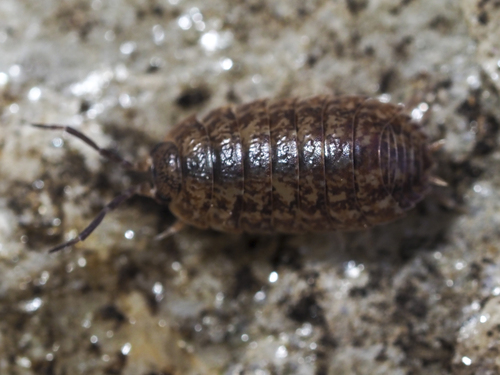
Porcellio debueni is a large Porcellio with a smooth back and mottled coloration. A natural history expedition encountered it frequently in the north-west of the Iberian Peninsula. This local abundance documents its presence in the habitats studied, without demonstrating that it is particularly easy to keep. [1]
Origin
Portugal and north-western Spain, the range stated in the catalogue and repeated in the BMIG study. [1][2]
- Iberian Peninsula
- Smooth back
- Natural history documentation
Natural-history or taxonomic sources distinguished from breeding accounts; captive limits explicit.
At a glance
This large Porcellio with a smooth, mottled back is documented in Portugal and north-western Spain, in varied habitats. [1][2]
| ADULT SIZE | Not quantified Described as large in the natural history study. [1] |
|---|---|
| LIFESPAN | Not established No supported individual lifespan in the selected sources. |
| LIFESTYLE | Ground-dwelling Gardens, coasts and pine or oak woodland. [1] |
Adult size
The study describes it as large without giving an adult measurement in its species account; no commercial length has been added. [1]
Lifespan
No individual lifespan established through a cohort in the selected sources.
Lifestyle
Observed in gardens, at coastal sites and in semi-natural pine or oak woodland. The context is more varied than a simple woodland label. [1]
Housing
NATURAL ENVIRONMENT
Varied Iberian habitats — Field observations; no validated long-term captive setup in these sources. [1]
The sources consulted describe field sites, without a protocol for long-term keeping. This profile recommends natural history observation rather than starting a culture using values borrowed from another species.
Care parameters
CAPTIVE CLIMATE
Not established — No validated husbandry range in the selected sources.
Humidity
Natural environment — Gardens, coasts and woodland; no captive humidity value inferred. [1]
Temperature
Not established for captive keeping A geographical range does not reveal the microclimate actually selected beneath a shelter.
Humidity
No validated captive value Presence at a coastal site does not imply immersion, salt water or a need for sandy substrate.
Feeding
DIET AND CALCIUM
No species-specific feeding trial has been retained. Diet, supplement frequency and calcium provision remain unestablished; the site list does not define them. [1]
Scope of this profile
Natural-history or taxonomic sources distinguished from breeding accounts; captive limits explicit.
Understand the context before drawing conclusions
The combination of a smooth back, large size and mottling provides an initial indication. [1] It is not a complete identification key for the genus Porcellio. Keep clear photographs of the head, the entire dorsal surface and the rear of the body, then seek specialist identification if these details do not rule out similar species.
An informative but localised survey
The BMIG survey in March 2004 found P. debueni at sixteen sites, including the garden at Finca Rio Miño and the harbour area of Oia. Males, females and juveniles appear in the records. [1] These results describe one survey and one season: they provide neither an annual breeding calendar nor a worldwide abundance ranking.
Setup and substrate: relevant gaps in knowledge
The published habitats include human-modified environments and woodland. [1] A setup therefore cannot be reduced to a single tree species, nor can the word garden be taken to mean multipurpose potting compost. The sources do not compare substrate depth, density, shelters or ventilation; this absence justifies not recommending a captive setup presented as tried and tested.
Diet and calcium
No feeding trial specific to P. debueni has been retained. The site lists do not specify which leaves were eaten, what stage of decomposition was sought or how calcium was obtained. A detailed diet with feeding frequencies would therefore be speculative. For animals already in captivity, seek an identifiable culture account before applying a menu intended for another Porcellio.
Reproduction and young
The coexistence of several life stages during collection confirms that the records did not concern adults alone. [1] It does not give the age of the juveniles, gestation length or the number of broods produced by a female. Juveniles observed in a group must remain associated with a verified identification; small size alone cannot establish their age.
Monitoring and natural history interest
The most useful information to pass on is a verifiable record: date, locality, precise habitat and photographs with a scale. For a group already in captivity, distinguish direct observation, reported provenance and husbandry hypotheses. A daily check of the shelter, soil condition and visible losses can document a situation; it does not turn this profile into a validated protocol.
Checklist
- Have the identification confirmed.
- Keep the context of each observation.
- Do not convert localities into climate instructions.
Observations to record
- Locality and shelter type
- Photographs of visible characteristics
- Adults and juveniles observed, without an assumed age
The app provides individual animal records. Check which features are available for your animal in the released version.
Sources
Document-based overview; not a substitute for veterinary advice.