
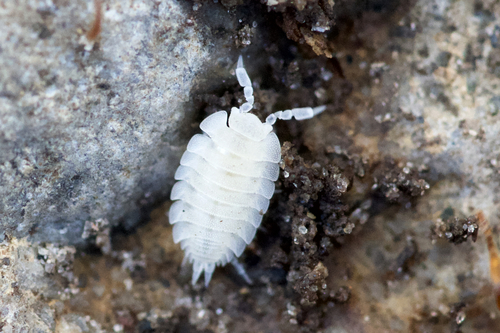
Scientific name
Platyarthrus hoffmannseggii
Platyarthrus hoffmannseggii is a myrmecophilous woodlouse: its biology is linked to ant nests. The study by Parmentier and colleagues treats it as an obligate ant associate, not simply an occasional occupant of their surroundings. [1]
Origin
The Belgian study by Dekoninck and colleagues places this species widely across western Europe. Its presence in Ghent does not establish a geographical origin for all strains. [2]
- Myrmecophilous
- Ant colonies
- Natural-history profile
Natural history profile; a complete captive protocol is not established by the sources consulted.
At a glance
Platyarthrus hoffmannseggii is an obligate ant associate in the study retained. It is not a woodlouse to keep as a simple isolated clean-up organism. [1]
| ADULT SIZE | 3–5 mm Body length according to Senckenberg. [3] |
|---|---|
| LIFESPAN | Not established No supported individual lifespan in the selected sources. |
| LIFESTYLE | Associated with ants Several host species are documented. [1][2] |
Adult size
3 to 5 mm in the Senckenberg profile. The head width compared in Parmentier’s study is a measurement distinct from this body length. [3][1]
Lifespan
Individual captive lifespan not established by the documents consulted.
Lifestyle
Associated with several ant species. Dependence on a nest environment does not mean exclusive fidelity to a single host species. [1][2]
Housing
NATURAL ENVIRONMENT
Ant nests — Association environment studied; no independent domestic enclosure validated. [1][2]
This profile does not propose an independent captive enclosure: the documents examined concern the relationship with ants and do not validate a domestic setup without them. [1][2]
Care parameters
CAPTIVE CLIMATE
Not established — No validated husbandry range in the selected sources.
Humidity
Natural nest environment — No captive settings established; figures for an associated springtail do not apply here. [2]
Temperature and humidity
No validated captive settings retained. The values discussed in the 2007 article for Cyphoderus albinus concern a springtail, not this woodlouse. [2]
Host
Identify the woodlouse and the associated ant separately. [2] Photograph and retain the two identifications in separate fields; an observed association does not replace identification.
Feeding
DIET AND CALCIUM
The articles provide neither a complete domestic diet nor a calcium dosage. The association with ants describes an ecology, not a ration to copy. [1][2]
Scope of this profile
Natural history profile; a complete captive protocol is not established by the sources consulted.
Recognising the ant woodlouse
Senckenberg describes a whitish, eyeless animal with a broadly oval body, unable to roll into a ball. Its antennal flagellum has two segments. [3] These characteristics go beyond mere presence near an ant nest, which is not sufficient identification.
Why the association with ants matters
Animals were observed in two of the five Lasius neglectus nests examined in Ghent in 2006. This observation establishes a local association; it does not prove that every colony of this ant houses the woodlouse. [2]
Size influenced by context
Parmentier and colleagues compared individuals associated with mound-building red wood ants and with Lasius flavus. Mean head width was greater in the former context. The authors propose plasticity linked to nest conditions; they did not find evidence of cryptic groups specialised on the hosts compared. [1]
Feeding: do not improvise a ration
The two articles retained do not provide a complete domestic diet with quantities and frequency. They therefore do not justify automatically recommending the food mix used for Porcellio scaber. Presence in an ant nest is ecological information, not a feeding recipe.
Breeding and development
The data used here establish neither a time to breeding, an incubation period nor a normal number of juveniles per female. A differing proportion of females between some nests, reported in 2017, is not a demonstration of parthenogenesis. [1]
Observe without confusing the organisms
The 2007 article concerns both this woodlouse and Cyphoderus albinus. Observations, temperatures and behaviours specific to the latter animal must not migrate into a woodlouse profile. Keeping the organism’s full name alongside each result avoids this confusion. [2]
Interest for enthusiasts
Its interest here is natural history: understanding a relationship between species. Inclusion in the encyclopaedia is not a recommendation to buy it or a promise of easy keeping. For a documented observation, a date, the nest environment and a checked identification contribute more than a commercial colour name.
Checklist
- Check the name of the woodlouse and its host ant.
- Do not transfer parameters from the springtail studied in the same article.
- Seek a species-specific protocol before any captive project.
Observations to record
- Documented host
- Nest environment
- Dated observations
The app provides individual animal records. Check which features are available for your animal in the released version.
Sources
Document-based overview; not a substitute for veterinary advice.
- Parmentier et al. (2017) — Body size in the ant-associated isopod Platyarthrus hoffmannseggii is host-dependent
Source accessed - Dekoninck, Lock & Janssens (2007) — Acceptance of two native myrmecophilous species by Lasius neglectus in Belgium
Source accessed - Senckenberg / Bodentier⁴ — Platyarthrus hoffmannseggii
Source accessed