
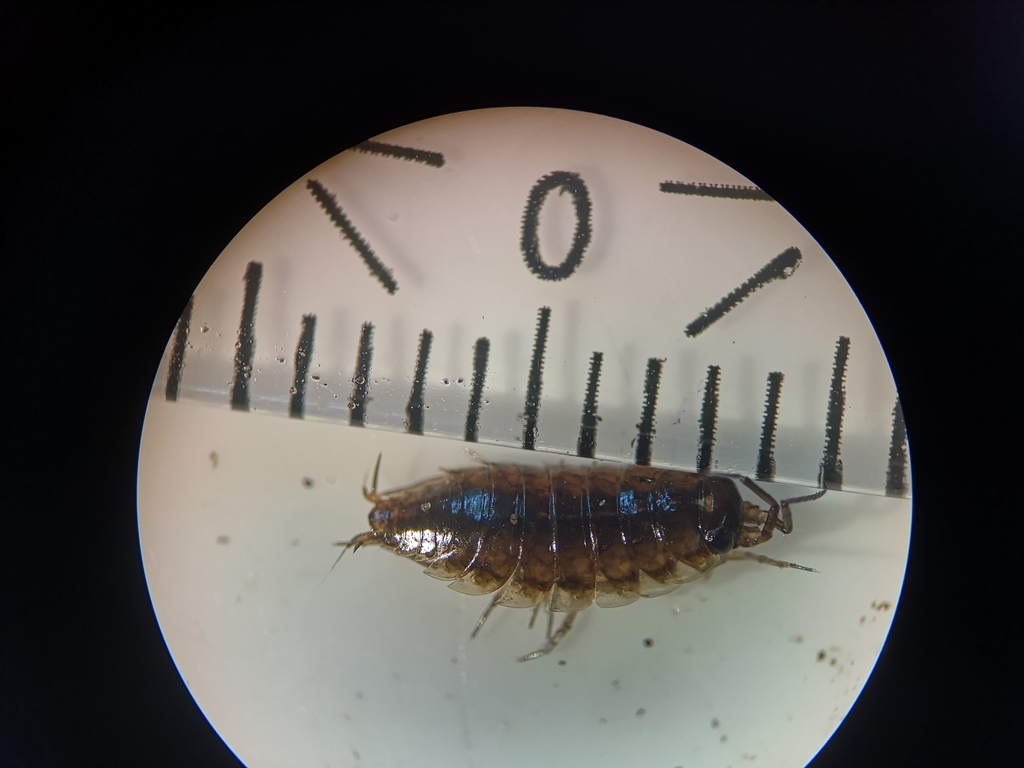
Scientific name
Ligidium hypnorum
Ligidium hypnorum is a woodlouse of moist habitats, with an outline narrowed at the abdomen. BMIG highlights its speed and the risk of confusion with Philoscia muscorum. [1]
Origin
BMIG describes its British distribution as mainly south of The Wash and the Severn, with a strong presence in south-eastern England. These regional observations do not constitute a worldwide map of origin. [1]
- Moist leaf litter
- Rapid movement
- Natural-history profile
Natural history profile; a complete captive protocol is not established by the sources consulted.
At a glance
Very fast-moving, Ligidium hypnorum inhabits moist environments. Its antennae allow it to be distinguished from Philoscia muscorum. [1]
| ADULT SIZE | 7–11 mm Senckenberg length reference point. [2] |
|---|---|
| LIFESPAN | Not established No supported individual lifespan in the selected sources. |
| LIFESTYLE | Ground-dwelling, very fast Mosses, leaf litter and shelters; does not roll into a ball. [1][2] |
Adult size
7 to 11 mm in the profile from Senckenberg’s Bodentier⁴ project. This is a length reference point, not an individual age scale. [2]
Lifespan
No sufficiently supported captive lifespan is retained from these two overviews.
Lifestyle
Found in mosses, leaf litter and ground-level shelters; the sources describe very rapid movements when disturbed. It lacks the ability to roll into a ball reported in some other woodlice. [1][2]
Housing
NATURAL ENVIRONMENT
Woodland and marshy areas — Moist leaf litter in natural habitats; no standard captive setup validated. [1][2]
The available data describe a moist natural environment, not a minimum enclosure volume. They do not guarantee success in a standard terrarium intended for species from drier habitats.
Care parameters
CAPTIVE CLIMATE
Not established — No validated husbandry range in the selected sources.
Humidity
Very moist natural environment — Ecological association; no domestic hygrometer percentage inferred. [1]
Environment
Moist leaf litter in deciduous woodland and marshy areas. [2] A description of natural habitats; it is not a substrate recipe or an enclosure humidity value.
Temperature
No validated keeping range in the sources retained. A field measurement can be recorded with its date and location, without automatically becoming a keeping instruction.
Humidity
Association with very moist habitats. [1] A habitat type does not automatically translate into a hygrometer percentage.
Feeding
DIET AND CALCIUM
A controlled captive ration, supplement frequency and calcium dose are not established. Leaf litter describes the environment, without constituting a complete menu on its own. [1][2]
Scope of this profile
Natural history profile; a complete captive protocol is not established by the sources consulted.
The useful characteristic: antennae
The flagellum bears many small, bead-like segments. Philoscia muscorum, which has a comparable shape, has only three elongated ones. Observing this characteristic is more reliable than choosing a name from mottled coloration alone. [1]
A distinctive outline and behaviour
Bodentier⁴ describes a narrowly oval, grey-brown body with an abdomen narrower than the thorax. The same key indicates an inability to roll into a ball. [2] The speed of a single individual is not, however, sufficient for identification.
Reading the habitat at the right scale
At the northern and western margins of its British distribution, BMIG describes it more often in semi-natural habitats, particularly old woodland and wet woodland. [1] The label “European woodlouse” would therefore be too vague to explain its environment.
Feeding and maintenance: current limits
The profiles consulted give no controlled captive ration, supplement frequency or calcium dosage. The litter in which the animal is found indicates its environment; it does not, by itself, establish the complete composition of a captive diet.
Breeding and moulting
Neither a maturity timetable nor an incubation period specific to this species is retained here. The seasonal chart presented by Bodentier⁴ uses field observations. It must be read as a distribution of observations, not as the date by which a domestic colony should produce juveniles. [2]
Before planning a colony
The priority is to confirm identity and obtain a documented species-specific protocol. For temporary observation, record the conditions actually encountered and the context, without turning a one-off temperature into an optimum. This profile presents the species without artificially assigning it a “beginner” level.
Checklist
- Examine the segments of the antennal flagellum.
- Distinguish regional presence from strain origin.
- Do not infer a husbandry protocol from a simple distribution map.
Observations to record
- Identification
- Microhabitat
- Observed conditions
The app provides individual animal records. Check which features are available for your animal in the released version.
Sources
Document-based overview; not a substitute for veterinary advice.
- British Myriapod and Isopod Group — Ligidium hypnorum
Source accessed - Senckenberg / Bodentier⁴ — Ligidium hypnorum
Source accessed