
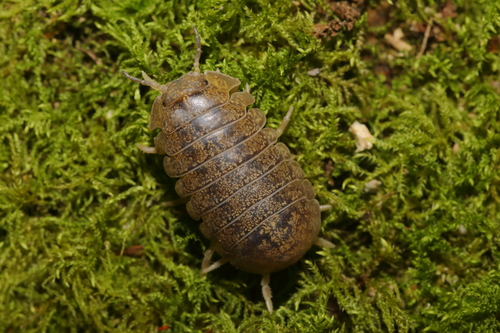
Scientific name
Helleria brevicornis
Helleria brevicornis belongs to the Tylidae and differs from commonly kept surface-dwelling woodlice through its burrowing activity. Its large size alone does not define its needs: substrate quality and interactions between individuals warrant particular attention. [1][2][3]
Origin
Tyrrhenian basin: southern France, Corsica, Sardinia, the Tuscan Archipelago and the Piombino area. This distribution is reiterated in a 2024 publication. [2]
- Burrowing
- Tylidae
- Food-providing substrate
- Group living
Natural-history or taxonomic sources distinguished from breeding accounts; captive limits explicit.
At a glance
A large burrowing woodlouse from the Tyrrhenian basin, Helleria brevicornis depends on a food-providing substrate; grouping also influences its biology. [2][3][4]
| ADULT SIZE | Can reach 25–30 mm Size reported by Cerretti and colleagues. [2] |
|---|---|
| LIFESPAN | Not established No supported individual lifespan in the selected sources. |
| LIFESTYLE | Burrowing Spends much of its time underground in culture. [3] |
Adult size
Can reach 25–30 mm according to the biological overview in Cerretti and colleagues (2024); this is not a guaranteed size for every adult. [2]
Lifespan
No individual lifespan established through a cohort in the selected sources.
Lifestyle
The captive breeding account consulted describes a species that spends much of its time underground and also uses bark on the surface or partly buried. [3]
Housing
ATTRIBUTED BREEDING PRACTICE
Deep substrate — Thoroughly decomposed wood and leaves, moisture and ventilation: Invertebrate Dude’s practice. [3]
Provide a deep substrate rich in thoroughly decomposed wood and leaves, kept moist with air exchange: this principle comes from a keeper’s practice, not an experimental comparison of enclosures. [3]
Care parameters
COMMERCIAL PRACTICE
Approximately 23–26 °C — 74–78 °F in the keeper’s account; no demonstrated optimum. [3]
SEASONAL CYCLE
To be documented — Cooling proposed; necessity not demonstrated. [3]
Humidity
Soil moist at depth — Keeper’s practice; the surface alone does not describe the occupied zone. [3]
Temperature
74–78 °F, or approximately 23–26 °C, proposed by the keeper [3] Attributed commercial reference point; no experimentally established optimal range is provided here.
Seasonal cycle
Winter cooling proposed, necessity not demonstrated [3] The account is insufficient to prescribe a mandatory duration or guarantee repeated breeding.
Humidity
Monitor the substrate at depth [3] The condition of the surface alone does not describe that of the zone occupied by a burrowing species.
Feeding
DIET AND CALCIUM
Very rotten wood and leaf litter form the main resource described by the keeper; supplements do not replace them. Calcium dosage not established. [3]
Scope of this profile
Natural-history or taxonomic sources distinguished from breeding accounts; captive limits explicit.
An identity distinct from garden woodlice
The catalogue places Helleria in the Tylidae. [1] The 2024 publication mentions its size among the largest Corsican isopods, in a discussion of a fly’s potential hosts. [2] That discussion puts forward a parasitism hypothesis: it does not prove that Helleria is actually a host of this fly and does not justify any preventive treatment.
Soil that also serves as food
Invertebrate Dude prioritises very rotten wood and leaf litter, of which the animals reportedly consume a substantial amount; supplements do not replace this resource. [3] Gradual depletion of useful material must therefore be distinguished from a merely cosmetic change. A layer that is still thick may have changed in texture or composition over time.
Ventilation, moisture and calcium
The keeper combines fairly open ventilation with maintained soil moisture. [3] These two elements must be considered together: altered ventilation can accelerate water loss. The selected sources do not provide a measured calcium dose for this species. The profile therefore prescribes neither a carbonate percentage in the mix nor a supplementation schedule.
Breeding: retain the social dimension
The review by Broly and colleagues reports a beneficial effect of grouping on female size and juvenile production in H. brevicornis; it cites experiments by Mead and Gabouriaut. [4] This suggests avoiding routine isolation of a female to make her easier to observe. It does not, however, define a maximum density or a universal minimum group size.
Juveniles and development rate
The captive account describes slow maturation and suggests a role for seasonal cooling in successive breeding events. [3] These observations must remain at the level of a keeper’s account: they do not demonstrate obligatory diapause in all strains. An absence of visible juveniles does not prove an absence of buried juveniles; constantly digging through the enclosure would undermine unobtrusive monitoring.
Daily monitoring and limits
Above all, check that moisture is maintained, check leftover supplements and follow changes in the substrate, without turning over its full depth every day. Relate seasonal changes to breeding observations rather than a promise of productivity. A numerical lifespan, a guaranteed brood and a rule stating that each female breeds only once are not established in this profile.
Checklist
- Check the soil beyond its surface alone.
- Preserve a supply of decomposed wood and leaves.
- Do not routinely isolate females.
Observations to record
- Substrate texture and moisture
- Group living and visible juveniles
- Seasonal changes in conditions
The app provides individual animal records. Check which features are available for your animal in the released version.
Sources
Document-based overview; not a substitute for veterinary advice.
- Schmalfuss — World catalog of terrestrial isopods : Helleria brevicornis
Source accessed - Cerretti et al. (2024) — Phylogenomics resolves long-standing questions about the affinities of an endangered Corsican endemic fly, p. 14
Source accessed - Invertebrate Dude — Helleria brevicornis, retour de culture
Source accessed - Broly, Deneubourg et Devigne (2013) — Benefits of aggregation in woodlice: a factor in the terrestrialization process?, texte déposé par un auteur
Source accessed