
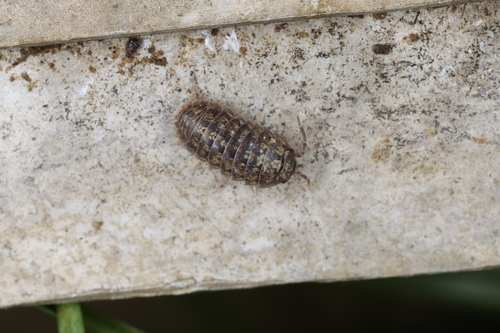
Scientific name
Armadillidium zenckeri
Armadillidium zenckeri deserves a profile distinct from Armadillidium commonly offered for fairly dry setups. The studies consulted describe it as closely associated with marshy environments. [1][2]
Origin
A European species of lowland wetlands in the study by Csonka and colleagues. [2] The Hungarian key documents it particularly in marshy sedge meadows. [1]
- Wetlands
- Sensitivity to desiccation
- Natural-history profile
Identification and ecology supported by publications; desiccation experiment not converted into a captive protocol; national status contextualised.
At a glance
Armadillidium zenckeri is associated with lowland wetlands; desiccation experiments are not husbandry instructions [1][2].
| DOCUMENTED SIZE | 8–10 mm Reference from the key by Farkas and Vilisics [1]. |
|---|---|
| LIFESPAN | To be documented No supported individual lifespan in the selected sources. |
| LIFESTYLE | Wetlands Dense vegetation and muddy ground in the Hungarian key [1]. |
Adult size
8–10 mm in the key by Farkas and Vilisics. [1]
Lifespan
Individual lifespan is not established by the selected documents; no numerical value is extrapolated.
Lifestyle
The Hungarian key describes movement through dense vegetation, including over muddy ground. This field context does not constitute an instruction to flood a captive enclosure. [1]
Housing
NATURAL HABITAT
Marshy meadows — Humid natural environments; water-loss experiments do not constitute a breeding method [1][2].
No validated husbandry recipe identified. Ecological observations and laboratory experiments must remain distinct from a breeding protocol.
Care parameters
CAPTIVE HUSBANDRY
Not established — No long-term husbandry temperature established by the selected sources.
Humidity
Very humid environment — Association with marshes and studied sensitivity to desiccation; no captive target inferred [1][2].
Temperature
No long-term husbandry temperature established by the source collection. The selected sources do not allow a species-specific husbandry temperature to be proposed.
Humidity and ventilation
Strong association with humid environments; no captive percentage prescribed. [1][2] Examine substrate beneath shelters and record the enclosure’s actual conditions.
Feeding
DIETARY DATA
The selected documents define neither a specific captive ration nor a calcium dose. No other species’ diet is substituted.
Scope of this profile
Identification and ecology supported by publications; desiccation experiment not converted into a captive protocol; national status contextualised.
Identifying before interpreting
The Hungarian key gives characters of the frons and telson, along with colour differences between sexes. [1] A colourful photo alone remains insufficient to confirm the species. Keeping several angles and stating who made the identification separates documented identification from an assumption. This distinction matters when a record is later used to draw conclusions about the environment.
What the experiment shows
Csonka and colleagues compare several Armadillidium in short water-loss experiments; zenckeri stands out through high sensitivity to desiccation under those conditions. [2] Experimental humidity levels are not care instructions and demonstrate no acceptable survival time in a terrarium. The result supports vigilance about drying without providing a breeding recipe.
Setup, substrate and ventilation
Recreating a miniature pond from the word ‘marsh’ alone would be an extrapolation. The documentation does not specify how to balance moisture, air circulation and soil structure for a sustainable culture. Before establishing a colony, a setup actually used with this species, its measurements and juvenile outcomes would need documenting. This profile retains that information need instead of setting an arbitrary volume.
Diet and calcium
The gathered sources do not test a specific captive ration or calcium dosage. No commercial product is therefore declared sufficient. For possible supervised monitoring, describe the plant materials and mineral resources provided precisely, then record their observable use. This documentation method does not turn a personal experiment into a general recommendation and must remain identifiable as such.
Reproduction and repeated observations
No number of young, brood frequency or maturation period is adopted. Records can distinguish identified adults, small size classes and unidentified individuals without automatically assigning ages. Photographing the same reference points over time helps make observations comparable. The need for further data remains even if a few young appear once.
Conservation and geographical limits
The German Red List places this species in category 2 and links its situation to wetland damage. This classification concerns Germany, not the entire global range. [3] Prioritise habitat documentation and conservation for natural-history observations. This profile attests neither captive availability nor ease of breeding and does not justify any collection from wild populations.
Checklist
- Document identification and its reliability.
- Describe the microhabitat and observation context.
- Do not extrapolate a husbandry protocol from another species.
Observations to record
- Manual natural-history log
- Photographs and identification criteria
- Context of repeated observations
The app provides individual animal records. Check which features are available for your animal in the released version.
Sources
Document-based overview; not a substitute for veterinary advice.
- Farkas & Vilisics, 2013 — A key to the terrestrial isopods of Hungary
Source accessed - Csonka et al., 2018 — Morphological traits, desiccation resistance and habitat characteristics of Armadillidium
Source accessed - Haferkorn, Allspach & von Knorre, 2024 — Rote Liste und Gesamtartenliste der Binnenasseln Deutschlands
Source accessed