
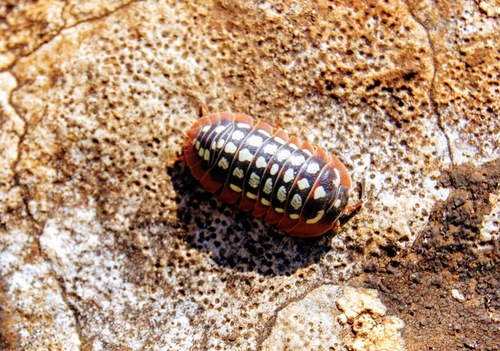
Scientific name
Armadillidium werneri
This rolling species must not be confused with Porcellio werneri, which belongs to another genus. Schmalfuss’s synthesis retains A. werneri as a species. [1]
Origin
Confirmed presence on the Greek island of Corfu in the selected taxonomic synthesis. [1]
- Conglobation
- Corfu
- To be distinguished from Porcellio werneri
Taxonomy and occurrence documented; incomplete commercial protocol, profile not sufficient on its own to start keeping the species.
At a glance
Armadillidium werneri is documented on Corfu and remains distinct from Porcellio werneri, which belongs to another genus [1].
| DOCUMENTED SIZE | 22–25 mm Commercial dimensions stated by Insektenliebe [2]. |
|---|---|
| LIFESPAN | To be documented No supported individual lifespan in the selected sources. |
| LIFESTYLE | In groups Observation from Insektenliebe’s collection [2]. |
Adult size
Insektenliebe states 22–25 mm; a commercial measurement without an accompanying specimen series. [2]
Lifespan
Individual lifespan is not established by the selected documents; no numerical value is extrapolated.
Lifestyle
The breeder describes grouped animals that are easily visible in its collection. Observation frequency will depend on the setup and check time. [2]
Housing
SETUP AND SHELTERS
Soil and shelters — Soil, leaves, wood and areas of contrasting moisture in the product page; captive data remain incomplete [3].
Insektenliebe’s product page suggests soil, leaves and wood, with humid and drier areas. [3] It gives no demonstrated minimum dimensions.
Care parameters
BREEDER REFERENCE
20–26 °C — Insektenliebe reference, not a demonstrated optimum [2].
Humidity
Contrasting areas — Humid shelter and other less humid areas; no validated air percentage [3].
Temperature
20–26 °C stated by Insektenliebe [2] A practice value when attributed to a breeder; no universal safety threshold is inferred.
Humidity and ventilation
Humid and drier areas, without a validated air percentage. [3] Examine substrate beneath shelters and record the enclosure’s actual conditions.
Feeding
DIET AND CALCIUM
Soil, leaves and wood are described in the setup [3]. Ration and calcium dose are not established in the selected sources.
Scope of this profile
Taxonomy and occurrence documented; incomplete commercial protocol, profile not sufficient on its own to start keeping the species.
Keeping the genus on every label
Writing only ‘werneri’ creates real ambiguity between two different woodlice. The register, photographs and any secondary enclosures must therefore keep the full name. A coloured lineage does not become an additional species; ask what its trade name means and record the answer as a provenance statement.
Identifying patterns cautiously
Insektenliebe describes five rows of pale spots and compares its animals with A. klugii. [2] This portrait is not a taxonomic key, and its absolute colour claims are not used here as decisive criteria. Keeping images of the head, back and rear with a scale reference allows more rigorous later checking.
Setup, food and calcium
The product page supplements the account with a mixture of soil, leaves and wood and areas of contrasting moisture. [3] It does not describe a proven ration or calcium dose. Ask for the group’s exact practices before acquisition: materials used, calcium resource and ventilation. Record this information as breeder experience, without turning it into a scientifically demonstrated protocol.
Humidity and temperature
The published thermal range is a commercial indication; the choice of humid and dry areas supplements this reference. [2][3] This does not allow an optimum to be calculated or heating to be set from a Greek climate average. Record temperature at the intended enclosure location and document shelter function before assessing colony behaviour.
Reproduction and young
The breeder reports easy reproduction and relatively short development in its collection. [2] This assessment is neither a commitment to results nor a lifespan measurement. Date the first young and keep the history of culture splits. A group comprising several ages may already contain reproductive females before arrival.
Monitoring and limits of knowledge
Observe aggregations, leftovers and any losses without drawing a conclusion from an isolated photograph. The natural-history publication specifies identity and the known range; it does not validate commercial care. Gaps remain visible, notably in quantitative nutrition and lifespan. Documenting the received strain’s conditions with the supplier avoids filling these gaps with another species’ figures.
Checklist
- Keep the group’s provenance and identification.
- Prepare resources and shelters before arrival.
- Define a simple check without regularly dismantling the environment.
Observations to record
- Manual intervention log
- Substrate and food condition
- Young, moults and deaths observed
The app provides individual animal records. Check which features are available for your animal in the released version.
Sources
Document-based overview; not a substitute for veterinary advice.