
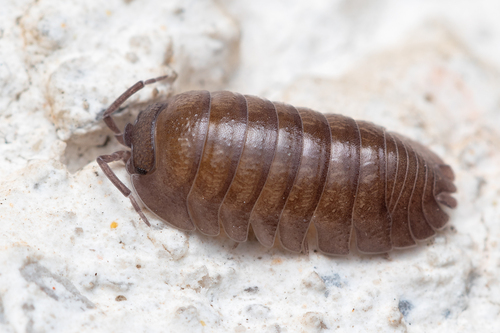
Scientific name
Armadillidium pallasii
Other names: Armadillidium frontirostre · Armadillidium pallasii frontirostre
The name Armadillidium frontirostre persists in collections and listings. The database reproduced by Mindat places the combination A. pallasii frontirostre under A. pallasii; these names must therefore not create two species profiles. [1]
Origin
Schmalfuss documents a distribution including Adriatic coasts and some Black Sea shores. [2] Commercial provenance without a locality does not assign a population to one of these territories.
- Synonymy
- Provenance to retain
- Colony observation
Correction from frontirostre to pallasii; indexing of Schmalfuss 2011 checked, direct PDF inaccessible. Reproduced taxonomic database actually read; husbandry attributed to two breeders’ practices.
At a glance
The former name ‘frontirostre’ is placed under Armadillidium pallasii in the cited database; keep the group’s original label [1].
| DOCUMENTED SIZE | Not adopted No sufficiently contextualised adult maximum. |
|---|---|
| LIFESPAN | To be documented No supported individual lifespan in the selected sources. |
| LIFESTYLE | Among shelters Colony observations at Planet Inverts [3]. |
Adult size
No adult maximum adopted: the husbandry sources consulted offer no sufficiently contextualised measurement.
Lifespan
Individual lifespan is not established by the selected documents; no numerical value is extrapolated.
Lifestyle
Planet Inverts describes, for its colonies, less burrowing behaviour than in some other Armadillidium and fairly slow growth. These are captive observations, not a constant of the species. [3]
Housing
SETUP AND SHELTERS
Food-providing substrate — PostPods combines leaves, soft wood, shelters and opposing ventilation openings; a commercial account [4].
PostPods describes nutritious soil mixing leaf matter and decaying wood, shelters and a localised humid zone, with cross-ventilation. This setup belongs to its commercial practice. [4]
Care parameters
BREEDER REFERENCE
18–26 °C — PostPods reference, without testing physiological limits [4].
Humidity
Humid shelter — A mostly less humid surface, with a localised humid shelter according to PostPods [4].
Temperature
18–26 °C stated by PostPods, without testing physiological limits. [4] A practice value when attributed to a breeder; no universal safety threshold is inferred.
Humidity and ventilation
Most of the surface drier, with a localised humid shelter. [4] Examine substrate beneath shelters and record the enclosure’s actual conditions.
Feeding
DIET AND CALCIUM
Leaves, decaying wood, available calcium and small protein supplements in PostPods’ practice [4].
Scope of this profile
Correction from frontirostre to pallasii; indexing of Schmalfuss 2011 checked, direct PDF inaccessible. Reproduced taxonomic database actually read; husbandry attributed to two breeders’ practices.
Current name and original label
Keep the former designation in the provenance file while using A. pallasii for the main profile. The nomenclatural association does not prove that every enclosure sold under the old name contains this species. [1] Before merging two colonies, compare their documents and have doubtful identifications confirmed; a name change in a catalogue is not a reason to mix animals immediately.
Setup, substrate and ventilation
PostPods’ setup combines nutritious substrate, leaves, soft wood and shelters, with openings on opposite sides. [4] Photographing the initial soil level and vent layout will help explain how the enclosure changes. Success reported by a breeder does not demonstrate a universal minimum volume; keep the dimensions actually used in the colony file.
Diet and calcium
PostPods maintains leaves and decaying wood, with available calcium and small protein supplements. [4] Planet Inverts also reports a varied detritivorous diet. [3] Recording background resources, supplements and the mineral source actually used separately avoids reading a product list as a quantitatively demonstrated diet. Useful records also mention foods ignored and leftovers removed.
Humidity and temperature
The PostPods culture combines a humid area and a drier surface; its thermal range remains breeder data. [4] Recording where animals gather, where substrate stays moist and how these zones change after an intervention allows this organisation to be monitored. Without documented initial conditions, simultaneously changing heating, ventilation and watering would make observations difficult to interpret.
Reproduction and young
PostPods reports reproduction in established colonies, while Planet Inverts highlights fairly slow growth. [3][4] These observations provide neither a universal maturity age nor a guaranteed schedule. Date the group’s arrival and the first observation of young, then keep comparable photos. A newly visible small animal was not necessarily born that day; avoid inferring age from colour.
Limits and checks
Nomenclature is better supported than the performance of each captive lineage. Commercial accounts supplement setup information without becoming comparative trials. Regularly check closures, leftovers and consistency between observations and the supplier’s reports. If a problem occurs, preserve the group’s history and avoid successive undocumented corrections. Selection names describe lineages; they do not create new taxa.
Checklist
- Keep the group’s provenance and identification.
- Prepare resources and shelters before arrival.
- Define a simple check without regularly dismantling the environment.
Observations to record
- Manual intervention log
- Substrate and food condition
- Young, moults and deaths observed
The app provides individual animal records. Check which features are available for your animal in the released version.
Sources
Document-based overview; not a substitute for veterinary advice.
- Mindat — Armadillidium pallasii frontirostre, données taxonomiques GBIF
Source accessed - Schmalfuss, 2013 — The species of the genus Armadillidium known from Greece, transcription intégrale
Source accessed - Planet Inverts — Isopods, observations des colonies d’Armadillidium pallasii
Source accessed - PostPods / Daniel Brown — Armadillidium pallasii care guide, pratique de ses colonies
Source accessed