
Scientific name
Androniscus dentiger
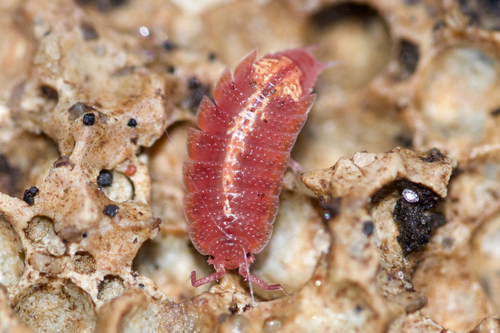
Androniscus dentiger is a small woodlouse, generally salmon-pink to orange, with a back covered in tubercles. Its colour catches the eye, but eye characteristics and surface relief must also be examined. [1]
Origin
BMIG reports it widely in the lowlands of Great Britain and Ireland. SEWBReC reports its presence in Wales; these regional sources do not delimit its entire worldwide range. [1][2]
- Pink to orange
- Small size
- Humid shelters
Natural history profile; a complete captive protocol is not established by the sources consulted.
At a glance
Generally salmon-pink to orange, Androniscus dentiger bears dorsal tubercles. Colour must be supplemented by examining the eyes and surface relief. [1]
| ADULT SIZE | Approximately 5 mm SEWBReC natural history reference point. [2] |
|---|---|
| LIFESPAN | Not established No supported individual lifespan in the selected sources. |
| LIFESTYLE | Beneath ground-level shelters Stones and moist debris, coastal or human-modified environments. [1] |
Adult size
Approximately 5 mm in SEWBReC’s natural history presentation; do not confuse this reference point with a minimum mesh size that retains juveniles. [2]
Lifespan
Captive lifespan not specified by the sources retained.
Lifestyle
Found particularly beneath stones and in moist places among debris. BMIG describes it in coastal environments and sites associated with human activities. [1]
Housing
NATURAL ENVIRONMENT
Stones and wood — Moist natural shelters; no complete captive setup validated. [2]
The sources document microhabitats, without a complete captive protocol. An enclosure and its lid cannot be declared suitable on adult size alone.
Care parameters
CAPTIVE CLIMATE
Not established — No validated husbandry range in the selected sources.
Humidity
Damp natural environment — Description of shelters observed; no captive humidity range established. [1][2]
Observed habitat
Moist shelters beneath stones and wood. [2] Record the shelter type and observation conditions without converting this record into a captive standard.
Temperature and humidity
No validated keeping values retained. No range borrowed from another woodlouse species is used to fill these fields.
Colour
Variable; pink or orange common in the living animal. [1] Coloration does not replace other identifying characteristics.
Feeding
DIET AND CALCIUM
The sources describe the species and its habitat without setting a captive ration. No calcium or protein dosage is retained. [1][2]
Scope of this profile
Natural history profile; a complete captive protocol is not established by the sources consulted.
Observe more than colour
Each eye has one black ommatidium, and the body’s tubercles are visible under magnification. Juveniles can be confused with other small woodlice. [1] SEWBReC also mentions a yellow midline, useful to observe without treating it as a universally sufficient characteristic. [2]
Photographing a live individual
BMIG states that pigments disappear rapidly in alcohol. [1] A photograph taken before any preservation and accompanied by a scale therefore retains different information from a preserved specimen. Image quality and the context of photography must remain associated with the identification.
An inconspicuous animal in an ordinary environment
Gardens, farmyards and disturbed ground are among the sites reported by BMIG. [1] SEWBReC emphasises that small size contributes to under-recording, even where the animal is present. [2] The number of records in a database therefore does not directly correspond to the number of individuals in the wild.
Feeding and maintenance
The two presentations consulted describe the animal and its habitat without establishing a captive ration. No supplement, calcium or protein dosage is therefore set here. Before using the species as a terrarium clean-up organism, its feeding and compatibility with other occupants still need to be documented.
Reproduction and young
The presence of small individuals alone does not give a precise age or date of birth. The references retained provide no gestation period, age at maturity or normal brood size usable as a breeding timetable. These fields remain explicitly open.
Scope of this profile
This overview helps identify a woodlouse and understand where it is encountered. It does not automatically classify the species as an easy culture. A sourced observation, a keeper’s protocol and a controlled study provide different evidence; this distinction must be retained before proposing domestic settings.
Checklist
- Photograph colour and surface relief in the living animal.
- Examine the eyes under suitable magnification.
- Do not state an undocumented breeding timetable.
Observations to record
- Identification
- Dated photographs
- Shelters and observations
The app provides individual animal records. Check which features are available for your animal in the released version.
Sources
Document-based overview; not a substitute for veterinary advice.
- British Myriapod and Isopod Group — Androniscus dentiger
Source accessed - SEWBReC — Species of the Month, May 2020: Rosy Woodlouse
Source accessed